
1. Introduction
The Rhino USA Adjustable Tire Deflators with Gauge are designed to simplify the process of reducing tire pressure for off-road driving. Deflating tires increases the tire's footprint, providing superior grip and a softer ride on various terrains such as sand, snow, or rocks. This manual provides instructions for the proper setup, operation, and maintenance of your deflator set.
2. Product Overview
The Rhino USA Adjustable Tire Deflators are engineered for efficiency and durability. Key features include:
- Automatic Deflation: Simply screw the deflators onto your tire valve stems, and they will automatically release air to your preset PSI.
- Adjustable PSI: Easily set your desired tire pressure between 6-30 PSI using the integrated lock ring adjustment.
- High-Quality Gauge: Features a large 2-inch, heavy-duty, glow-in-the-dark dial for easy reading in various conditions.
- Durable Construction: Made with solid brass deflators and a shock-resistant design for long-lasting performance in rugged environments.
- Wide Range: The gauge measures up to 60 PSI, suitable for a variety of applications.
3. What's Included
Your Rhino USA Adjustable Tire Deflator set includes the following components:
- 1x 60 PSI Tire Gauge
- 4x Solid Brass Adjustable Tire Deflators
- 4x Chrome Valve Caps
- 4x Replacement Valve Cores
- 1x 4-Way Valve Core Tool
- 1x Compact, Rugged Storage Case

Image: The complete kit, including the gauge, four deflators, valve caps, valve cores, and a 4-way valve core tool, all stored in a compact case.
4. Setup and Calibration
Follow these steps to set up and calibrate your tire deflators:
- Set Your Desired PSI: Use the lock ring adjustment on each deflator to set your target tire pressure. Turn the adjustment ring to align the desired PSI with the indicator mark. It is recommended to use a separate, accurate tire gauge to verify the initial setting.
- Attach to Valve Stem: Remove the valve cap from your tire. Screw the deflator onto the tire valve stem until it is finger-tight. Air will begin to release from the tire.
- Allow Deflation: The deflator will automatically stop releasing air once the tire reaches the preset PSI.
- Check Pressure: After the deflator stops, remove it and use the included 60 PSI tire gauge to confirm the accurate tire pressure. Adjust the deflator's setting if necessary for future use.
- Repeat for all tires: For optimal off-road performance, ensure all tires are deflated to the same desired pressure.

Image: A person demonstrating how to attach the deflator to a tire valve stem.
Video: An official demonstration of the Rhino USA Deflator, showing its features and how to use it for tire deflation.
Video: A demonstration of the Rhino USA Pro-Tire Deflator Set (4PK), illustrating the quick and easy deflation process.
5. Operating Instructions
Once calibrated, using the deflators is straightforward:
- Ensure the deflators are set to your desired PSI for the terrain.
- Remove the valve caps from all tires.
- Screw one deflator onto each tire's valve stem.
- Allow the deflators to work automatically. You can attend to other tasks while your tires are deflating.
- Once air stops releasing, remove the deflators.
- Use the included tire gauge to double-check the pressure in each tire.
- Replace valve caps to protect the valve stems.

Image: A close-up view of the 2-inch glow-in-the-dark dial on the Rhino USA tire gauge, showing a pressure reading.
6. Maintenance
Proper maintenance ensures the longevity and accuracy of your tire deflators:
- Cleaning: After each use, especially in dusty or muddy conditions, wipe down the deflators and gauge with a clean cloth to remove dirt and debris.
- Storage: Always store the deflators and gauge in the provided compact, rugged storage case when not in use. This protects them from damage and keeps all components together.
- O-Ring Inspection: Periodically inspect the O-rings on the deflators for any signs of wear, cracking, or damage. Worn O-rings can lead to air leaks. Replace them if necessary using standard valve stem O-rings.
- Gauge Care: Avoid dropping or subjecting the gauge to harsh impacts, as this can affect its accuracy.
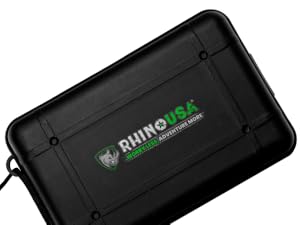
Image: The compact, rugged storage case designed to protect the deflators and gauge when not in use.
7. Troubleshooting
If you encounter issues with your tire deflators, consider the following:
- Deflator Not Stopping at Set PSI: Ensure the lock ring adjustment is securely set. Check for debris or damage to the internal mechanism that might prevent proper sealing. Inspect the O-rings for wear or improper seating.
- Inaccurate Pressure Readings: If the gauge provides inconsistent or inaccurate readings, ensure it has not been dropped or damaged. Compare its reading with another known accurate gauge.
- Air Leaks from Deflator: Check the connection point to the valve stem for tightness. Inspect the O-ring on the deflator for damage or displacement. A weak or damaged O-ring can cause air to leak or prevent the deflator from sealing properly.
- Deflator Malfunction: If a deflator consistently fails to operate as intended (e.g., not deflating at all, or not stopping), it may indicate an internal component issue. Refer to the warranty information for support.
8. Specifications
| Feature | Specification |
|---|---|
| Brand | Rhino USA |
| Model | RNO-DEFLATORS-4PK |
| Material | Brass |
| Item Dimensions (L x W x H) | 8 x 5 x 2 inches |
| Item Weight | 1 Pound |
| Thread Type | 1/4-28 Npt |
| Unit Count | 1.0 Count (set of 4 deflators) |
| UPC | 850022810497 |
9. Warranty and Support
Rhino USA offers comprehensive support for its products:
- Lifetime Protection: All Rhino USA products come with unlimited lifetime protection. If you encounter any problems or damage, the company will replace the product.
- Contact Support: For questions or issues, you can reach the Rhino USA team toll-free at (800) 575-7310, Monday through Friday, 9 AM to 5 PM PST.
10. Safety Information
Always observe the following safety guidelines when using tire deflators:
- Ensure your vehicle is parked on a level surface and the parking brake is engaged before deflating tires.
- Do not over-deflate tires beyond the recommended pressure for your specific off-road conditions. Over-deflation can lead to tire damage or bead separation.
- Always re-inflate tires to the manufacturer's recommended on-road pressure before driving on paved surfaces. Driving with under-inflated tires on roads can be dangerous and cause tire failure.
- Keep small components like valve caps and cores out of reach of children.