
1. Introduction to Cascadia
Cascadia is a tile-laying and token-drafting board game where players compete to create the most harmonious ecosystem in the Pacific Northwest. Players select habitat tiles and wildlife tokens to build their personal landscape, aiming to fulfill specific scoring goals for both habitat types and wildlife arrangements. The game offers variable scoring conditions, ensuring a unique experience with each play.
2. Components Overview
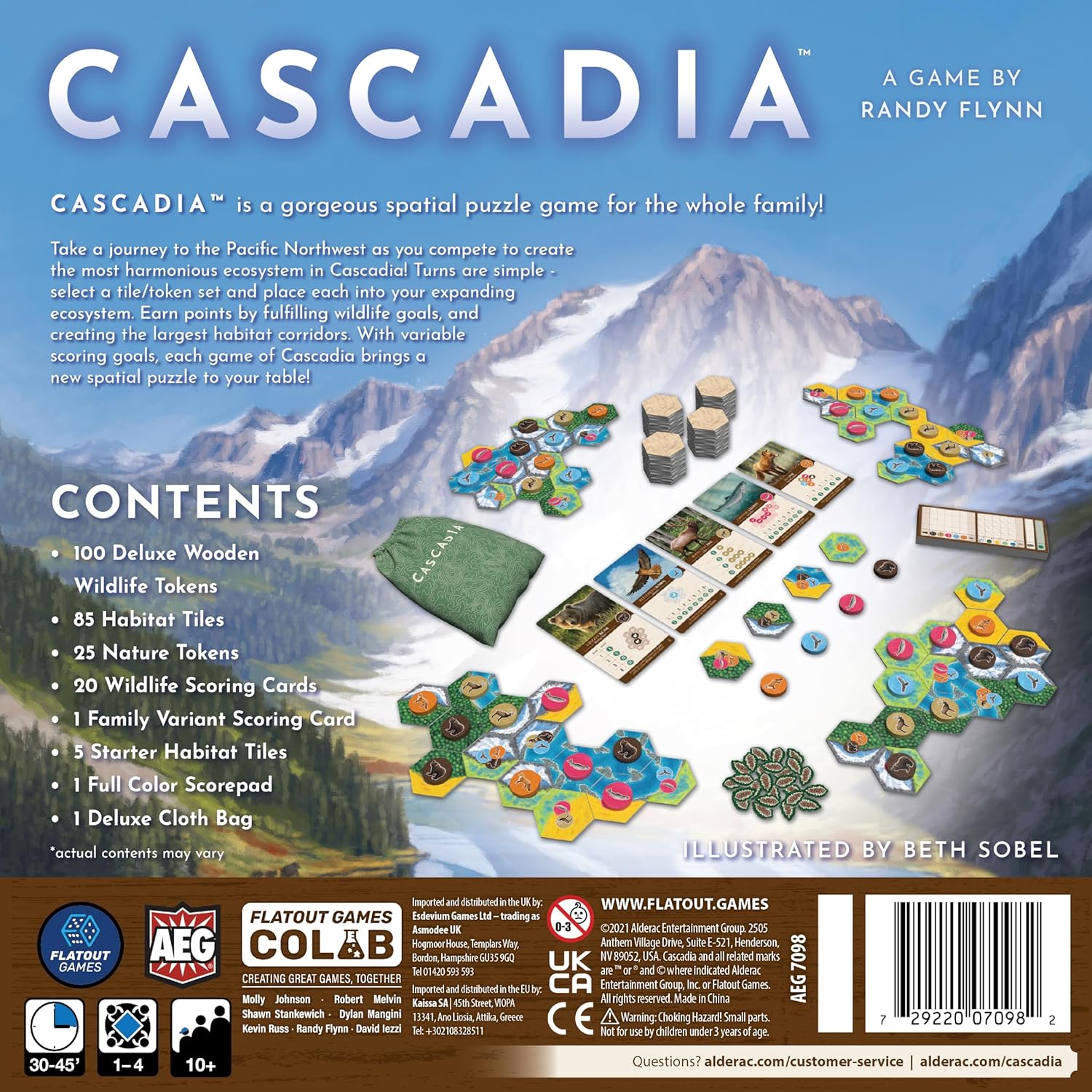
The Cascadia game box contains the following components:
- 100 Deluxe Wooden Wildlife Tokens
- 85 Habitat Tiles
- 25 Nature Tokens
- 20 Wildlife Scoring Cards
- 1 Family Variant Scoring Card
- 5 Starter Habitat Tiles
- 1 Full Color Scorepad
- 1 Deluxe Cloth Bag

3. Game Setup
- Prepare Habitat Tiles: Shuffle the 85 Habitat Tiles and form a face-down draw pile. Each player receives one Starter Habitat Tile.
- Prepare Wildlife Tokens: Place all 100 Deluxe Wooden Wildlife Tokens into the Deluxe Cloth Bag and mix thoroughly.
- Set Up Scoring Cards: Randomly select one Wildlife Scoring Card for each of the five wildlife types (Bear, Elk, Hawk, Salmon, Fox). Place these face-up where all players can see them. These cards define how each animal type will score points at the end of the game. For a simpler game, use the Family Variant Scoring Card.
- Create the Offer: Draw four Habitat Tiles and place them face-up in a row. Next to each Habitat Tile, draw one Wildlife Token from the cloth bag and place it on the tile. This forms the 'Offer' for players to choose from.
- Nature Tokens: Place the 25 Nature Tokens in a general supply.
- Scorepad: Keep the Full Color Scorepad and a writing utensil nearby for scoring at the end of the game.

4. Gameplay Instructions
4.1 Game Turn Overview
Cascadia is played over a series of turns until all Habitat Tiles have been used. On each player's turn, they will perform the following steps:
- Select a Tile/Token Pair: Choose one of the four available Habitat Tile and Wildlife Token pairs from the Offer.
- Place the Habitat Tile: Add the chosen Habitat Tile to your growing ecosystem. Tiles must be placed adjacent to an already placed tile.
- Place the Wildlife Token: Place the chosen Wildlife Token onto an empty Habitat Tile in your ecosystem. The token must be placed on a tile that shows the matching animal type.
- Refill the Offer: Draw a new Habitat Tile and a new Wildlife Token to replace the pair you took, maintaining four pairs in the Offer.
4.2 Nature Tokens
Nature Tokens can be used to manipulate the Offer. When you take a tile/token pair, if the Habitat Tile has a Keystone icon, you gain a Nature Token. Nature Tokens can be spent to perform one of two actions:
- Swap Wildlife Tokens: Spend one Nature Token to swap any two Wildlife Tokens in the Offer.
- Clear and Redraw Offer: Spend one Nature Token to discard all four Wildlife Tokens from the Offer and draw four new ones from the bag.
4.3 Scoring
Points are awarded at the end of the game based on two main criteria:
- Habitat Corridors: Points are scored for the largest contiguous areas of each of the five habitat types. The player with the largest corridor of a specific habitat type scores points for that corridor.
- Wildlife Goals: Points are scored based on how well you arranged your Wildlife Tokens according to the five face-up Wildlife Scoring Cards. Each card specifies a unique scoring condition for its animal type (e.g., groups of bears, lines of elk, adjacent salmon).

4.4 End of Game
The game ends when all 20 Habitat Tiles from the draw pile have been used. Players then calculate their scores based on Habitat Corridors and Wildlife Goals. The player with the highest total score wins.
4.5 Solo Play
Cascadia includes rules for solo play, allowing a single player to challenge themselves against a set of automated scoring objectives. Refer to the main rulebook for detailed solo play instructions.
5. Care and Maintenance
To ensure the longevity of your Cascadia board game components, please follow these guidelines:
- Storage: Store all components in the original box in a cool, dry place away from direct sunlight.
- Handling: Handle game pieces with clean, dry hands to prevent damage or discoloration.
- Cleaning: If necessary, gently wipe plastic or wooden components with a soft, dry cloth. Avoid using harsh chemicals or abrasive materials.
- Prevent Loss: Keep all small tokens and cards organized, ideally using the provided cloth bag for wildlife tokens, to prevent loss.
6. Troubleshooting
6.1 Missing Components
If you find any components missing upon opening your game, please contact AEG customer support (see Section 8) with details of the missing items. Provide proof of purchase if requested.
6.2 Rule Clarification
For any questions regarding specific game rules or scenarios, refer to the official rulebook included with your game. Many online board game communities also offer forums for rule discussions and clarifications.
7. Product Specifications
| Specification | Detail |
|---|---|
| Product Dimensions | 9.5 x 9.5 x 0.1 inches |
| Item Weight | 2.31 pounds |
| ASIN | B093H8RGXX |
| Item Model Number | AEG7098 |
| Manufacturer Recommended Age | 10 years and up |
| Release Date | October 2, 2020 |
| Language | English |
| Manufacturer | ALDERAC ENTERTAINMENT GROUP |
8. Warranty and Support
Specific warranty information for the Cascadia board game is not provided in the available product data. For details regarding warranty coverage or to contact customer support for assistance with your game, please visit the official Alderac Entertainment Group (AEG) website or refer to the contact information provided in the game's physical rulebook.
You can often find support resources, FAQs, and contact forms on the manufacturer's official website:
- AEG Official Website: www.alderac.com