
Introduction
This manual provides essential information for the safe and efficient use of your Miady 12.8V 7.2Ah LiFePO4 Lithium Battery, model LFP8AH. Please read these instructions carefully before installation and operation to ensure optimal performance and longevity of your battery.
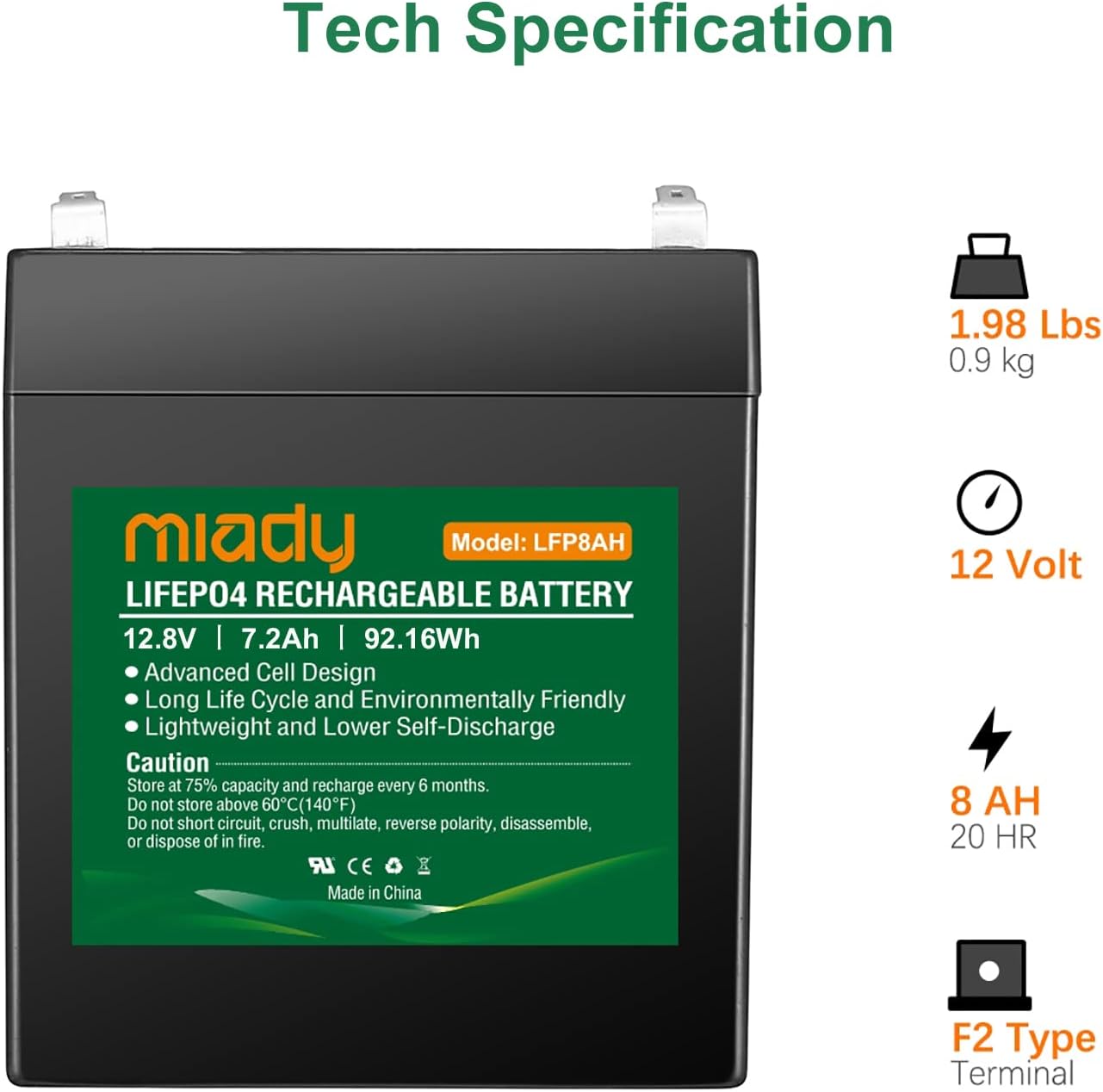
Front view of the Miady LFP8AH LiFePO4 battery, showing its model number, voltage, capacity, and key features on the label.
Safety Information
Always observe the following safety precautions to prevent injury or damage to the battery and connected equipment.
Important Warnings:
- When operating in series or parallel, the number of batteries must not exceed 3.
- Simultaneous series and parallel connections are not permitted.
- The battery must be fully charged before connecting it in series or parallel.
- This battery is not a starter battery and cannot be used to start an engine.
- Use a dedicated LiFePO4 battery charger. Using an incorrect charger may prevent full charging and compromise battery performance.
- Use specialized test equipment for lithium-ion batteries when performing charge/discharge tests.
- Do not short circuit, crush, mutilate, reverse polarity, disassemble, or dispose of in fire.
- Do not store above 60°C (140°F).
Product Features
The Miady LFP8AH LiFePO4 battery offers advanced technology and robust design for reliable power.
- Extended Cycle Life: Provides approximately 2000 charge and discharge cycles, significantly longer than traditional lead-acid batteries.
- Integrated BMS: Features a built-in Battery Management System to protect against overcharge, over-discharge, overcurrent, and short circuits.
- Lightweight Design: Smaller and lighter than comparable lead-acid batteries, simplifying installation and handling.
- Environmentally Friendly: More eco-conscious than lead-acid batteries, with no concerns about gas discharge or acid leakage.
- Low Self-Discharge Rate: Excellent self-discharge rate, maintaining charge for longer periods when not in use.
- Advanced Cell Design: Utilizes advanced cell technology for superior safety and performance.

Infographic comparing the Miady LiFePO4 battery with a traditional AGM battery, highlighting advantages such as cycle life, weight, safety, and environmental impact.
Setup
Unpacking and Inspection
Upon receiving your Miady LiFePO4 battery, carefully unpack it and inspect for any signs of physical damage. If any damage is found, contact customer support immediately.
Initial Charge
Before first use, it is recommended to fully charge the battery using a dedicated LiFePO4 charger. This ensures the battery is balanced and ready for optimal performance.
Connection Guidelines
- Ensure all connections are secure and correct polarity is observed (positive to positive, negative to negative).
- For series or parallel connections, ensure all batteries are fully charged to the same voltage before connecting.
- Do not connect more than 3 batteries in series or parallel.
- Never attempt simultaneous series and parallel connections.
- The F1 terminals are silver-plated for excellent conductivity. Ensure proper terminal connectors are used for a secure fit.

Close-up images showing the ultra-tough non-conductive ABS plastic case, silver-plated F1 terminals for excellent conductivity, and well-protected packaging.
Operating Instructions
Charging
- Always use a charger specifically designed for LiFePO4 batteries.
- Recommended charge voltage: 14.6V.
- Standard charge current: 2A.
- Maximum charge current: 10A.
- Charge temperature range: 0°C to 45°C (32°F to 113°F).
Discharging
- Standard discharge current: 2A.
- Maximum continuous discharge current: 22A.
- Maximum pulse current: 40A (<3S).
- Discharge cut-off voltage: 10.0V. The BMS will protect the battery from over-discharge.
- Discharge temperature range: -20°C to 60°C (-4°F to 140°F).
Typical Applications
This battery is suitable for various applications requiring reliable deep-cycle power, including:
- Recreational Vehicles (RVs)
- Marine applications (boats)
- Solar energy systems
- Uninterruptible Power Supplies (UPS)
- Electric vehicles (e.g., children's cars, e-rickshaws)
- Lighting systems

Illustrations depicting common applications for the Miady LiFePO4 battery, including motorcycles, children's electric cars, solar installations, UPS systems, security cameras, and portable sprayers.
Maintenance
Storage
- Store the battery at approximately 75% capacity.
- Recharge the battery every 6 months during prolonged storage to maintain its health.
- Storage temperature range: -20°C to 60°C (-4°F to 140°F).
- Store in a cool, dry place away from direct sunlight and heat sources.
Cleaning
Keep the battery terminals clean and free from corrosion. Use a dry cloth to wipe the battery casing. Do not use solvents or harsh chemicals.
Environmental Considerations
LiFePO4 batteries are more environmentally friendly than lead-acid. Dispose of the battery responsibly according to local regulations at the end of its life cycle.
Troubleshooting
If you encounter issues with your Miady LiFePO4 battery, refer to the following common problems and solutions.
Battery Not Charging
- Check Charger: Ensure you are using a dedicated LiFePO4 charger. An SLA charger may not fully charge the battery.
- Check Connections: Verify that all charging cables are securely connected and polarity is correct.
- BMS Protection: The built-in BMS may have activated due to over-discharge or other fault conditions. Disconnect the load and attempt to charge with a compatible charger.
Low Voltage Output
- Over-Discharge Protection: The BMS will cut off power if the battery voltage drops below 10.0V to protect the cells. Recharge the battery immediately.
- Load Exceeded: Ensure the connected load does not exceed the maximum continuous or pulse discharge current.
Battery Not Holding Charge
- Storage Conditions: Ensure the battery is stored at recommended capacity and recharged every 6 months.
- Charger Compatibility: Confirm the charger is suitable for LiFePO4 batteries and is functioning correctly.
If problems persist, please contact Miady customer support for further assistance.
Specifications
Detailed technical specifications for the Miady 12.8V 7.2Ah LiFePO4 Lithium Battery (Model LFP8AH).
| Characteristic | Value |
|---|---|
| Model Number | LFP8AH |
| Nominal Voltage | 12.8V |
| Nominal Capacity | 7.2Ah @0.2C |
| Energy | 92.16Wh |
| Cycle Life | >2000 Cycles @ 0.2C Charge/Discharge at 100% DOD, End of Life 70% Capacity. |
| Months Self Discharge | ≤3.5% per month at 25°C |
| Charge Voltage | 14.6V±0.1V |
| Charge Mode (CC/CV) | At 0°C~45°C temperature, charged to 14.6V±0.1V at a constant current of 0.2CSA, and then charged continuously with constant voltage of 14.6V±0.1V until the current was not more than 0.02CSA. |
| Charger Current | 10A |
| Max. Charge Current | 22A |
| Discharge Current | 22A |
| Max. Continuous Current | 22A |
| Max. Pulse Current | 40A (<3S) |
| Discharge Cut-off Voltage | 10.0V |
| Charge Temperature | 0°C to 45°C (32°F to 113°F) @60±25% Relative Humidity |
| Discharge Temperature | -20°C to 60°C (-4°F to 140°F) @60±25% Relative Humidity |
| Storage Temperature | 0°C to 45°C (32°F to 113°F) @60±25% Relative Humidity |
| Water Dust Resistance | IP54 |
| Cell & Method | 18730-4S4P |
| Plastic Case | ABS |
| Dimension (L*W*H) | 90*70*101-107mm |
| Weight | Approx. 0.9kg |
| Terminal | F1 |

A comprehensive table outlining the electrical characteristics, standard charge/discharge parameters, environmental conditions, and mechanical specifications of the Miady LiFePO4 battery.

Diagram illustrating the physical dimensions of the Miady LFP8AH battery in inches and centimeters, including height, width, and depth.
Warranty and Support
Warranty Information
The Miady 12.8V 7.2Ah LiFePO4 Lithium Battery (Model LFP8AH) comes with a 12-month warranty from the date of purchase. This warranty covers defects in materials and workmanship under normal use.
Customer Support
For technical assistance, warranty claims, or any questions regarding your Miady battery, please contact Miady customer support through the retailer where the product was purchased or visit the official Miady website for contact information.