
ELECTOP ELECTOP6WAY
ELECTOP 6-Way Fuse Block Instruction Manual
Model: ELECTOP6WAY
1. Introduction
This manual provides detailed instructions for the installation, operation, and maintenance of your ELECTOP 6-Way Blade Fuse Block. Designed for 12V/24V automotive, marine, and RV applications, this fuse block offers efficient circuit protection and organization for various electrical accessories.
2. Product Features
- 6-Way Design: Accepts 1A to 20A ATC/ATO (middle size) fuses, providing 6 independent circuits.
- Integrated Negative Bus: Features both positive and negative terminals for each circuit, simplifying wiring and organization.
- High Capacity: Supports a maximum of 20 Amp per circuit and 75 Amp total per panel.
- Durable Construction: Made from environmentally friendly PBT material, ensuring mechanical strength, insulation, heat resistance, and flame resistance.
- Transparent Protection Cover: A splash and dust-proof cover with screw nuts for easy operation and added protection.
- Pre-Printed Sticker Labels: Includes multi-function stickers for easy identification of each circuit, aiding in examination and troubleshooting.
- Wide Application: Suitable for use in cars, trucks, boats, tankers, marine vehicles, SUVs, yachts, RVs, vans, and other 12V/24V automotive systems.
3. Package Contents
The package includes the following items:
- 1 x ELECTOP 6-Way Blade Fuse Block with Protection Cover
- 4 x 20A Fuses
- 2 x 15A Fuses
- 2 x 10A Fuses
- 4 x 5A Fuses
- 4 x Mounting Screws
- 2 x Sticker Sheets for labeling circuits

Image: Contents of the ELECTOP 6-Way Fuse Block package, showing the fuse block, various fuses, mounting screws, and label stickers.
4. Specifications
| Attribute | Value |
|---|---|
| Model Number | ELECTOP6WAY |
| Voltage Rating | 12V / 24V DC (Max. 32V DC) |
| Max. Current per Circuit | 20 Amp |
| Max. Current per Panel | 75 Amp |
| Fuse Type | ATC/ATO Blade Fuses (1A-20A) |
| Main Line Terminal Rating | M6 threaded studs (75A 32V DC max) |
| Main Line Wire Size | #4-6 AWG |
| Single Line Terminal Rating | M4 threaded studs (20A 32V DC max) |
| Single Line Wire Size | #12-16 AWG |
| Material | PBT Plastic |
| Mounting Type | Through-Hole Mount |
| Dimensions (L x W x H) | Approx. 4.72 x 1.96 x 1.96 inches (5.51 x 3.46 x 2.48 inches package) |
| Weight | Approx. 6.7 ounces |

Image: Detailed product specifications including dimensions and wire size recommendations.
5. Setup and Installation
Proper installation is crucial for the safe and effective operation of your fuse block. Follow these steps carefully:
5.1 Wiring Diagram Overview
The fuse block is designed with a common positive input and a common negative bus. Each fused output has a corresponding negative terminal. Refer to the wiring diagram for a visual guide:

Image: Wiring diagram illustrating connections from DC positive and negative to the fuse block, and then to individual loads.
- Connect the main DC positive power source (e.g., battery positive) to the large positive input stud.
- Connect the main DC negative (ground) source (e.g., battery negative) to the large negative bus stud.
- For each accessory, connect its positive wire to one of the fused output terminals.
- Connect the negative wire of each accessory to the corresponding negative terminal on the negative bus.
5.2 Fuse Selection and Installation
Select the appropriate ATC/ATO blade fuse for each circuit based on the current requirements of the connected electrical appliance. The fuses are color-coded to indicate their amperage:

Image: A visual guide to fuse colors and their amperage ratings (Yellow: 20A, Blue: 15A, Red: 10A, Orange: 5A).
- Determine the current draw of each appliance you intend to connect.
- Choose a fuse with an amperage rating slightly higher than the appliance's normal operating current, but not exceeding 20A per circuit.
- Insert the selected fuse firmly into the corresponding fuse slot on the fuse block.
5.3 Mounting and Protection
Mount the fuse block securely using the provided screws. The transparent cover provides protection against splashes and dust.
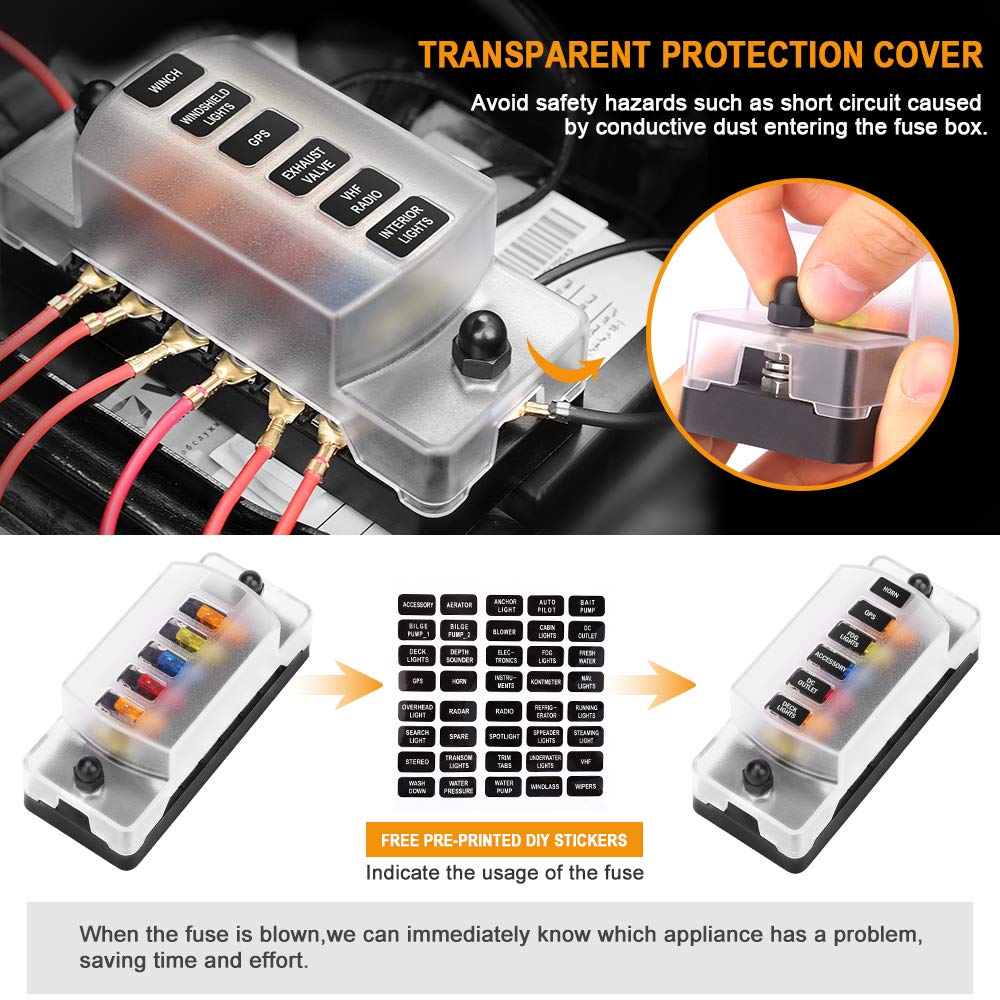
Image: The transparent cover being installed on the fuse block, and a sheet of pre-printed labels for circuit identification.
- Identify a suitable mounting location that is dry, secure, and accessible for future maintenance.
- Use the four provided screws to firmly attach the fuse block to the mounting surface.
- Once all wiring and fuses are in place, secure the transparent protection cover over the fuse block using the screw nuts.
- Apply the pre-printed sticker labels to the cover above each fuse to clearly identify the connected circuit. This aids in quick troubleshooting.
5.4 Visual Installation Guide
Watch this official video from ELECTOP for a visual demonstration of the fuse block's features and installation process:
Video: An official Electop video demonstrating the 6-Way Blade Fuse Block, its components, and a basic wiring example. This video provides a helpful visual aid for understanding the product's functionality and installation.

Image: Example of the fuse block installed with multiple wires connected, demonstrating a typical wiring setup in a vehicle.
6. Operating Instructions
The ELECTOP 6-Way Fuse Block operates passively to protect your electrical circuits. Once properly installed with the correct fuses, it requires no further user interaction for its primary function.
- Ensure all connections are secure and fuses are correctly inserted before applying power.
- The fuse block will automatically interrupt the circuit if an overcurrent condition occurs, protecting your connected devices.
7. Maintenance
Regular maintenance ensures the longevity and reliability of your fuse block.
7.1 Fuse Replacement
If a connected device stops working, the fuse for that circuit may have blown. To replace a blown fuse:
- Disconnect power to the fuse block before attempting any fuse replacement.
- Remove the transparent protection cover.
- Carefully pull out the blown fuse. A blown fuse typically has a broken filament inside.
- Replace it with a new fuse of the exact same amperage rating. Using a fuse with a higher rating can damage your devices or wiring.
- Securely re-attach the transparent protection cover.
7.2 Cleaning
Periodically inspect the fuse block for dirt, dust, or corrosion. Clean with a dry, soft cloth. Ensure the fuse block is completely dry before re-applying power.
8. Troubleshooting
Most issues related to the fuse block involve blown fuses or incorrect wiring.
- Device Not Working: Check the fuse for that specific circuit. If blown, replace it with a fuse of the correct amperage. If the new fuse blows immediately, there may be a short circuit or an overload in the connected device or wiring.
- No Power to Any Device: Check the main power connections to the fuse block (positive and negative studs). Ensure the battery is charged and connections are secure.
- Loose Connections: Ensure all wire terminals are securely fastened to the fuse block studs. Loose connections can cause intermittent power or overheating.
- Incorrect Fuse Rating: Always use fuses with the specified amperage rating. Using an undersized fuse will cause it to blow frequently, while an oversized fuse will not provide adequate protection and can lead to damage.
9. Wide Application Examples
The ELECTOP 6-Way Fuse Block is versatile and can be used in a variety of 12V/24V DC applications to manage and protect electrical circuits. Common uses include:
- Automotive: Car dome lights, headlights, width lamps, fog lamps, warning lights, car refrigerators, car chargers, car fans, car TVs, etc.
- Marine: Boat lighting, bilge pumps, navigation systems, fish finders, and other marine electronics.
- RV/Camper: Interior lighting, water pumps, charging ports, and other auxiliary systems.
- Trucks & Commercial Vehicles: Auxiliary lighting, communication equipment, and other added electrical components.

Image: Examples of diverse applications for the fuse block, such as in cars, trucks, boats, and RVs, highlighting its versatility.
10. Warranty and Support
For any questions regarding the ELECTOP 6-Way Fuse Block, including installation, operation, or troubleshooting, please contact ELECTOP customer service. Refer to the product packaging or the seller's information on the purchase platform for specific contact details and warranty terms.
Ask a question about this manual
Ask about setup, troubleshooting, compatibility, parts, safety, or missing instructions. Manuals+ will review the question and use this page’s manual context to help answer it.