
1. Introduction and Product Overview
The Wiltec NW-SOFT-C1 water softener is designed to effectively combat limescale problems that can clog pipes and reduce the efficiency of household appliances. This model is capable of softening up to 500 liters of water per hour, providing a reliable solution for both domestic and professional use.
The system operates on the principle of ion exchange, where calcium and magnesium ions (responsible for water hardness) are captured by a special resin and exchanged for sodium ions. This process significantly reduces water hardness without affecting the initial pH value. A key feature of the NW-SOFT-C1 is its automatic resin regeneration, which occurs when the resin reaches saturation. This involves drawing brine from the salt tank to flush out the accumulated calcium and magnesium ions, restoring the resin's softening capacity. Regular addition of salt to the softener is all that is required for continuous operation.
Key Features:
- Effective Limescale Removal: Transforms hard water into soft water, protecting pipes and appliances from scale buildup.
- Ion Exchange Technology: Reduces calcium and magnesium concentration without altering water pH.
- Automatic Regeneration: Resin automatically regenerates using salt, ensuring continuous optimal performance with minimal manual intervention.
- High Flow Rate: Processes up to 500 liters of water per hour, suitable for various applications.
- Self-Cleaning System: Prevents resin fouling and extends the system's lifespan.
2. Safety Instructions
Please read and understand all safety instructions before installing, operating, or performing maintenance on the water softener. Failure to follow these instructions may result in property damage, injury, or death.
- Electrical Safety: Ensure the unit is properly grounded. Do not operate with damaged power cords or plugs. Disconnect power before any service or maintenance.
- Water Pressure: Do not exceed the maximum operating pressure specified in the technical data. Install a pressure reducer if necessary.
- Installation: Installation should be performed by a qualified professional in accordance with local plumbing and electrical codes.
- Chemicals: Use only water softener salt (sodium chloride) specifically designed for water softeners. Keep salt and other chemicals out of reach of children and pets.
- Temperature: Do not install the unit where it may be exposed to freezing temperatures, as this can cause severe damage.
- Leakage: Regularly check for leaks. In case of a leak, shut off the water supply to the unit immediately.
3. Product Components and Diagrams
Familiarize yourself with the various parts of your Wiltec NW-SOFT-C1 water softener.
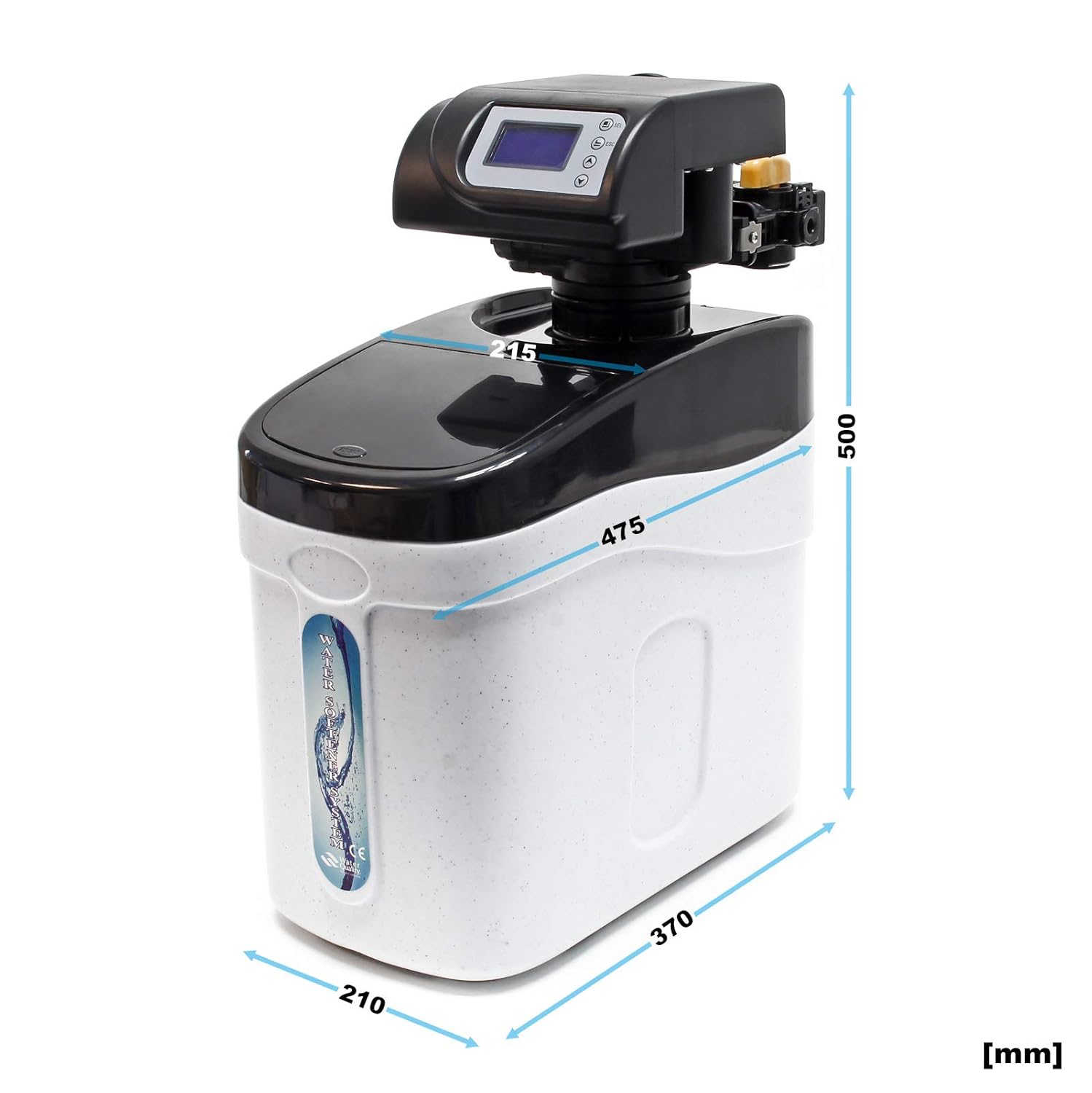
Figure 3.1: Front view of the Wiltec NW-SOFT-C1 water softener, showing overall dimensions: width 215mm, depth 475mm, height 500mm. The unit is white with a black top control panel.

Figure 3.2: Side view of the Wiltec NW-SOFT-C1 water softener, indicating a height of 400mm from the base to the top of the main body, and a pipe diameter of 14mm.

Figure 3.3: Top-down view of the Wiltec NW-SOFT-C1 water softener with the lid open, revealing the internal brine tank. Internal dimensions are indicated: 120mm width and 175mm depth for the salt compartment.
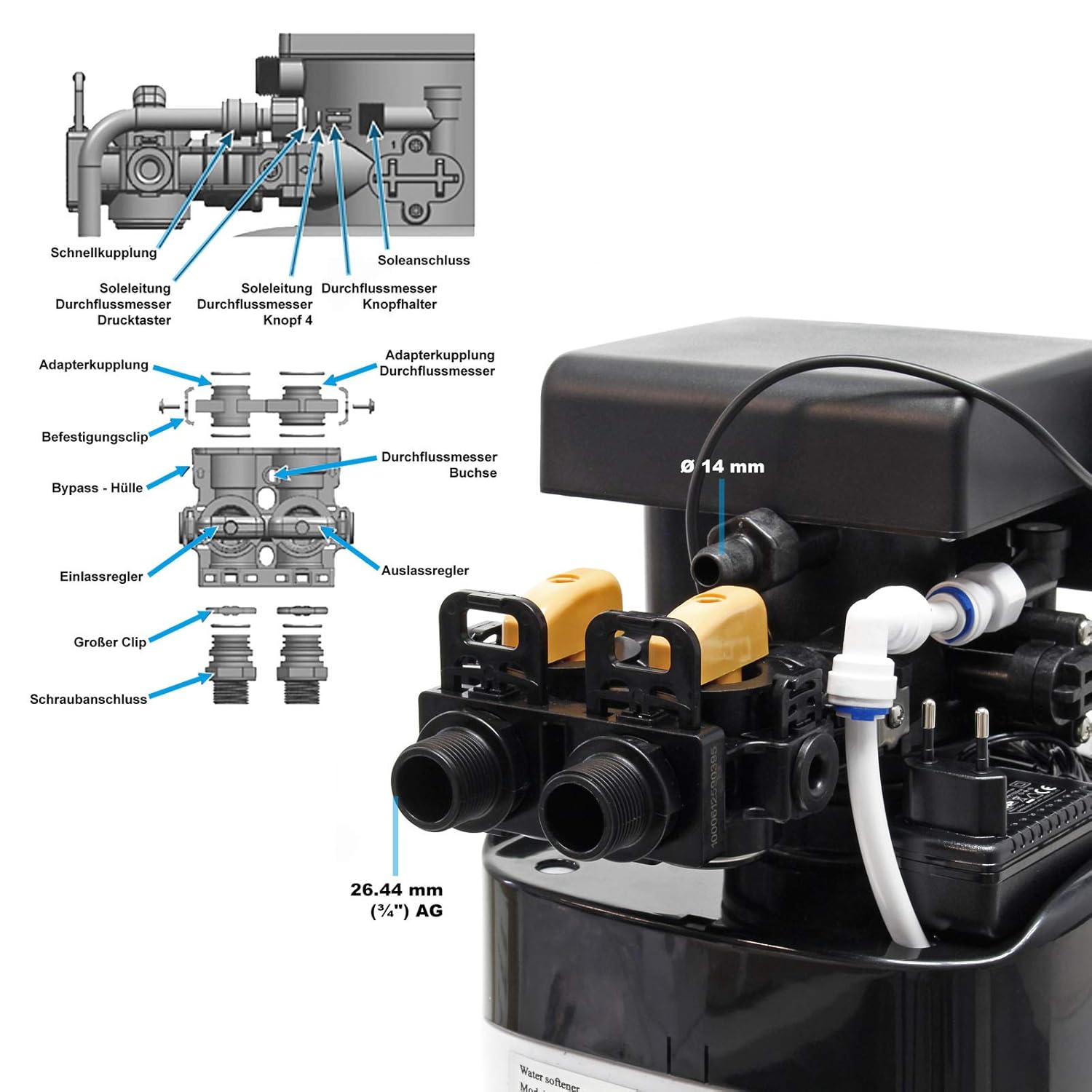
Figure 3.4: Detailed diagram illustrating the connection points and components of the Wiltec NW-SOFT-C1 water softener. Key parts include quick couplings, brine line, pressure button, adapter coupling, fastening clip, bypass housing, inlet regulator, outlet regulator, large clip, screw connection, brine connection, flow meter, and bushing. The main water connections are 26.44 mm (3/4 inch) AG.

Figure 3.5: Cross-sectional diagram showing the internal components and water flow within the Wiltec NW-SOFT-C1 water softener. It highlights the automatic central control valve, bypass valves for inlet/outlet, drain for rinse water, hard water inlet, soft water outlet, brine hose, safety brine valve/float, regeneration salt/brine, pressure tank, suction lance, exchange resin, softened water, and cabinet container.

Figure 3.6: Diagram illustrating the ion exchange process. Hardness ions (Ca2+, Mg2+) are captured by the ion exchange resin (cations), and sodium ions (Na+) are released into the water, resulting in softened water.
4. Setup and Installation
The Wiltec NW-SOFT-C1 is a standalone unit. Proper installation is crucial for optimal performance and longevity.
4.1 Site Selection:
- Choose a location near the main water supply line, preferably after the main shut-off valve and before any branches to unsoftened water outlets (e.g., outdoor faucets).
- Ensure the location is level, dry, and protected from freezing temperatures and direct sunlight.
- Provide adequate space around the unit for maintenance and salt replenishment.
- A nearby drain is required for the regeneration wastewater.
- An electrical outlet (cable électrique) is needed for power.
4.2 Plumbing Connections:
- Shut off the main water supply.
- Install a bypass valve system (if not already integrated) to allow water flow during softener maintenance.
- Connect the hard water inlet to the softener's inlet port (refer to Figure 3.4 for connection details). The connections are 26.44 mm (3/4 inch) AG.
- Connect the softener's outlet port to the soft water line.
- Connect the drain line from the control valve to a suitable drain, ensuring an air gap to prevent back-siphonage.
- Connect the brine line from the salt tank to the control valve.
4.3 Electrical Connection:
- Plug the power cord into a grounded electrical outlet.
4.4 Initial Startup:
- Slowly open the main water supply valve and check for leaks.
- Allow the softener tank to fill with water.
- Add water softener salt to the brine tank (refer to Section 6.1 for details).
- Refer to the operating instructions to set the initial water hardness level on the control panel.
5. Operating Instructions
The Wiltec NW-SOFT-C1 features an automatic control system for ease of use.
5.1 Setting Water Hardness:
- Locate the control panel on top of the unit.
- Use the display and buttons to enter your local raw water hardness level. This setting is crucial for the system to calculate regeneration cycles accurately.
- Consult your local water provider for your specific water hardness value.
5.2 Automatic Operation:
- Once the water hardness is set, the unit will automatically monitor water consumption and initiate regeneration cycles as needed.
- Regeneration typically occurs during periods of low water usage (e.g., overnight) to minimize disruption.
- During regeneration (approximately 30 minutes), softened water may not be available, or water pressure might temporarily drop. Plan water usage accordingly.
5.3 Manual Regeneration (Optional):
- If you anticipate unusually high water usage or notice a decrease in water softness, you can initiate a manual regeneration cycle via the control panel. Refer to the specific instructions on the control panel for this procedure.
6. Maintenance
Regular maintenance ensures the efficient and long-lasting operation of your water softener.
6.1 Salt Replenishment:
- The water softener requires salt for the regeneration process. Check the salt level in the brine tank regularly (e.g., monthly).
- Ensure the salt level is always above the water level in the brine tank, ideally at least halfway full.
- Use only high-quality water softener salt (pellets, crystals, or blocks) specifically designed for water softeners. Do not use rock salt or ice melt.
- When adding salt, distribute it evenly in the tank. Avoid overfilling, which can lead to 'salt bridging' (a crust of salt forming, preventing proper brine formation).
6.2 Brine Tank Cleaning:
- Periodically (e.g., once a year), inspect the brine tank for any sediment or sludge buildup.
- If cleaning is necessary, remove all salt and water from the tank. Disconnect the brine line and thoroughly clean the tank with a mild detergent and rinse well.
- Reassemble and refill with salt and water as per initial setup.
6.3 Resin Bed Maintenance:
- The NW-SOFT-C1 features a self-cleaning system for the resin, which helps prevent fouling and extends its lifespan.
- In some cases, resin cleaners (e.g., iron removers) may be used if iron or other contaminants are present in the water supply and affecting performance. Consult a professional if you suspect such issues.
7. Troubleshooting
This section provides solutions to common issues you might encounter with your water softener.
| Problem | Possible Cause | Solution |
|---|---|---|
| Water is not soft | Low salt level in brine tank Incorrect hardness setting Bypass valve open Resin bed fouled or exhausted | Add salt to brine tank Verify and adjust hardness setting on control panel Close bypass valve Initiate manual regeneration; if problem persists, consider resin cleaner or professional service |
| Salt bridge in brine tank | Salt caked together, preventing brine formation | Carefully break up the salt bridge with a blunt object (e.g., broom handle). Do not use sharp objects that could puncture the tank. |
| Low water pressure | Clogged filters or lines Regeneration cycle in progress | Check and clean any pre-filters. Inspect plumbing for obstructions. Wait for the regeneration cycle to complete. |
| Unit not regenerating | No power Control panel error Brine line clogged | Check power connection and circuit breaker. Refer to control panel manual for error codes or reset procedure. Inspect and clear brine line. |
| Excessive salt usage | Incorrect hardness setting Frequent regeneration cycles | Verify and adjust hardness setting. Ensure no leaks are causing excessive water usage. |
8. Specifications
Detailed technical specifications for the Wiltec NW-SOFT-C1 water softener.
| Specification | Value |
|---|---|
| Manufacturer | WilTec |
| Model Number | NW-SOFT-C1 (52360) |
| Product Dimensions (L x W x H) | 21.5 x 47.5 x 50 cm |
| Package Dimensions | 57.5 x 46.4 x 24.1 cm |
| Item Weight | 10.5 Kilograms |
| Color | White |
| Material | Magnesium Resin |
| Power Source | Electric Cable |
| Installation Method | Standalone |
| Purification Method | Ion Exchange |
| Flow Rate | 500 Liters per hour |
| Special Feature | Automatic resin regeneration |
| Included Components | Water softener, brine tank, possibly accessories |
| Battery(ies) Required | No |
8.1 Performance Data (NW-SOFT-C1)

Figure 8.1: Table providing technical information for various Wiltec water softener models, including NW-SOFT-C1. It lists capacity at different dH levels, nominal flow, max/min raw water pressure, pressure drop, salt consumption per regeneration, and regeneration duration. For NW-SOFT-C1, capacity at 10°dH is 1500L, at 15°dH is 1000L, at 20°dH is 800L. Nominal flow (20°dH to 8°dH) is 2 m3/h, (20°dH to 0.5°dH) is 0.3 m3/h. Max pressure 6.0 bar, min pressure 1.0 bar. Pressure drop max flow 0.6 bar. Salt consumption per regeneration 0.8 kg. Regeneration time 30 min.
9. Warranty and Support
For warranty information, technical support, or spare parts availability, please refer to the official WilTec website or contact their customer service directly. Keep your purchase receipt as proof of purchase for any warranty claims.
- Manufacturer: WilTec Wildanger Technik GmbH
- Website: Visit the WilTec Store on Amazon


