
PD DIN 9021 M8 Nylon Washers
Instruction Manual for PD DIN 9021 M8 Nylon Washers
Model: DIN 9021 M8 Nylon Washers
1. Introduction
This manual provides comprehensive information regarding the PD DIN 9021 M8 Nylon Washers. These washers are designed for various applications requiring insulation, vibration damping, or protection of surfaces. Understanding their properties and proper application will ensure optimal performance and longevity.
2. Product Overview and Features
The PD DIN 9021 M8 Nylon Washers are manufactured from high-quality polyamide (PA) nylon, offering a balance of strength, flexibility, and chemical resistance. They conform to the DIN 9021 standard, ensuring consistent dimensions and performance.

Figure 2.1: PD DIN 9021 M8 Nylon Washers. The image shows two individual M8 nylon washers in the foreground, with a clear plastic bag containing more washers and the 'PD' brand logo in the background.
2.1 Key Properties of PA Nylon Washers
- High Wear Resistance: Excellent durability against abrasion and friction.
- High Thermal Stability: Maintains integrity across a range of temperatures.
- Good Strength & Hardness: Provides reliable support and prevents deformation under load.
- Good Damping Properties: Helps reduce vibrations and noise.
- Extremely Lightweight: Contributes minimally to the overall weight of an assembly.
- Ideal for Indoor & Outdoor Use: Resistant to environmental factors, suitable for diverse environments.
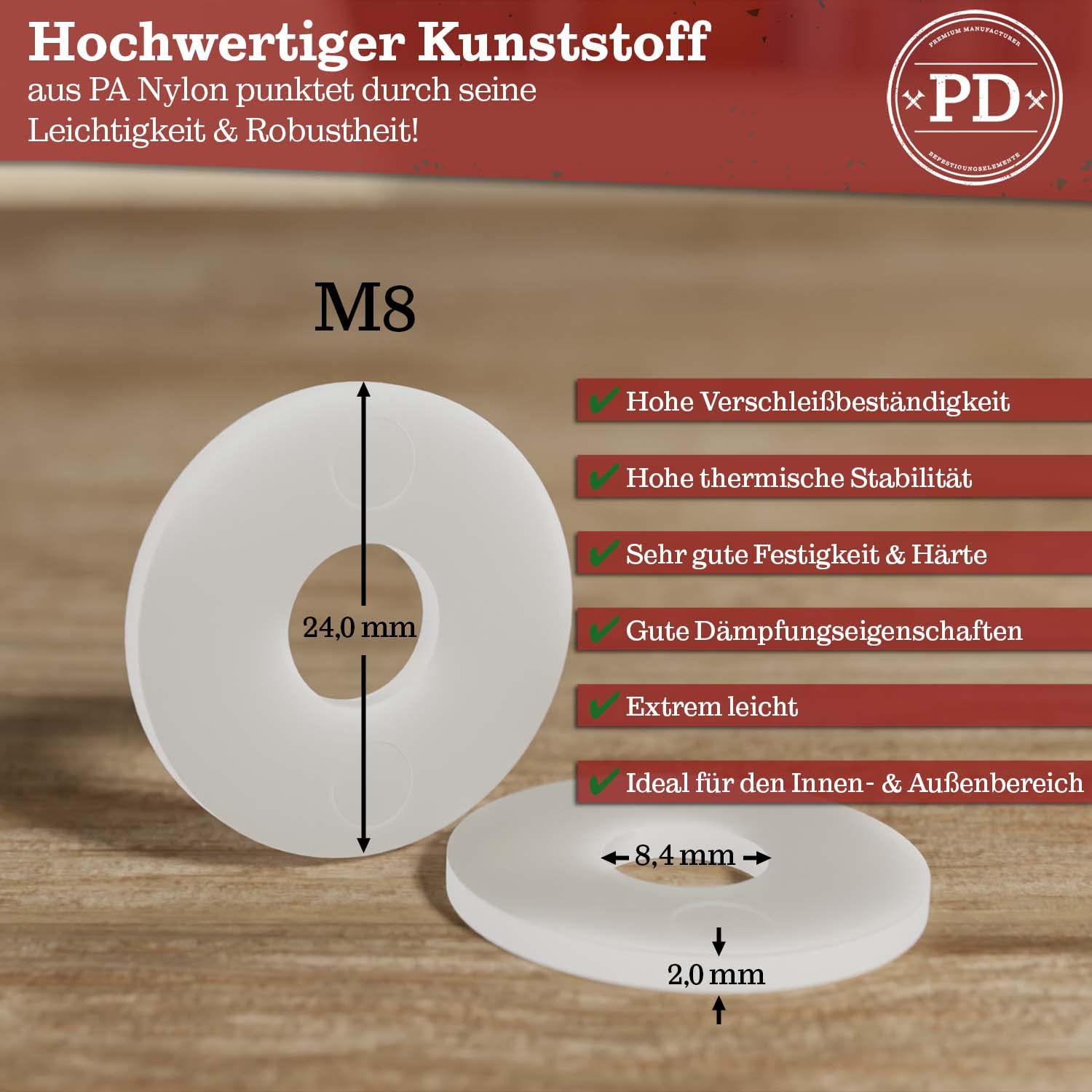
Figure 2.2: Detailed view of an M8 nylon washer with key dimensions and properties. The image highlights the outer diameter (24.0 mm), inner diameter (8.4 mm), and thickness (2.0 mm) of an M8 washer, alongside a list of its beneficial properties.
2.2 Dimensions (DIN 9021 Standard)
The following table provides the standard dimensions for DIN 9021 washers, with the M8 size highlighted.

Figure 2.3: Technical drawing illustrating washer dimensions (d1, d2, h) and a table listing these dimensions for various M sizes according to DIN 9021 standard. The table includes measurements for M2 to M36 washers.
| Dimension | M2 | M2.5 | M3 | M4 | M5 | M6 | M8 | M10 | M12 | M14 | M16 | M18 | M20 | M24 | M30 | M36 |
|---|---|---|---|---|---|---|---|---|---|---|---|---|---|---|---|---|
| d1 [mm] (Inner Diameter) | 2.2 | 2.7 | 3.2 | 4.3 | 5.3 | 6.4 | 8.4 | 10.5 | 13 | 15 | 17 | 20 | 22 | 26 | 33 | 39 |
| d2 [mm] (Outer Diameter) | 7 | 8 | 9 | 12 | 15 | 18 | 24 | 30 | 37 | 44 | 50 | 56 | 60 | 72 | 92 | 110 |
| h [mm] (Thickness) | 0.8 | 0.8 | 0.8 | 1 | 1.2 | 1.6 | 2 | 2.5 | 3 | 3 | 4 | 4 | 5 | 6 | 8 |
2.3 Common Applications
These versatile washers are suitable for a wide range of applications:
- Protection of Sensitive Surfaces: Prevents scratching or damage when fastening components.
- Crafts and DIY Projects: Ideal for various creative and repair tasks.
- General Repairs: Useful in household or industrial repairs where a non-conductive or protective washer is needed.
- Model Building: Lightweight and precise for intricate assemblies.

Figure 2.4: Collage demonstrating various applications for the washers, including protecting furniture surfaces, use in craft projects, general repairs on items like a wheelbarrow, and in model building such as drones.
3. Specifications
| Attribute | Detail |
|---|---|
| Product Type | Big Washers, Flat Washers |
| Material | Nylon (Polyamide, PA) |
| Standard | DIN 9021 |
| Size (Nominal Diameter) | M8 |
| Inner Diameter (d1) | 8.4 mm |
| Outer Diameter (d2) | 24.0 mm |
| Thickness (h) | 2.0 mm |
| Number of Pieces | 25 |
| Brand | PD |
| ASIN | B07QDT6KQ1 |
| Manufacturer | Ing. Ph. J. Daum GmbH & Co. KG |
| Package Dimensions | 5.83 x 3.98 x 0.39 inches; 0.71 ounces |
4. Setup and Installation
Nylon washers are simple to install and do not require specialized tools. Follow these general guidelines:
- Select Correct Size: Ensure the washer's inner diameter (d1) matches or is slightly larger than the bolt or screw diameter (M8 in this case). The outer diameter (d2) should be appropriate for the surface area you wish to cover or protect.
- Clean Surfaces: Ensure the surfaces where the washer will be placed are clean and free of debris to ensure proper seating and prevent damage.
- Placement: Place the washer directly under the head of the bolt or screw, or under the nut, depending on the application. For surface protection, place it between the fastener and the sensitive material. For spacing or insulation, place it as required in the assembly.
- Fasten Securely: Tighten the fastener to the appropriate torque. Nylon washers can provide some vibration damping and surface protection, but avoid over-tightening, which could deform the washer or the material being fastened.
5. Operating Principles
Nylon washers operate by distributing the load of a fastener, preventing damage to the fastened material, and providing insulation or spacing. Their key operating principles include:
- Load Distribution: Spreads the clamping force of a bolt or nut over a larger area, reducing the pressure on the fastened material and preventing indentation or cracking.
- Surface Protection: Acts as a barrier between a metal fastener and a softer or more delicate surface, preventing scratches, galvanic corrosion, or other damage.
- Electrical Insulation: As nylon is a non-conductive material, these washers can be used to electrically isolate components, preventing short circuits or unwanted current paths.
- Vibration Damping: The inherent elasticity of nylon helps to absorb minor vibrations, reducing the likelihood of fasteners loosening over time.
- Spacing: Provides a precise standoff or gap between components in an assembly.
6. Maintenance
PD DIN 9021 M8 Nylon Washers require minimal maintenance due to their durable material properties. Consider the following:
- Inspection: Periodically inspect installed washers for signs of wear, cracking, or deformation, especially in high-stress or high-temperature environments.
- Cleaning: If necessary, clean with mild soap and water. Avoid harsh chemicals or abrasive cleaners that could degrade the nylon.
- Storage: Store unused washers in a cool, dry place away from direct sunlight and extreme temperatures to preserve their material integrity.
7. Troubleshooting
While nylon washers are generally trouble-free, here are some common considerations:
- Washer Deformation/Cracking: This often indicates over-tightening of the fastener or exposure to temperatures beyond the nylon's tolerance. Ensure correct torque is applied and verify environmental conditions are suitable.
- Fastener Loosening: While nylon offers some damping, extreme vibrations or improper tightening can still lead to loosening. Re-tighten fasteners to specification. Consider additional locking mechanisms if vibration is severe.
- Inadequate Protection: If the washer is not adequately protecting the surface, ensure the washer's outer diameter (d2) is sufficient for the load distribution required.
- Chemical Degradation: Exposure to certain strong acids, bases, or solvents can degrade nylon. Ensure the washer is compatible with any chemicals it may come into contact with.
8. Warranty and Support
For information regarding product warranty, returns, or technical support, please refer to the purchase documentation or contact the manufacturer directly. As a general consumable item, specific warranties may vary.
Manufacturer: Ing. Ph. J. Daum GmbH & Co. KG
For further product information and a wider range of fastening solutions, you may visit the PD brand's official channels or product listings.
Ask a question about this manual
Ask about setup, troubleshooting, compatibility, parts, safety, or missing instructions. Manuals+ will review the question and use this page’s manual context to help answer it.