
1. Introduction
The AUTOOL X60 OBD computer is a smart and powerful automotive meter designed to provide essential vehicle data. It is particularly useful for vehicles that lack a built-in speedometer, engine temperature gauge, oil thermometer, boost gauge, or fuel consumption meter. The X60 monitors and displays critical information such as battery voltage, engine charging voltage, and provides warnings for over-speed and engine temperature. It also features real-time data stream reading, trouble code scanning, and clearing capabilities.
2. Key Features
- Supported Vehicles: Compatible with petrol vehicles using standard OBD-II protocol, especially those manufactured after 1996 (US), 2002 (EU petrol), 2004 (EU diesel), and 2009 (Asia).
- Easy Installation: Simple plug-and-play setup via the OBD port, requiring no wire modification. Includes a mount and dual-sided tape for secure placement.
- Advanced Hardware: Powered by a 32-bit ARM CORTEX-M3 kernel CPU with a maximum operating frequency of 72MHz, supporting multiple high-speed auto communication protocols.
- Warning Functions: Features water temperature warning, over-speed alarm, shifting reminders, and vehicle malfunction warnings to enhance driving safety.
- Multi-Function Display: Displays various parameters including driving speed, engine RPM, battery voltage, coolant temperature, oil temperature, oil pressure, driving distance, fuel consumption, clock, engine load, and intake pressure.
- Diagnostic Capabilities: Reads real-time data streams, scans, and clears trouble codes.
3. Package Contents
The AUTOOL X60 package includes the following items:
- 1 x AUTOOL X60 Digital Meter
- 1 x OBD Cable
- 1 x Dual-Sided Tape
- 1 x User Manual
- 1 x Certificate

Video: Unboxing the AUTOOL X60 and reviewing its package contents.
4. Setup and Installation
Follow these steps to properly install your AUTOOL X60 Digital Meter:
- Locate OBD-II Port: Identify your vehicle's OBD-II diagnostic port, typically located under the dashboard on the driver's side.
- Connect OBD Cable: Plug the provided OBD cable into the vehicle's OBD-II port.
- Route Cable: Carefully route the OBD cable to the desired mounting location for the X60 unit, ensuring it does not interfere with driving controls or safety features. You may tuck the cable into seams for a cleaner look.
- Connect to X60: Plug the other end of the OBD cable (USB port) into the AUTOOL X60 unit.
- Mount X60: Use the provided mount and dual-sided tape to securely fix the X60 unit on your dashboard or preferred location. Ensure the display is clearly visible and does not obstruct your view of the road.

Image: Step-by-step visual guide for connecting the OBD adapter and mounting the AUTOOL X60 unit.

Image: Various angles of the AUTOOL X60 and its mounting base, showing how it attaches to the dashboard.
Video: Demonstrates the installation process and how the Autool Dashboard Meter functions in a vehicle.
Video: Shows the AUTOOL X60 Multi-Function Digital Meter in action, including its installation and various display modes.
5. Operating Instructions
5.1. Power On/Off
The AUTOOL X60 automatically powers on when the vehicle is started and powers off when the vehicle is turned off, as it draws power directly from the OBD-II port.
5.2. Menu Navigation
The unit features a single multi-directional button (often a scroll wheel or rocker switch) on the top or side for navigation. Pressing the button typically confirms a selection, while tilting it left/right or rotating it allows you to scroll through options or change display modes.
5.3. Display Modes and Parameters
The X60 offers multiple display interfaces and a wide range of parameters. You can cycle through different display layouts and select which parameters are shown on the screen.

Image: Examples of different interface displays available on the AUTOOL X60, showing various data points like speed, RPM, and temperatures.

Image: Icons representing the various displayable functions (e.g., Driving Speed, Engine RPM, Battery Voltage) and alarm functions (e.g., Speed Alarm, Coolant Temp. Alarm).
Common Displayable Parameters:
- Engine Coolant Temperature (ECT)
- Average Fuel Consumption (AVG)
- Revolutions-per-Minute (RPM)
- Turbo Pressure (PSI)
- Voltage (VLT)
- Inlet Pressure (MAP)
- Air-Fuel Ratio (A/F)
- Driving Time (MIN)
- Driving Distance (DIS)
- Engine Load (ELD)
- System Time (TIM)
- Total Mileage (ODO)
- Oil Temperature (OIT)
- Altitude (ASL)
- Throttle Position Sensor (TPS)
- Transmission Temperature (CVT)
- Driving Direction (DIR)
5.4. Alarm Functions
The X60 provides audible and visual alerts for various conditions:
- Water Temperature Warning: Alerts if engine coolant temperature exceeds a set limit.
- Over-Speed Alarm: Notifies the driver if the vehicle speed surpasses a pre-set threshold.
- Shifting Reminding: Provides prompts for optimal gear shifting.
- Vehicle Malfunction Warning: Alerts to detected engine or system malfunctions.
- Fatigue Driving Alarm: Reminds the driver to take a break after extended driving periods.
- RPM Alarm: Alerts if engine RPM exceeds a set limit.
- Voltage Alarm: Warns if battery voltage falls outside optimal range.
5.5. System Settings
Access the system settings menu to customize various aspects of the X60, including:
- Language Set: Change the display language.
- Sound Switch: Enable or disable audible alerts.
- Brightness: Adjust screen brightness (manual or automatic).
- Unit: Switch between Metric (km/h, Celsius) and Imperial (mph, Fahrenheit) units.
- Alarm Thresholds: Configure specific values for speed, RPM, voltage, and temperature alarms.
- Time Adjustment: Set or adjust the clock.

Image: Illustrates the automatic light sensor feature, which adjusts screen brightness for optimal visibility during both daytime and nighttime driving.
6. Maintenance
To ensure the longevity and optimal performance of your AUTOOL X60 Digital Meter, follow these maintenance guidelines:
- Cleaning: Use a soft, dry cloth to clean the display screen and the unit's exterior. Avoid abrasive cleaners or solvents that could damage the device.
- Cable Inspection: Periodically check the OBD cable for any signs of wear, fraying, or damage. Replace if necessary to maintain a secure connection.
- Environmental Conditions: Avoid exposing the unit to extreme temperatures, direct sunlight for prolonged periods, or excessive moisture.
- Firmware Updates: Check the official AUTOOL website for any available firmware updates to ensure your device has the latest features and bug fixes.
7. Troubleshooting
If you encounter issues with your AUTOOL X60, refer to the following common troubleshooting steps:
- "Failed to Connect" Message:
- Ensure the OBD cable is securely plugged into both the vehicle's OBD-II port and the X60 unit.
- Verify your vehicle is compatible with the X60 (12V OBD-II standard, manufactured after specified dates).
- Turn off the vehicle, unplug the X60, wait a few seconds, and then plug it back in and restart the vehicle.
- Check for any loose connections or damage to the OBD cable.
- Inaccurate Readings:
- Ensure the correct units (Metric/Imperial) are selected in the system settings.
- Some parameters may require calibration or adjustment in the system settings (e.g., speed adjustment).
- If specific sensors are not reading, try unplugging and replugging the unit.
- Display Not Turning On:
- Confirm the vehicle's ignition is on.
- Check the OBD cable connection.
- Ensure the vehicle's battery has sufficient charge.
- Annoying Beeping Sounds:
- Access the system settings to adjust or disable specific alarm sounds (e.g., over-speed, RPM alarm).
8. Specifications
| Feature | Description |
|---|---|
| Operating Voltage | 10-18V DC |
| Operating Current | <80mA |
| CPU | 32-bit ARM CORTEX-M3 kernel |
| Max Operating Frequency | 72MHz |
| Item Weight | 5.6 ounces |
| Package Dimensions | 3.8 x 3.3 x 3.1 inches |
| Manufacturer Part Number | X60-AMZ-101 |
| UPC | 733810027102, 714583379629, 733810044451 |
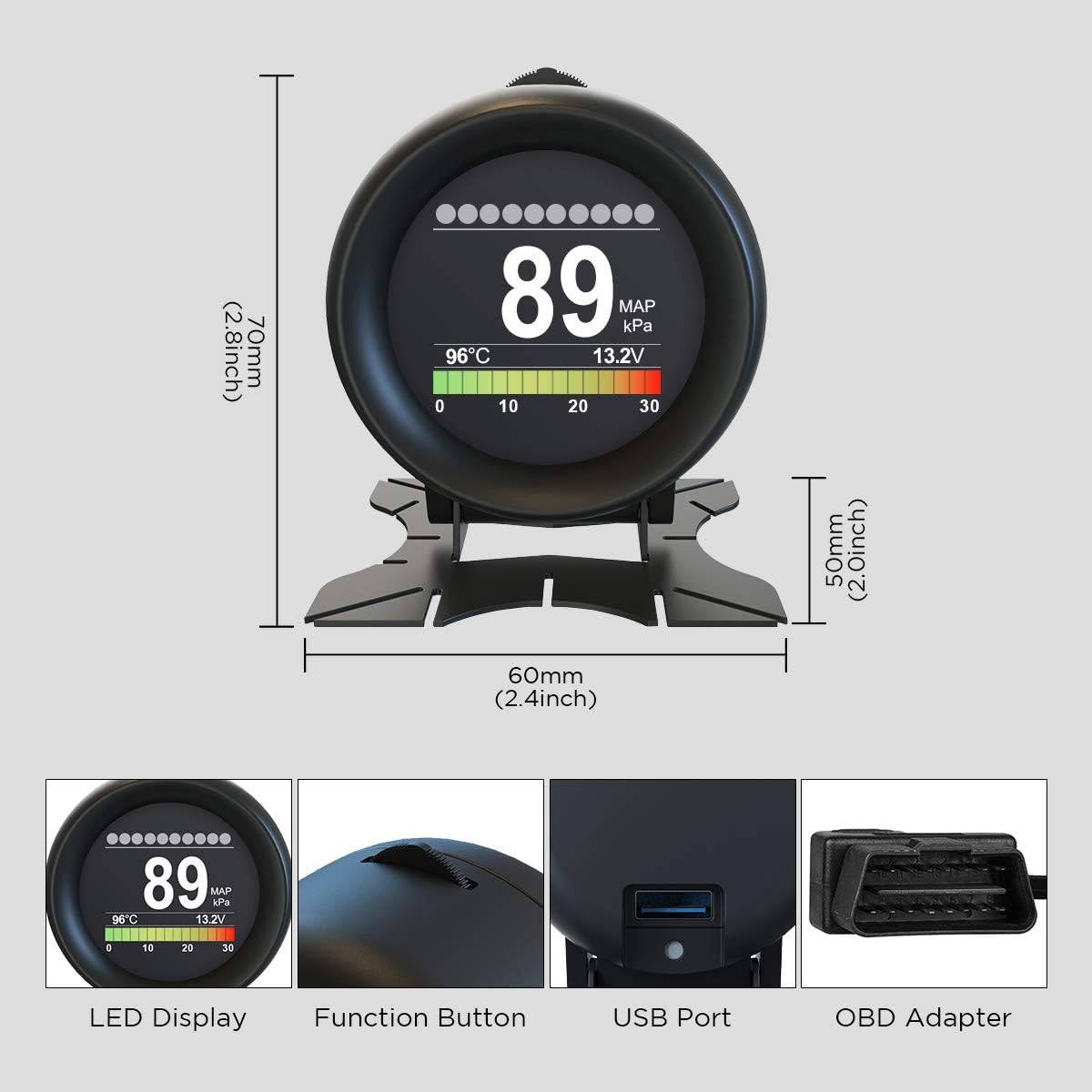
Image: Detailed view of the AUTOOL X60 showing its dimensions (70mm height, 60mm width) and key components like the LED display, function button, USB port, and OBD adapter.

Image: Diagram illustrating the pinout of a standard OBD-II connector, indicating which pins are used for various signals like SAE J1850 Bus+, Chassis, Signal Ground, CAN High/Low, and Vehicle Battery Positive.
9. Warranty and Support
For warranty information, technical support, or service inquiries, please refer to the contact details provided in your product packaging or visit the official AUTOOL website. Keep your purchase receipt as proof of purchase for warranty claims.


