
Introduction
The ThinkFun Potato Pirates is a card game designed to introduce fundamental programming concepts through engaging gameplay. Players assume the role of Potato Pirates, leading a crew of "sea-buds" on a mission to collect Potato King Cards. The game involves strategic attacks, resource management, and the application of coding logic.
This manual provides comprehensive instructions for setting up and playing the game, understanding its components, and mastering the core mechanics.

Image: Potato Pirates game logo banner.
Components
The Potato Pirates game includes the following components:
- 84 Potato Crew with storage sack (70 small puff balls, 14 big puff balls)
- 16 Ship Tokens
- 32 Action Cards
- 2 Control Cards
- 22 Surprise Cards
- 7 Potato King Cards
- Instruction Manual

Image: All game components, including cards, ship tokens, potato crew, and the instruction manual.
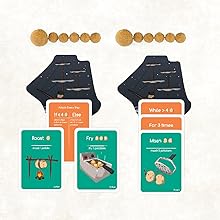
Image: Close-up of ship tokens, Potato Pirates cards, and potato crew pieces.
Setup
- Player Count: The game is designed for 3-6 players.
- Potato Crew: Place the 84 potato crew pieces (puff balls) into the storage sack.
- Ship Tokens: Each player selects a ship token and places it in front of them.
- Card Distribution:
- Shuffle the Action Cards and deal a starting hand to each player (refer to the specific rulebook for exact starting hand size based on player count).
- Shuffle the Surprise Cards and place them face down as a draw pile.
- Shuffle the Potato King Cards and place them face down as a separate draw pile.
- Keep the Control Cards accessible to all players.
- Starting Potatoes: Each player starts with a designated number of potato crew members on their ship (refer to the specific rulebook for exact starting crew size).

Image: The instruction manual, emphasizing clear instructions for setup and play.
Gameplay
The objective of Potato Pirates is to be the first player to collect all seven Potato King Cards, or to be the last player remaining with a ship and crew. Players take turns performing actions to attack opponents, manage their crew, and acquire Potato King Cards.
Turn Structure:
- Draw Phase: Draw cards from the Action Card pile.
- Action Phase: Play Action Cards from your hand to perform various maneuvers. These actions can include:
- Roast: Eliminate a specified number of potato crew from an opponent's ship.
- Mash: Eliminate a specified number of potato crew from an opponent's ship.
- Fry: Eliminate a specified number of potato crew from an opponent's ship.
- Loot: Steal cards from an enemy's hand.
- Hijack: Steal an enemy ship and its remaining crew.
- Surprise Cards: These cards introduce unexpected events or powerful effects that can alter the game state.
- Collecting Potato King Cards: When an opponent's ship is eliminated (all potato crew removed), the attacking player may acquire a Potato King Card.
Players must strategically use their Action Cards and understand the programming concepts embedded within them to effectively attack and defend.

Image: A player engaging with the game cards and components during a turn.

Image: An example of an attack sequence, demonstrating how crew members are eliminated.
Programming Concepts
Potato Pirates integrates fundamental programming concepts into its gameplay, allowing players to learn through practical application.
Key Concepts:
- Loops: Action Cards can specify actions to be repeated a certain number of times (e.g., "For 2 times, Roast 1 potato"). This introduces the concept of iteration.
- Conditionals (If/Else Statements): Control Cards and some Action Cards feature "If/Else" logic, where an action is performed only if a certain condition is met (e.g., "If < 60 potatoes, attack ships with fewer than 6 potatoes; Else, attack ships with 6 or more potatoes"). This teaches conditional execution.
- Functions: Each Action Card can be seen as a function, performing a specific task.
- Variables: The number of potatoes on a ship can be considered a variable that changes throughout the game.
By using these cards, players intuitively grasp how these programming structures work and how they can be combined for strategic advantage.
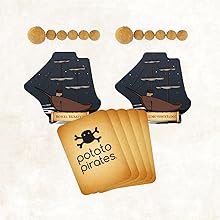
Image: Game cards demonstrating programming concepts like loops ("For x times") and actions ("Loot", "Mash").
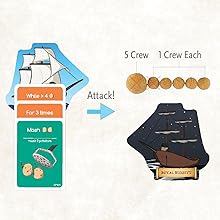
Image: Action cards illustrating various attack types and conditional logic.
Video: Official product video demonstrating Potato Pirates gameplay and programming concepts.
Maintenance
To ensure the longevity of your Potato Pirates game:
- Storage: Store all game components in their original box in a cool, dry place away from direct sunlight.
- Cleaning: Wipe cards and tokens with a dry, soft cloth if necessary. Avoid using liquids or abrasive cleaners.
- Handling: Handle cards and potato crew pieces with care to prevent bending, tearing, or loss.
Troubleshooting
If you encounter any issues while playing Potato Pirates, consider the following:
- Missing Components: Carefully check the box and packaging. If components are genuinely missing, contact ThinkFun customer support.
- Rules Clarification: Re-read the relevant sections of this instruction manual. Online resources or community forums may also offer additional insights.
- Game Flow Issues: Ensure all players understand the turn order and card effects. Sometimes a quick review of the rules can resolve misunderstandings.
Specifications
| Feature | Detail |
|---|---|
| Brand | ThinkFun |
| Model Name | Potato Pirates |
| Model Number | 44001930 |
| UPC | 019275019303 |
| Age Range | 7 and Up |
| Number of Players | 3-6 |
| Material Type | Paper |
| Educational Objective | Teach programming and problem-solving skills |
| Item Weight | 500 Grams |
| Item Dimensions (L x W x H) | 6.5 x 2 x 8 inches |
Warranty and Support
For warranty information or customer support regarding your ThinkFun Potato Pirates game, please refer to the official ThinkFun website or contact their customer service department directly. Details are typically provided on the product packaging or within the included instruction booklet.
Manufacturer: ThinkFun
Website: www.thinkfun.com (This is a generic link, please refer to the product packaging for the most accurate support information.)

