
1. Introduction
This manual provides detailed instructions for the proper use, setup, operation, and maintenance of the MeterTo HT-225 Concrete Test Hammer. The HT-225 is designed for testing the compressive strength of building concrete components, bridges, and similar structures. Adherence to these instructions will ensure accurate results and extend the lifespan of your instrument.
The HT-225 concrete test hammer complies with standards GB/T9138-1988, JJG817-93, JGJ/T23-2011, and ASTM C 805.
2. Product Overview and Key Features
The MeterTo HT-225 Concrete Test Hammer is a robust instrument built for precision and durability.
Key Features:
- The center rod is constructed from imported materials, ensuring high accuracy and durable resistance.
- The instrument's shell is made from high-grade aluminum or high polymer material, providing excellent protection against damage and extending its service life.
- The pointer slider features an external structure, allowing for balanced friction and easy adjustment to maintain instrument accuracy.
Included Components:
The HT-225 Concrete Test Hammer typically includes the main hammer unit, a carrying case, and essential accessories for operation and maintenance.
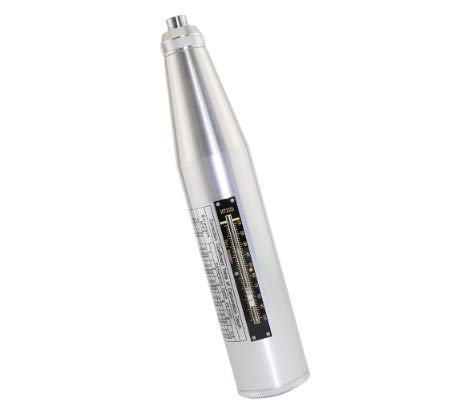
Image: The MeterTo HT-225 Concrete Test Hammer kit, neatly arranged in a durable metal carrying case. The case contains the main hammer unit, a manual, and various tools and accessories.
3. Setup
Before first use, ensure all components are present and in good condition.
Initial Inspection:
Carefully remove the test hammer and accessories from the carrying case. Inspect for any visible damage that may have occurred during transit.
Preparing the Hammer:
Ensure the pointer slider moves freely but with appropriate friction. The friction can be adjusted if necessary. Familiarize yourself with the internal components, such as the guide key.

Image: A close-up view of the internal mechanism of the HT-225 test hammer, highlighting the "Guide key" with a red arrow. This component is crucial for the hammer's operation.
Verify the dust felt ring and black rubber ring are correctly positioned on the cover cap to prevent dust ingress and ensure smooth operation.

Image: A detailed view of the exterior of the HT-225 test hammer, showing the "Dust felt ring" and "Black rubber ring on the Cover cap" indicated by red arrows. These rings are important for sealing and smooth movement.
Also, check the black rubber ring on the end cover for proper seating.

Image: A close-up of the end cover of the HT-225 test hammer, with a red arrow pointing to the "Black rubber ring on the End cover." This ring helps secure the cover and protect internal components.
4. Operating Instructions
Performing a Test:
- Select a representative test area on the concrete surface. The surface should be smooth, clean, and dry.
- Hold the test hammer firmly, perpendicular to the test surface.
- Slowly press the hammer against the concrete surface. The internal mechanism will engage.
- Continue pressing until the hammer impacts the surface. A distinct click will indicate the impact.
- Read the rebound value indicated by the pointer on the scale.
- Record the reading. Repeat the test at several points within the test area (typically 9-12 impacts) to obtain an average value.
Interpreting Results:
The rebound value obtained from the test hammer correlates to the compressive strength of the concrete. Refer to the provided conversion chart (usually found in a separate document or on the device itself) to convert the rebound number into compressive strength (Mpa).
The test range for this device is 10~60Mpa.
5. Maintenance
Cleaning:
After each use, wipe the test hammer clean with a soft, dry cloth. Ensure no concrete dust or debris remains on the impact rod or inside the mechanism.
Lubrication:
Periodically, apply a small amount of light machine oil to the moving parts of the hammer, particularly the guide key and impact rod, to ensure smooth operation.

Image: A close-up view of the internal mechanism of the HT-225 test hammer, again highlighting the "Guide key" with a red arrow. Regular cleaning and lubrication of this area are essential for accurate readings.
Storage:
Store the HT-225 Concrete Test Hammer in its original carrying case in a dry, clean environment when not in use. Avoid extreme temperatures and humidity.
Calibration:
For optimal accuracy, it is recommended to have the instrument calibrated by a qualified service center annually or after significant impact. The average rebound value on a steel anvil should be 80±2.
6. Troubleshooting
Inaccurate Readings:
- Ensure the test surface is clean, smooth, and dry.
- Verify the hammer is held perpendicular to the surface during impact.
- Check for excessive friction or sticking in the pointer slider mechanism. Adjust if necessary.
- Consider recalibration if discrepancies persist.
Hammer Not Impacting:
- Ensure sufficient pressure is applied to engage the impact mechanism.
- Check for obstructions or debris within the hammer's internal components.
Pointer Not Resetting:
- Inspect the pointer slider for any physical damage or excessive friction.
- Clean and lubricate the internal mechanism.
7. Specifications
| Parameter | Value |
|---|---|
| Test Range | 10~60Mpa |
| Standard Impact Energy | 2.207J (0.225Kgf.m) |
| Stroke of Rebound Hammer | 75mm |
| Friction of Pointer Slider | 0.5N~0.8N |
| Sphere Radius of Rebound Pole SR | 25mm±1mm |
| Average Rebound Value on Steel Anvil Rm | 80±2 |
| Size | Φ54*278mm |
| Weight | ≈1KG (2.2 pounds) |
8. Warranty and Support
MeterTo products are designed for quality and reliability. For specific warranty information, please refer to the documentation included with your purchase or contact MeterTo customer support.
For technical assistance, troubleshooting, or service inquiries, please contact MeterTo directly. Ensure you have your product model (HT-225) and purchase details available.
The manufacturer of this product is MeterTo.