
1. Introduction
This manual provides essential information for the proper use, setup, and maintenance of the BD Nexiva Closed IV Catheter System. This system is designed for vascular access and fluid administration, intended for use by trained healthcare professionals.
Product Features:
- Clinically demonstrated to enable longer dwell times and preserve sites for extended periods.
- Features a built-in stabilization platform to minimize movement and reduce accidental dislodgement, thereby reducing catheter complications and associated costs.
2. Components
The BD Nexiva Closed IV Catheter System includes the following primary components:
- IV Catheter (22 G x 1.00 inch / 1.1 mm x 25 mm)
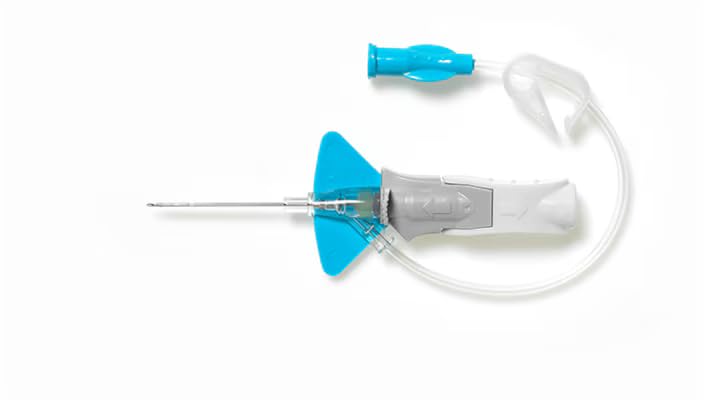
Figure 1: Overview of the BD Nexiva Closed IV Catheter System. The image displays the catheter needle, the blue stabilization wings, the grey and white catheter hub, and the clear tubing leading to a blue luer lock connector.
3. Setup Instructions
Proper setup is crucial for patient safety and effective operation. Always follow aseptic techniques and institutional protocols.
- Preparation: Ensure all necessary supplies are available and within their sterile packaging. Verify product integrity before use.
- Site Selection: Choose an appropriate venipuncture site according to clinical guidelines.
- Skin Preparation: Cleanse the insertion site thoroughly with an antiseptic solution as per institutional protocol. Allow to air dry completely.
- System Inspection: Before opening the sterile package, inspect the catheter system for any damage or defects. Do not use if the package is compromised.
- Opening Package: Open the sterile package carefully, maintaining sterility of the catheter system.
- Priming (if applicable): If the system requires priming, follow standard clinical procedures to remove air from the line.
Note: This device is intended for use by trained healthcare professionals. Refer to your institution's specific protocols and guidelines for detailed insertion procedures.
4. Operating Procedures
The BD Nexiva Closed IV Catheter System is designed for single-use only. Do not re-sterilize or reuse.
- Insertion: Perform venipuncture according to standard clinical practice. Advance the catheter into the vein.
- Needle Retraction: Activate the safety mechanism to retract the needle immediately after successful venipuncture, as per device instructions. Ensure the needle is fully and irreversibly locked within the protective housing.
- Stabilization: Utilize the built-in stabilization platform to secure the catheter at the insertion site, minimizing movement.
- Connection: Connect the appropriate IV administration set or extension set to the catheter hub using a luer lock connection.
- Flushing: Flush the catheter with an appropriate solution to confirm patency and remove any residual blood.
- Dressing: Apply a sterile, transparent dressing over the insertion site and catheter hub to secure the device and protect the site.
Caution: Improper insertion or handling can lead to complications such as phlebitis, infiltration, or infection. Always adhere to universal precautions and bloodborne pathogen safety guidelines.
5. Maintenance and Care
Proper maintenance of the insertion site and catheter is essential to prevent complications and ensure patient safety.
- Site Assessment: Regularly inspect the insertion site for signs of infection (redness, swelling, pain, pus), phlebitis, or infiltration.
- Dressing Changes: Change the sterile dressing according to institutional policy, typically every 5-7 days or immediately if it becomes soiled, loose, or damp.
- Flushing: Flush the catheter regularly with an appropriate solution (e.g., saline) to maintain patency and prevent clot formation, as per clinical guidelines.
- Securement: Ensure the catheter remains securely stabilized to prevent accidental dislodgement.
- Disconnection: When disconnecting administration sets, always use aseptic technique and cap the catheter hub with a sterile luer lock cap.
Disposal:
Dispose of the used catheter system and all associated materials in an approved sharps container immediately after use, following all local, state, and federal regulations for biohazardous waste.
6. Troubleshooting
This section addresses common issues that may arise during the use of the BD Nexiva Closed IV Catheter System. Always consult a healthcare professional for guidance.
| Problem | Possible Cause | Solution |
|---|---|---|
| Inability to flush catheter | Occlusion (e.g., blood clot), catheter kink, or tip against vessel wall. | Do not force flush. Assess for kinks. Reposition patient's arm. If occlusion persists, consider catheter removal and replacement by a qualified professional. |
| Pain or swelling at insertion site | Infiltration, phlebitis, or infection. | Discontinue infusion immediately. Remove catheter. Apply warm or cold compress as indicated. Elevate extremity. Notify healthcare provider. |
| Catheter dislodgement | Insufficient securement, patient movement, or accidental pull. | Remove catheter. Re-establish IV access at a new site if needed. Ensure proper securement techniques are used for new insertion. |
7. Product Specifications
| Attribute | Detail |
|---|---|
| Model Number | 383512 |
| Catheter Gauge | 22 G |
| Catheter Length | 1.00 inch (25 mm) |
| Catheter Diameter | 1.1 mm |
| System Type | Closed IV Catheter System, Single Port |
| Manufacturer | BD |
| ASIN | B07G79H93V |
| Country of Origin | USA |
| Package Dimensions | 6.3 x 6 x 6 inches |
| Package Weight | 12.17 ounces |
8. Warranty and Support
For product inquiries, technical support, or to report adverse events, please contact the manufacturer directly.
Manufacturer: BD
Contact Number: 844-823-5433
Website: Visit the BD Store on Amazon
Please retain your purchase records for any warranty claims or product inquiries.
