1. Introduction
The D'Addario String Height Gauge is a versatile tool designed for precise measurement of various critical parameters on stringed instruments. Constructed from durable stainless steel, it assists in accurately assessing string height, pickup height, fret height, and neck relief, facilitating optimal instrument setup.
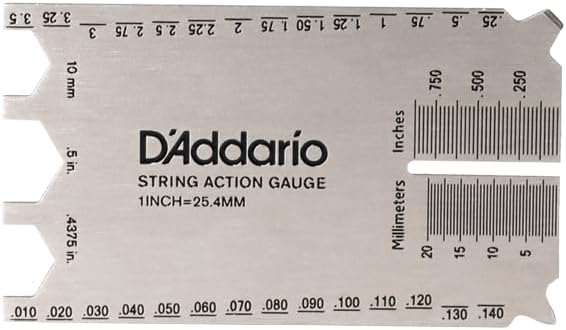
Figure 1: Front view of the D'Addario String Height Gauge, displaying various imperial and metric measurement scales.
2. Key Features
- US and metric sizes for universal compatibility.
- Stainless steel construction for durability and longevity.
- Accurate markings for precise instrument setup.
3. Setup and Operation
The String Height Gauge features multiple scales on both sides for comprehensive measurements. Familiarize yourself with the different scales before use.
3.1. Measuring String Height
String height, also known as action, is the distance between the bottom of the string and the top of the fret. Proper string height is crucial for playability and tone.
- Place the gauge perpendicular to the strings, resting its edge on the fretboard at the desired measurement point (e.g., 12th fret).
- Read the measurement on the appropriate scale (inches or millimeters) where the bottom of the string aligns with a line on the gauge.
- Refer to the recommended string action guidelines provided on the gauge for electric, acoustic, and bass guitars.

Figure 2: Measuring string height at the 12th fret using the gauge.
3.2. Measuring Pickup Height
Pickup height affects the output volume and tone of your instrument. Adjusting it can significantly alter your sound.
- Hold the gauge vertically, resting its base on the top of the pickup pole piece.
- Read the measurement on the appropriate scale where the bottom of the string aligns with a line on the gauge.
- Adjust pickup screws to raise or lower the pickup as needed.

Figure 3: Using the gauge to measure the distance between the string and the pickup.
3.3. Measuring Fret Height and Wear
Consistent fret height is essential for preventing buzzing and ensuring smooth playability. The notched edge of the gauge allows for quick assessment of fret height and wear.
- Place the notched edge of the gauge directly over a fret.
- Identify the notch that most closely matches the fret's height. The corresponding number indicates the fret height in thousandths of an inch or millimeters.
- Use this to identify uneven frets or excessive fret wear.

Figure 4: Measuring fret height using the notched side of the gauge.
3.4. Checking Neck Relief
Neck relief is the slight forward bow in the neck of a stringed instrument. It is typically measured at the 6th fret while holding down the 1st and 12th frets.
- Place a capo at the 1st fret and hold down the 6th string at the 12th fret.
- Use the gauge to measure the gap between the bottom of the 6th string and the top of the 6th fret.
- Compare this measurement to recommended specifications for your instrument type.
3.5. Measuring Nut Slot Height
The nut slot height is critical for comfortable playability in the lower positions and for accurate intonation.
- Place the gauge on the fretboard just past the nut.
- Measure the distance from the bottom of the string to the top of the first fret.
- The gauge provides specific markings for nut slot height.
3.6. Video Demonstrations
Video 1: Demonstration of a String Action Gauge Ruler for various string instruments, highlighting imperial and metric measurements and fret crown height. (Source: Msuhettu Direct)
Video 2: Overview of a String Action Ruler Gauge Tool, demonstrating its use for measuring string height and pickup height. (Source: Co-link store)
Video 3: FretGuru String Action Gauge demonstration, showcasing its features for precise guitar setup measurements. (Source: Merchant Video)
Video 4: Dunlop System 65 Action Gauge in use, demonstrating how to measure string action on a guitar. (Source: Jim Dunlop)
Video 5: Official D'Addario product video showcasing the String Height Gauge (PW-SHG-01) and its applications. (Source: Merchant Video)
4. Maintenance
The D'Addario String Height Gauge is constructed from durable stainless steel. To ensure longevity and accuracy, wipe the gauge clean with a soft, dry cloth after each use. Avoid abrasive cleaners or materials that could scratch the etched markings. Store in a protective sleeve or case to prevent damage.
5. Troubleshooting
- Inaccurate Readings: Ensure the gauge is placed flat against the fretboard or bridge. Verify that the instrument's strings are properly tuned and that the neck relief is correctly set before taking measurements.
- Sharp Edges: The gauge features precisely machined edges. Handle with care to avoid scratching instrument surfaces. Consider gently dulling sharp corners with very fine grit sandpaper if preferred, though this may affect measurement precision if not done carefully.
6. Specifications
| Attribute | Value |
|---|---|
| Item Weight | 0.896 ounces (25.4 g) |
| Product Dimensions | 3.75 x 0.1 x 6.93 inches |
| Material Type | Stainless Steel |
| Color | Black |
| Model Number | PW-SHG-01 |
7. Warranty and Support
For warranty information or product support, please refer to the official D'Addario website or contact their customer service directly.


