
TRUPOW TP01813
TRUPOW 3/4" NPT 110V Hot Water 3-Speed Circulation Pump User Manual
Model: TP01813
Product Overview
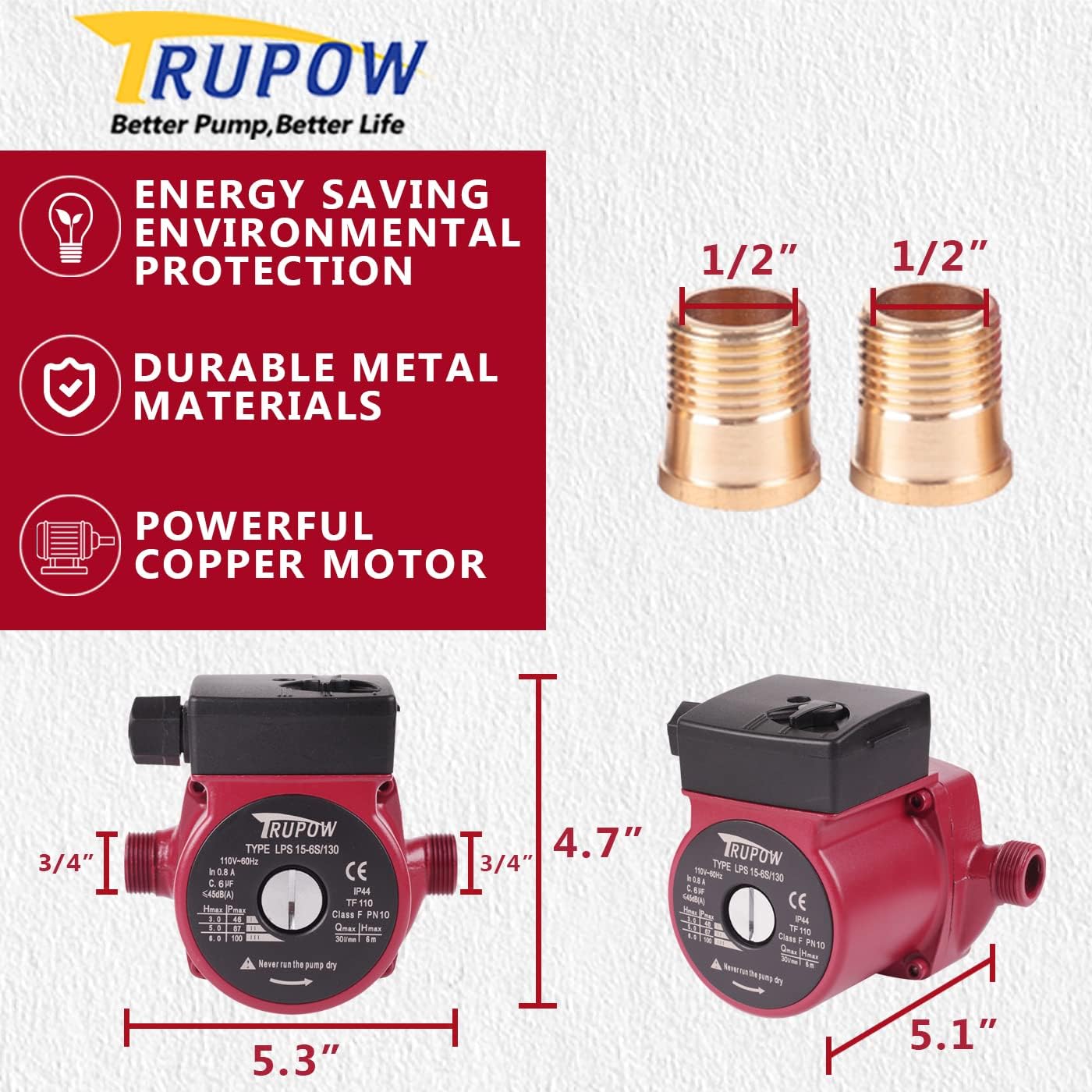
The TRUPOW 3/4" NPT 110V Hot Water 3-Speed Circulation Pump is designed for efficient and quiet circulation of hot water in various domestic and industrial applications. This pump features a robust cast iron body, an aluminum housing, and a copper motor, ensuring durability and reliable performance.
Key features include:
- 3/4" NPT outlet for standard plumbing connections.
- Operates on 110-120V/60Hz power supply.
- Three adjustable speeds with rated power of 100/67/46W.
- Maximum flow rate of 30 L/min (approximately 7.92 GPM).
- Maximum head of 6.0 meters (approximately 20 feet).
- Suitable for liquid temperatures ranging from 0°F to +212°F.
- Designed for low noise operation and environmental protection.

Safety Information
Please read all safety instructions carefully before installation and operation to prevent injury or damage. Failure to follow these instructions may result in electric shock, fire, or serious injury.
- Always disconnect power before servicing or installing the pump.
- Installation should be performed by a qualified professional in accordance with local plumbing and electrical codes.
- Ensure the pump is properly grounded to prevent electrical hazards.
- Do not operate the pump dry. Running the pump without liquid will cause damage.
- Protect the pump from freezing temperatures.
- Do not use this pump for flammable or corrosive liquids. It is designed for hot water circulation only.
- Keep children and unauthorized persons away from the pump during operation.
Product Specifications
| Specification | Value |
|---|---|
| Model Number | TP01813 |
| Voltage | 110-120V / 60Hz |
| Rated Power | 100W / 67W / 46W (3-speed) |
| Max Flow Rate | 30 L/min (7.92 GPM) |
| Max Head | 6.0 m (20 ft) |
| Liquid Temperature Range | 0°F to +212°F (0°C to +100°C) |
| Outlet Size | 3/4" NPT |
| Pump Body Material | Cast Iron |
| Pump Housing Material | Aluminium |
| Impeller Material | PP (Polypropylene) |
| Motor Wire | Copper |
| Shaft Material | Ceramic |
| Bearing Material | China (Ceramic) |
| Product Dimensions (L x W x H) | 5.1" x 5.3" x 4.7" |
| Item Weight | 5.3 Pounds |

Installation Instructions
Proper installation is crucial for the pump's performance and longevity. It is recommended that installation be carried out by a qualified plumber or technician.
1. Pre-Installation Checklist:
- Ensure the power supply matches the pump's requirements (110-120V/60Hz).
- Verify that the piping system is clean and free of debris.
- Have appropriate tools and sealing materials (e.g., thread sealant tape) ready.
- Confirm the installation location allows for proper ventilation and access for maintenance.
2. Mounting the Pump:
- Choose a stable and level surface for mounting. The pump can be installed horizontally or vertically, but ensure the motor housing is not below the pump body to prevent water ingress.
- Connect the pump to the hot water circulation line using the provided 3/4" NPT fittings. Apply thread sealant to ensure a watertight connection.
- Ensure the flow direction arrow on the pump body aligns with the desired water flow in your system.
3. Electrical Connection:
- Connect the pump's power cord to a grounded 110-120V/60Hz electrical outlet.
- Ensure all electrical connections are secure and protected from moisture.
4. Priming the Pump:
Before initial operation, it is essential to prime the pump to remove any trapped air. This prevents dry running and potential damage.
- Open all valves in the circulation system to allow water to fill the pump and piping.
- Locate the bleed screw on the pump housing (if present) and slowly open it until a steady stream of water, free of air bubbles, emerges.
- Close the bleed screw tightly.

Operating Instructions
Once installed and primed, the pump is ready for operation.
1. Powering On:
Plug the pump into a suitable electrical outlet. The pump will begin operating at its current speed setting.
2. Adjusting Speed:
The TRUPOW circulation pump features a three-speed control switch located on the motor housing. Rotate the switch to select the desired speed setting (I, II, or III) based on your system's flow requirements. Speed I is the lowest power/flow, and Speed III is the highest.
- Speed I: 46W (Lowest power, lowest flow)
- Speed II: 67W (Medium power, medium flow)
- Speed III: 100W (Highest power, highest flow)

3. Continuous Operation:
The pump is designed for continuous operation within its specified temperature and pressure limits. Monitor the system for any unusual noises or leaks during initial operation.
Maintenance
Regular maintenance helps ensure the longevity and efficient operation of your TRUPOW circulation pump.
1. Routine Checks:
- Periodically inspect the pump for any signs of leaks around the connections. Tighten fittings if necessary.
- Listen for unusual noises during operation, which could indicate air in the system or a mechanical issue.
- Ensure the pump motor is not excessively hot to the touch.
2. Cleaning:
- Keep the exterior of the pump clean and free of dust and debris to ensure proper heat dissipation.
- Do not use harsh chemicals or abrasive cleaners on the pump.
3. Winterization (if applicable):
- If the pump is installed in an area prone to freezing temperatures and will not be used, drain the system to prevent water from freezing inside the pump, which can cause severe damage.
Troubleshooting
This section provides solutions to common issues you might encounter with your circulation pump.
| Problem | Possible Cause | Solution |
|---|---|---|
| Pump does not start | No power supply; Motor seized; Electrical fault. | Check power connection and circuit breaker. Ensure pump is not dry. If motor is seized, contact support. |
| Low flow or no circulation | Air in the system; Clogged impeller; Incorrect speed setting; Closed valves. | Bleed air from the pump. Check for obstructions in the impeller. Adjust speed setting. Ensure all necessary valves are open. |
| Pump is noisy | Air in the system; Cavitation; Loose mounting; Foreign object in pump. | Bleed air from the pump. Ensure adequate water supply. Check mounting bolts. Inspect impeller for debris (disconnect power first). |
| Water leakage | Loose connections; Damaged seals/gaskets. | Tighten pipe connections. Inspect and replace damaged seals or gaskets. |
| Pump runs hot | Dry running; Insufficient ventilation; Motor overload. | Ensure pump is fully primed and has constant water supply. Check for proper ventilation around the motor. Verify correct voltage. |
If you encounter issues not listed here or if the suggested solutions do not resolve the problem, please contact TRUPOW customer support.
Warranty and Support
TRUPOW products are manufactured to high-quality standards. For warranty information or technical support, please refer to the contact details provided with your purchase or visit the official TRUPOW website.
When contacting support, please have your product model number (TP01813) and purchase date available.
For additional resources and product information, you may visit the TRUPOW Store on Amazon.
Ask a question about this manual
Ask about setup, troubleshooting, compatibility, parts, safety, or missing instructions. Manuals+ will review the question and use this page’s manual context to help answer it.