

1. Introduction
This technical manual, published by ETAI, provides comprehensive information for the maintenance, repair, and diagnosis of the Mini II Phase 2 (R56) models, specifically those equipped with 1.6D 90 and 112ch engines manufactured between 2010 and 2013. It is designed for both professional technicians and informed enthusiasts.

This image shows a page from the manual detailing the content structure, explaining what each major section (Vehicle Presentation, Maintenance, Repair Methods, Diagnostics, Bodywork, Technical Data) covers.
1.1. Important Notices and Precautions
Before undertaking any work on your vehicle, it is crucial to read and understand all safety warnings and operational guidelines provided in this manual. Always use appropriate tools and personal protective equipment. Disconnect the battery before working on electrical components.
1.2. Scope of This Manual (RTA vs MTA)
This RTA (Revue Technique Automobile) provides detailed, practical information for common maintenance and repair operations. It is distinct from an MTA (Méthode Technique Automobile), which offers more in-depth, specialized procedures often requiring advanced diagnostic tools and specific manufacturer data. The RTA focuses on common tasks that can be performed by a wide range of users.

This image illustrates the distinction between RTA (Revue Technique Automobile) and MTA (Méthode Technique Automobile) manuals, highlighting their respective levels of detail and target audiences.
1.3. Evolution of RTA Manuals
Since 1946, ETAI has published various versions of its technical manuals. This particular RTA represents the modern, full-color version introduced since 2015, designed for clarity and ease of use. Earlier versions included 'L'original' and 'Le classique', each with different presentation styles and content organization.
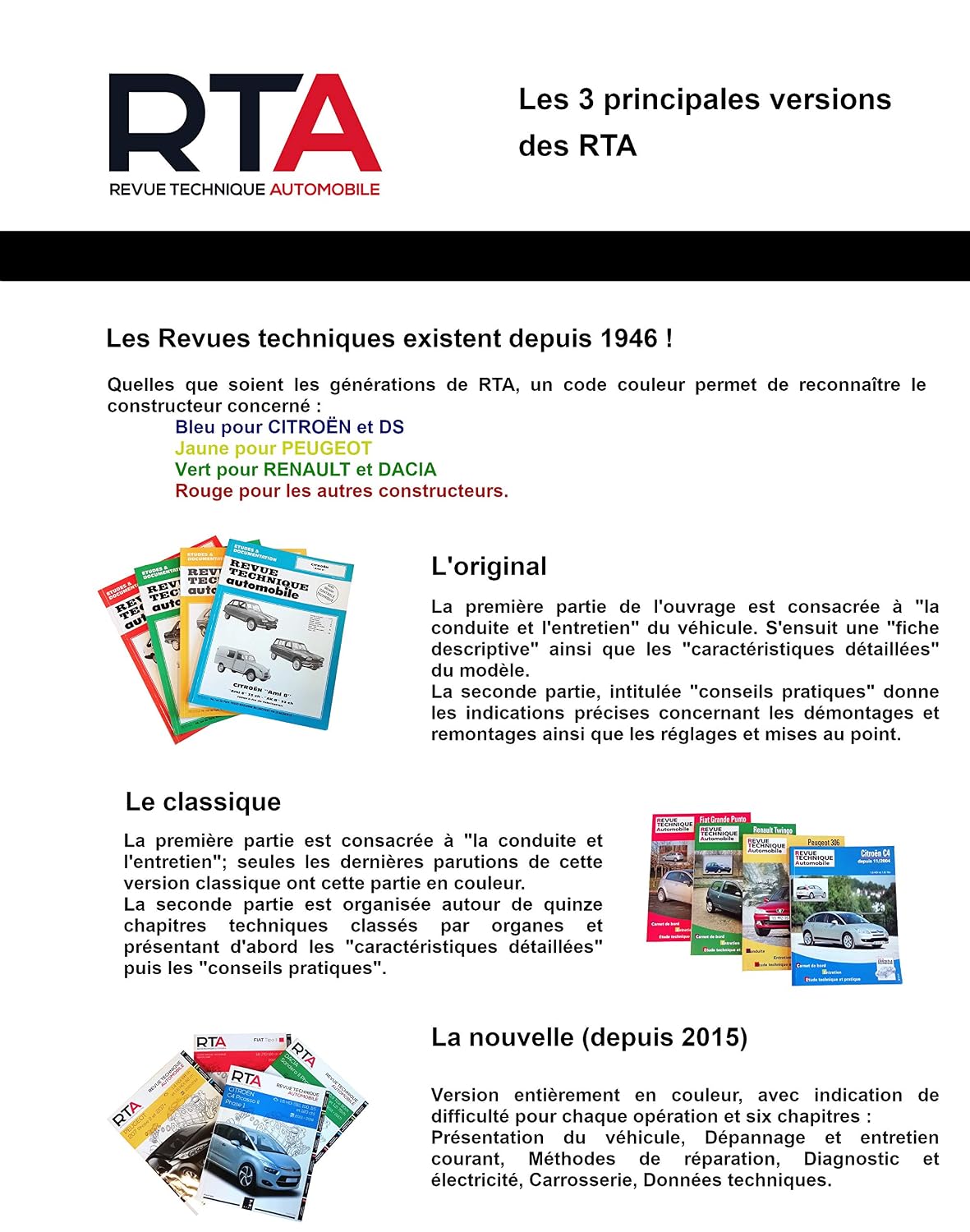
This image displays the evolution of RTA manuals, showing examples of 'L'original', 'Le classique', and 'La nouvelle (depuis 2015)' versions.
2. Vehicle Presentation
This section provides essential information for identifying your Mini II Phase 2 (R56) and understanding the layout of its main components.
2.1. Vehicle Identification
Learn how to locate and interpret your vehicle's identification number (VIN) and other key identifiers necessary for parts ordering and service records.
2.2. Component Identification
Detailed diagrams and descriptions help you identify major components and systems within the vehicle, including engine bay layout, interior controls, and undercarriage elements.
3. Current Maintenance and Troubleshooting
This section covers routine maintenance procedures and initial troubleshooting steps for common issues.
3.1. Access and Lifting
Instructions for safely accessing various parts of the vehicle and proper lifting points for jacking and stands.
3.2. General Troubleshooting
Guidance on diagnosing common problems before resorting to complex repairs, including checks for fluid leaks, unusual noises, and warning lights.
3.3. Checks and Fluid Levels
Procedures for checking and topping up essential fluids such as engine oil, coolant, brake fluid, power steering fluid, and windshield washer fluid.
3.4. Battery and Disassembly
Instructions for battery inspection, testing, removal, and reinstallation, including safety precautions.
3.5. Exterior Lighting
Maintenance and replacement procedures for headlights, taillights, turn signals, and other exterior lighting components.
3.6. Maintenance Schedule
Recommended service intervals for various components and systems to ensure optimal vehicle performance and longevity.
3.7. Visibility and Comfort Systems
Maintenance for windshield wipers, washers, and interior comfort features.
3.8. Engine Protection
Tips and procedures for protecting the engine from wear and tear, including air filter replacement and general cleanliness.
3.9. Brake Maintenance
Basic inspection and maintenance procedures for the braking system, including pad wear checks and fluid level monitoring.
4. Detailed Repair Methods
This section provides step-by-step instructions for more complex repair procedures.
4.1. Draining, Filling, and Bleeding
Procedures for draining and refilling various fluids, including engine oil, transmission fluid, and coolant, along with bleeding air from hydraulic systems.
4.2. Charging and Starting Systems
Detailed repair and testing procedures for the alternator, starter motor, and associated wiring.
4.3. Engine
Comprehensive repair guides for engine components, including cylinder head, block, and internal parts.
4.4. Engine Lubrication and Cooling
Repair and maintenance of the oil pump, oil cooler, radiator, water pump, and thermostat.
4.5. Fuel Systems and Emissions Control
Procedures for fuel injectors, fuel pump, fuel lines, and emission control components like the DPF and EGR system.
4.6. Gearbox and Clutch
Removal, inspection, repair, and reinstallation of manual and automatic gearboxes, as well as clutch components.
4.7. Transmission
Maintenance and repair of drive shafts, universal joints, and differential components.
4.8. Steering, Suspension, and Wheel Alignment
Procedures for steering rack, power steering pump, shock absorbers, springs, control arms, and basic wheel alignment checks.
4.9. Braking System
Detailed repair of brake calipers, discs, drums, master cylinder, and brake lines, including bleeding procedures.
4.10. Heating and Air Conditioning
Repair and maintenance of HVAC components, including the blower motor, evaporator, condenser, and refrigerant system.
5. Diagnostics and Electrical Systems
This section focuses on electrical troubleshooting and diagnostic procedures.
5.1. General Diagnostics
Methods for using diagnostic tools and interpreting fault codes to identify electrical and electronic system issues.
5.2. Electrical Protection
Information on fuses, relays, and circuit breakers, including their location and replacement procedures.
5.3. Engine Management (N47C16A)
Specific diagnostic and repair information for the N47C16A engine management system, including sensors and actuators.
5.4. Anti-Theft System
Overview and troubleshooting for the vehicle's anti-theft and immobilizer systems.
5.5. Anti-lock Braking System (ABS) and Stability Control
Diagnostic and repair procedures for ABS and DSC (Dynamic Stability Control) systems, including sensors and control units.
5.6. Power Steering
Troubleshooting and repair of the electric power steering system.
5.7. Airbags and Pretensioners
Safety guidelines and diagnostic procedures for the Supplemental Restraint System (SRS), including airbags and seatbelt pretensioners.
5.8. Automatic Climate Control
Diagnostic and repair information for the automatic climate control system, including sensors, actuators, and control modules.
6. Bodywork
This section provides information on the repair and maintenance of the vehicle's body structure and exterior components.
6.1. Underbody Protection
Inspection and repair of underbody panels and protective coatings.
6.2. Bumpers
Removal, installation, and repair of front and rear bumper assemblies.
6.3. Optics (Lights)
Detailed procedures for removing and installing exterior light assemblies, including headlights and taillights.
6.4. Trims
Removal and installation of interior and exterior trim pieces.
6.5. Airbags (Bodywork related)
Information on airbag module locations within the body structure and safe handling procedures.
6.6. Removable Parts
Procedures for removing and installing various removable body components.
6.7. Glazing, Mechanisms, and Locks
Repair and replacement of windows, window regulators, door locks, and central locking systems.
6.8. Bonded Elements
Information on body components that are bonded rather than bolted or welded, and their specific repair considerations.
6.9. Welded Elements
Guidance on structural body components that are welded, and considerations for their repair or replacement.
6.10. Bodywork Checks
Procedures for inspecting the body for damage, alignment issues, and corrosion.
7. Technical Data and Specifications
This section provides detailed technical specifications and data for the Mini II Phase 2 (R56).

This image displays the internal table of contents of the manual, outlining all major sections and their respective sub-sections, providing a detailed overview of the manual's content organization.
7.1. Precautions and Capacities
Important precautions related to fluid handling and specified capacities for various systems (e.g., oil, coolant, fuel tank).
7.2. Electrical Equipment Specifications
Detailed specifications for electrical components, including fuse ratings, bulb types, and battery specifications.
7.3. Engine Specifications
Technical data for the 1.6D 90 and 112ch engines, including bore, stroke, compression ratio, and power output.
7.4. Engine Lubrication and Cooling Specifications
Specifications for engine oil types, coolant types, and system pressures.
7.5. Fuel Systems and Emissions Control Specifications
Data related to fuel pressure, injector specifications, and emission standards compliance.
7.6. Gearbox and Clutch Specifications
Specifications for transmission fluid types, gear ratios, and clutch dimensions.
7.7. Transmission Specifications
Technical data for drive shafts and differential components.
7.8. Steering, Suspension, and Wheel Alignment Specifications
Alignment angles, torque specifications for suspension components, and steering system data.
7.9. Braking System Specifications
Brake disc and pad dimensions, fluid specifications, and torque values for brake components.
7.10. Bodywork Specifications
Dimensions, panel gaps, and material specifications for body components.
7.11. Covered Engine Models
This RTA specifically covers the following diesel engine models:

This image displays a page from the manual that explicitly lists the diesel engine models covered by this specific RTA, including their power output and engine codes.
- 1.6D112 16V TURBO (82KW) - N47C16A - M 6
- 1.6D90 TURBO (66KW) - N47C16A - M 6
7.12. General Product Specifications
| Specification | Value |
|---|---|
| ASIN | B01LX3IFN3 |
| Publisher | ETAI |
| Publication Date | October 1, 2017 |
| Language | French |
| ISBN-13 | 979-1028306144 |
| Item Weight | 12.7 ounces |
| Dimensions | 8.27 x 0.39 x 10.63 inches |
8. Warranty and Support
For information regarding product warranty or technical support, please refer to the publisher's official website or contact their customer service directly. This manual does not include specific warranty details for the vehicle itself, only for the publication.
For further assistance or inquiries, please visit the ETAI official website or consult an authorized Mini service center.