
ICOM IC-7300
ICOM IC-7300 Direct Sampling Shortwave Radio User Manual
Model: IC-7300
Introduction
This manual provides essential instructions for the safe and efficient operation of your ICOM IC-7300 Direct Sampling Shortwave Radio. Please read this manual thoroughly before using the transceiver to ensure proper functionality and to prevent damage.
The ICOM IC-7300 is a high-performance HF/50MHz transceiver featuring RF direct sampling technology. It includes a 4.3-inch color touchscreen LCD, a real-time spectrum scope, and a built-in automatic antenna tuner. It supports various modes including SSB, CW, RTTY, AM, and FM, with a maximum output power of 100 Watts.
Safety Information
- Do not operate the transceiver in explosive atmospheres.
- Ensure proper grounding to prevent electric shock.
- Avoid exposing the unit to direct sunlight, rain, or extreme temperatures.
- Use only the specified power supply (13.8V DC).
- Do not open the transceiver casing; refer servicing to qualified personnel.
Package Contents
Verify that all items are present in the package:
- ICOM IC-7300 Radio Unit
- HM-219 Hand Microphone
- DC Power Cable
- Installation Hardware
- User Manual (this document)
Setup
1. Connecting the Power Supply
Connect the supplied DC power cable to the transceiver's DC IN connector and to a stable 13.8V DC power source. Ensure correct polarity (red to positive, black to negative) to prevent damage.
2. Connecting the Antenna
Connect a suitable HF/50MHz antenna to the ANT connector on the rear panel. For optimal performance and to protect the transceiver, use an antenna designed for the operating frequencies and ensure it is properly matched.
3. Connecting the Microphone
Plug the HM-219 hand microphone into the MIC connector on the front panel.
4. Initial Power On
Press the POWER button to turn on the transceiver. The ICOM logo will appear on the display, followed by the operating screen.

Image: Front panel of the ICOM IC-7300, displaying the main operating screen with frequency, mode, and spectrum scope.
Operating Instructions
Basic Operation
- Frequency Selection: Use the large MULTI dial to change the operating frequency. You can also directly input frequencies using the touchscreen keypad.
- Mode Selection: Tap the mode indicator on the touchscreen (e.g., USB, LSB) to cycle through available modes (SSB, CW, RTTY, AM, FM).
- Volume Adjustment: Use the AF/RF/SQL knob to adjust the audio output level.
- Transmitting: Press the TRANSMIT button or the PTT button on the microphone to transmit. Ensure your antenna is tuned before transmitting.
Using the Touchscreen Display
The 4.3-inch color touchscreen provides intuitive access to various functions and settings.
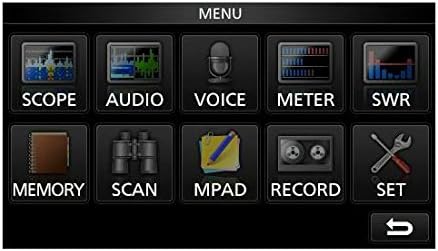
Image: The main menu screen of the IC-7300, accessible via the touchscreen, showing various function icons.
- Spectrum Scope: Tap SCOPE to view the real-time spectrum scope, which displays signal activity across a selected frequency range.
- Meter Display: Tap METER to view various operational parameters such as output power, ALC, SWR, and voltage.
- Settings: Tap SET to access detailed configuration options for the transceiver.
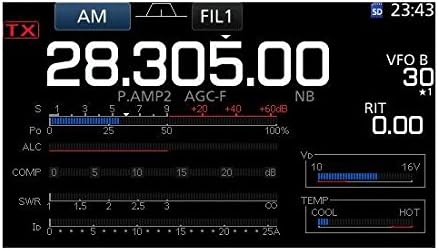
Image: A detailed view of the IC-7300's display in AM mode, showing frequency, filter settings, and various operational meters.
Built-in Auto Tuner
The IC-7300 includes an internal automatic antenna tuner. To activate, press the AUTO TUNE button. The tuner will automatically adjust to achieve the lowest possible SWR for your connected antenna. This function is effective for SWR values up to approximately 3:1.
Maintenance
- Cleaning: Use a soft, dry cloth to clean the exterior of the transceiver. Do not use abrasive cleaners or solvents.
- Ventilation: Ensure the ventilation holes on the top and sides of the unit are not obstructed to prevent overheating.
- Storage: When not in use for extended periods, store the transceiver in a dry, dust-free environment.
Troubleshooting
| Problem | Possible Cause | Solution |
|---|---|---|
| No power | Power cable disconnected; incorrect voltage; blown fuse. | Check power cable connections; verify 13.8V DC supply; inspect and replace fuse if necessary. |
| No audio output | Volume too low; speaker/headphone disconnected; squelch set too high. | Adjust AF/RF/SQL knob; check speaker/headphone connection; reduce squelch level. |
| Cannot transmit | Antenna not connected; high SWR; PTT button not pressed. | Connect antenna; use auto tuner or external tuner to reduce SWR; ensure PTT is engaged. |
| Poor reception | Antenna issue; incorrect mode/frequency; high noise level. | Check antenna connection and type; verify operating mode and frequency; adjust noise reduction (NB, NR) settings. |
Specifications
| Feature | Detail |
|---|---|
| Model Number | IC-7300 |
| Frequency Range (RX) | 0.030 - 74.800 MHz |
| Output Power | 100 W (SSB, CW, RTTY, FM); 25 W (AM) |
| Receiver Type | Direct Sampling |
| Number of Channels | 101 |
| Power Supply Voltage | 13.8 V DC (±15%) |
| Dimensions (W×H×D) | 9.4 x 3.7 x 9.4 inches (240 × 94 × 238 mm) |
| Weight | 8.4 pounds (3.8 kg) |
| Special Features | 4.3-inch Color Touchscreen LCD, Real-time Spectrum Scope, Built-in Auto Tuner |
Warranty and Support
For warranty information and technical support, please refer to the official ICOM website or contact your authorized ICOM dealer. Keep your purchase receipt as proof of purchase for warranty claims.
Online resources and additional support may be available at the ICOM America Store on Amazon.
Compliance Information
This device complies with Part 15 of the FCC Rules. Operation is subject to the following two conditions: (1) This device may not cause harmful interference, and (2) this device must accept any interference received, including interference that may cause undesired operation.
Related documentsIC-7300


Ask a question about this manual
Ask about setup, troubleshooting, compatibility, parts, safety, or missing instructions. Manuals+ will review the question and use this page’s manual context to help answer it.