
1. Introduction
This manual provides essential information for the proper setup, operation, and maintenance of your ELECOM DEFT M-DT2URBK Wired Trackball Mouse. Please read it thoroughly before using the product.
Package Contents
- ELECOM DEFT M-DT2URBK Wired Trackball Mouse
- English Manual
- Japanese Manual

Image: The ELECOM DEFT M-DT2URBK trackball mouse and included manuals.
2. Setup
System Requirements
- Operating System: Windows 8, Windows 10, Windows 11 or later; macOS 10.10 or later.
- Hardware Platform: Mac, PC
- Available USB port
Connecting the Trackball Mouse
- Locate an available USB port on your computer.
- Plug the USB connector of the ELECOM DEFT M-DT2URBK trackball mouse into the USB port.
- Your operating system should automatically detect and install the necessary drivers.
Installing ELECOM Mouse Assistant Software (Optional)
For advanced customization of buttons and functions, download and install the ELECOM Mouse Assistant software. This software allows you to remap buttons, adjust scrolling behavior, and fine-tune pointer speed.
- Visit the official ELECOM website or refer to the product page for the Mouse Assistant download link.
- Download the appropriate version for your operating system (Windows or macOS).
- Run the installer and follow the on-screen instructions.

Image: Screenshot illustrating the ELECOM Mouse Assistant software download page.

Image: Screenshot of the ELECOM Mouse Assistant software interface for button customization.
3. Operating Instructions
Ergonomic Design and Finger Control
The ELECOM DEFT M-DT2URBK is designed for index finger operation, providing precise cursor movement and reducing wrist strain. Its ergonomic shape supports the hand in a natural, angled position for extended comfort.
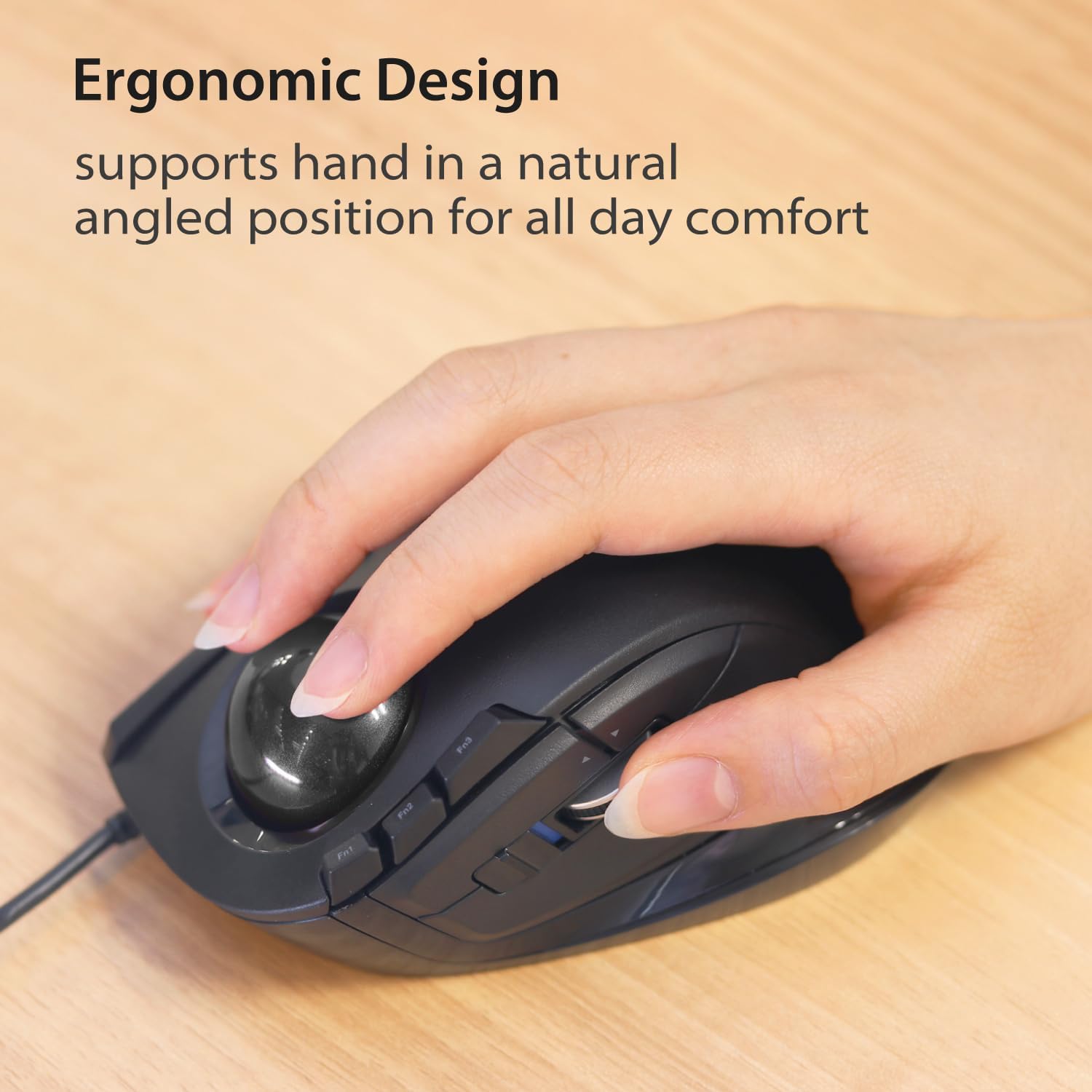
Image: A hand comfortably resting on the trackball mouse, highlighting its ergonomic design.

Image: A close-up view of an index finger precisely controlling the trackball.
Button Functions
The trackball mouse features 8 physical buttons and a tilt wheel, offering a total of 10 customizable functions. The default functions are:

Image: A detailed diagram labeling the Right Click, 34mm ball, Function buttons, Back/Forward buttons, Tilt Wheel, Left Click, and Ball Removal Hole.
- Left Click: Primary selection button.
- Right Click: Secondary click for context menus.
- Scroll Wheel: Vertical scrolling.
- Tilt Wheel (Left/Right): Horizontal scrolling (may require Mouse Assistant software or specific OS support).
- Function Buttons (Fn1, Fn2, Fn3): Customizable buttons.
- Back/Forward Buttons: Navigate web pages or folders.
- DPI Button: Switches between 500 DPI (LOW) and 1500 DPI (HIGH) for cursor speed adjustment.
Adjusting DPI (Cursor Speed)
The DPI button, typically located near the trackball, allows you to instantly switch between two cursor speeds:
- 500 DPI (LOW): For precise, slower cursor movements.
- 1500 DPI (HIGH): For faster cursor movements across the screen.
Press the DPI button once to toggle between these two settings.
4. Maintenance
Cleaning the Trackball
Regular cleaning of the trackball and its housing is essential for maintaining smooth and accurate cursor movement. Dust and debris can accumulate around the ball bearings.
- Disconnect the trackball mouse from your computer.
- Locate the ball removal hole on the underside of the mouse.
- Gently push the trackball out through this hole using a non-abrasive tool (e.g., the blunt end of a pen).
- Wipe the trackball with a soft, lint-free cloth.
- Use a cotton swab or compressed air to clean any dust or debris from the ball bearings and the trackball housing.
- Reinsert the trackball into its housing until it clicks securely into place.
5. Troubleshooting
Cursor Not Moving or Moving Erratically
- Check Connection: Ensure the USB cable is securely plugged into your computer's USB port. Try a different USB port.
- Clean Trackball: Dust or debris around the trackball can impede movement. Refer to the "Cleaning the Trackball" section.
- Restart Computer: A system restart can resolve temporary software conflicts.
- Test on Another Computer: If possible, test the trackball on another computer to determine if the issue is with the device or your system.
Buttons Not Responding
- Check Software: If using the ELECOM Mouse Assistant, ensure button assignments are correct and the software is running properly.
- Reinstall Drivers: Disconnect the mouse, uninstall any ELECOM drivers or software, restart your computer, and then reconnect the mouse to allow the OS to reinstall generic drivers. Reinstall Mouse Assistant if desired.
Horizontal Scrolling Not Working
- Software Configuration: Ensure horizontal scrolling is enabled and configured correctly in the ELECOM Mouse Assistant software.
- Operating System Support: Note that horizontal scrolling functionality may not be fully supported on older operating systems like Windows RT8.1.
6. Specifications
| Feature | Detail |
|---|---|
| Model Number | M-DT2URBK |
| Connectivity | Wired (USB) |
| Movement Detection | Optical Trackball |
| DPI Settings | 500 DPI (LOW), 1500 DPI (HIGH) |
| Buttons | 8 physical buttons + Tilt Wheel (10 customizable functions) |
| Dimensions (LxWxH) | 4.9 x 3.7 x 1.9 inches (124.4 x 94.7 x 47.9 mm) |
| Weight | 4 oz (113 g) |
| Operating System Support | Windows 8, 10, 11; macOS 10.10 or later |

Image: Diagram illustrating the length, width, and height of the trackball mouse.
7. Warranty and Support
ELECOM products are designed for reliability and performance. For specific warranty details, please refer to the warranty card included with your product or visit the official ELECOM website. If you encounter any issues not covered in this manual, please contact ELECOM customer support for assistance.
For further support and driver downloads, please visit the official ELECOM website: www.elecom.co.jp/global/


