
Webb 15911
Webb 15911 Unground Ball Bearing User Manual
Model: 15911 | Brand: Webb
Product Overview
The Webb 15911 Unground Ball Bearing is a robust component designed for various industrial applications. Unground bearings are typically used in applications where precision and high speeds are not the primary requirements, but rather durability and cost-effectiveness. This bearing is new in its factory box, ensuring quality and readiness for installation.

A close-up view of the Webb 15911 Unground Ball Bearing, featuring its distinctive red seal and the 'WEBB' brand name visible on the outer race. The model number '15911' is also visible.

This image displays two Webb 15911 Unground Ball Bearings side-by-side. One bearing is sealed with the red cover, while the other is shown with its internal ball bearings exposed, illustrating the internal components.
Specifications
| Attribute | Value |
|---|---|
| Bearing Type | Ball Bearing |
| Bearing Number | 15911 |
| Material | Steel |
| Item Weight | 0.01 Ounces |
| Manufacturer | Webb |
| Date First Available | August 16, 2015 |
| ASIN | B013ZS3C12 |
For detailed dimensional specifications, refer to the technical chart and measurement images below:
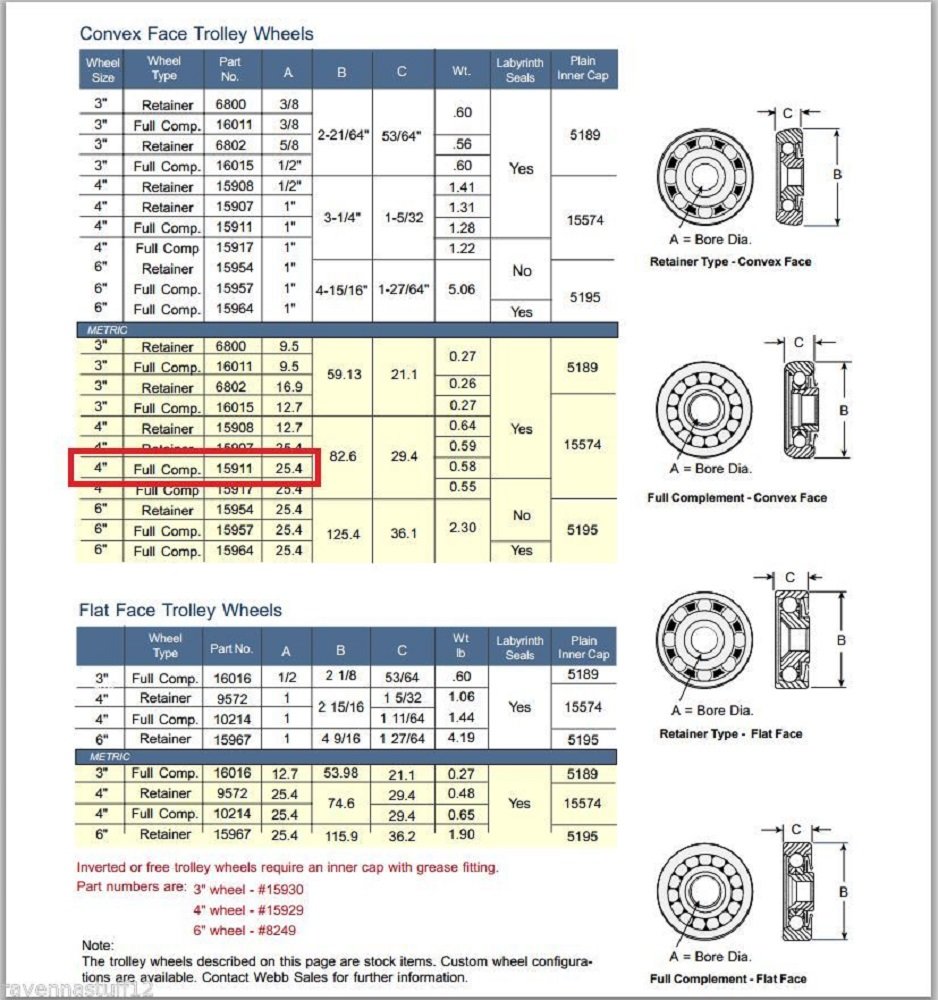
A detailed technical chart providing specifications for various trolley wheels, including the Webb 15911 bearing. The chart lists wheel size, part number, dimensions (A, B, C), weight, and labyrinth seal information. The 15911 model is highlighted within the 'Convex Face Trolley Wheels' section, showing its specific dimensions.

A digital caliper is shown measuring the outer diameter of the Webb 15911 Unground Ball Bearing. The display reads 82.53 mm, indicating the overall width of the bearing.

A digital caliper is used to measure the inner diameter (bore) of the Webb 15911 Unground Ball Bearing. The digital readout shows 25.83 mm, which is the diameter of the central hole.

This image shows a digital caliper measuring the thickness or width of the Webb 15911 Unground Ball Bearing. The measurement displayed on the caliper is 25.55 mm.
Installation Guidelines
Proper installation is crucial for the longevity and performance of the Webb 15911 Unground Ball Bearing. Follow these general guidelines:
- Preparation: Ensure the shaft and housing bores are clean, free from burrs, and within specified tolerances.
- Lubrication: Apply a thin layer of appropriate lubricant to the shaft and housing bore before installation to facilitate smooth mounting and prevent damage.
- Mounting:
- For press fit applications, use a bearing installation tool or a soft-faced hammer with a sleeve that contacts only the inner ring when mounting onto a shaft, or the outer ring when mounting into a housing.
- Never strike the outer ring when pressing onto a shaft, or the inner ring when pressing into a housing, as this can damage the bearing.
- Ensure the bearing is seated squarely and fully.
- Alignment: Verify proper alignment after installation to prevent premature wear and excessive loads.
- Sealing: If the application requires additional sealing beyond the bearing's integrated seals, ensure external seals are properly installed without interfering with bearing rotation.
Note: For specific machinery or equipment, always refer to the manufacturer's installation manual for detailed instructions.
Operating Principles
The Webb 15911 Unground Ball Bearing operates on the principle of rolling friction. It consists of an inner ring, an outer ring, a set of steel balls, and a retainer (cage) that spaces the balls. When a load is applied, the balls roll between the raceways of the inner and outer rings, allowing for smooth rotation with minimal friction.
- Load Distribution: The balls distribute the load evenly across the raceways, reducing stress concentration.
- Reduced Friction: Rolling elements significantly reduce friction compared to sliding contact, leading to higher efficiency and less heat generation.
- Support: Ball bearings are primarily designed to handle radial loads, but can also accommodate some axial (thrust) loads.
Unground bearings, like the 15911, are manufactured to less stringent precision tolerances than ground bearings. This makes them suitable for applications where high speeds, extreme precision, or very low noise levels are not critical, but where robust performance and cost-effectiveness are important.
Maintenance
Regular maintenance can extend the lifespan of your Webb 15911 Unground Ball Bearing. While unground bearings are often used in less demanding applications, proper care is still beneficial.
- Lubrication:
If the bearing is sealed (like the red-sealed version shown), it is typically pre-lubricated for life and requires no further lubrication. If it is an open bearing or part of a system with external lubrication, ensure it receives appropriate grease or oil according to the equipment manufacturer's recommendations. Over-lubrication can be as detrimental as under-lubrication.
- Cleaning:
Keep the area around the bearing clean to prevent contaminants (dust, dirt, moisture) from entering the bearing, which can cause premature wear and failure. Use clean cloths and appropriate solvents if necessary, ensuring no residue is left behind.
- Inspection:
Periodically inspect the bearing for signs of wear, damage, or unusual noise/vibration. Look for:
- Excessive play or looseness.
- Discoloration or signs of overheating.
- Corrosion or rust.
- Damage to seals or shields.
Replace the bearing if any significant damage or wear is detected.
Troubleshooting
If you encounter issues with your Webb 15911 Unground Ball Bearing, consider the following common problems and potential solutions:
| Problem | Possible Cause(s) | Solution(s) |
|---|---|---|
| Excessive Noise / Vibration |
|
|
| Overheating |
|
|
| Premature Failure |
|
|
If problems persist, consult with a qualified technician or the equipment manufacturer.
Warranty and Support
Warranty information for the Webb 15911 Unground Ball Bearing is typically provided by the original seller or manufacturer at the time of purchase. Please retain your proof of purchase for any warranty claims.
For technical support, specific application advice, or to inquire about replacement parts, please contact the manufacturer, Webb, or the authorized distributor from whom you purchased the product. Contact details are usually available on their official websites or product packaging.
Disclaimer: This manual provides general guidelines. Always adhere to specific safety instructions and installation procedures provided by the equipment manufacturer where the bearing will be used.
Ask a question about this manual
Ask about setup, troubleshooting, compatibility, parts, safety, or missing instructions. Manuals+ will review the question and use this page’s manual context to help answer it.