
1. Introduction
This manual provides detailed instructions for the installation, operation, maintenance, and troubleshooting of the ASRock H81M-HDS R2.0 Micro ATX Motherboard. Please read this manual thoroughly before installing or using your motherboard to ensure proper functionality and to prevent damage.
The ASRock H81M-HDS R2.0 is designed for Intel LGA 1150 processors, supporting DDR3 memory and offering essential connectivity for a reliable computing experience.
2. Product Overview
The ASRock H81M-HDS R2.0 motherboard features the Intel H81 chipset, providing a stable platform for your system. Key features include:
- Socket Type: LGA 1150
- Chipset: Intel H81
- Memory: 2x DDR3/DDR3L-1600/1333/1066 DIMM Slots, Dual Channel, Non-ECC, Unbuffered, Max Capacity of 16GB
- Expansion Slots: 1x PCI Express 2.0 x16 Slot, 1x PCI Express 2.0 x1 Slot
- Storage: 2x SATA3 Ports, 2x SATA2 Ports
- Audio: Realtek ALC662 5.1-Channel High Definition Audio CODEC
- USB Ports: 4x USB 3.0 Ports (2 rear, 2 via header), 8x USB 2.0 Ports (4 rear, 4 via headers)
- Video Outputs: 1x VGA Port, 1x DVI-D Port, 1x HDMI Port
- Network: 1x RJ45 LAN Port
- Form Factor: MicroATX
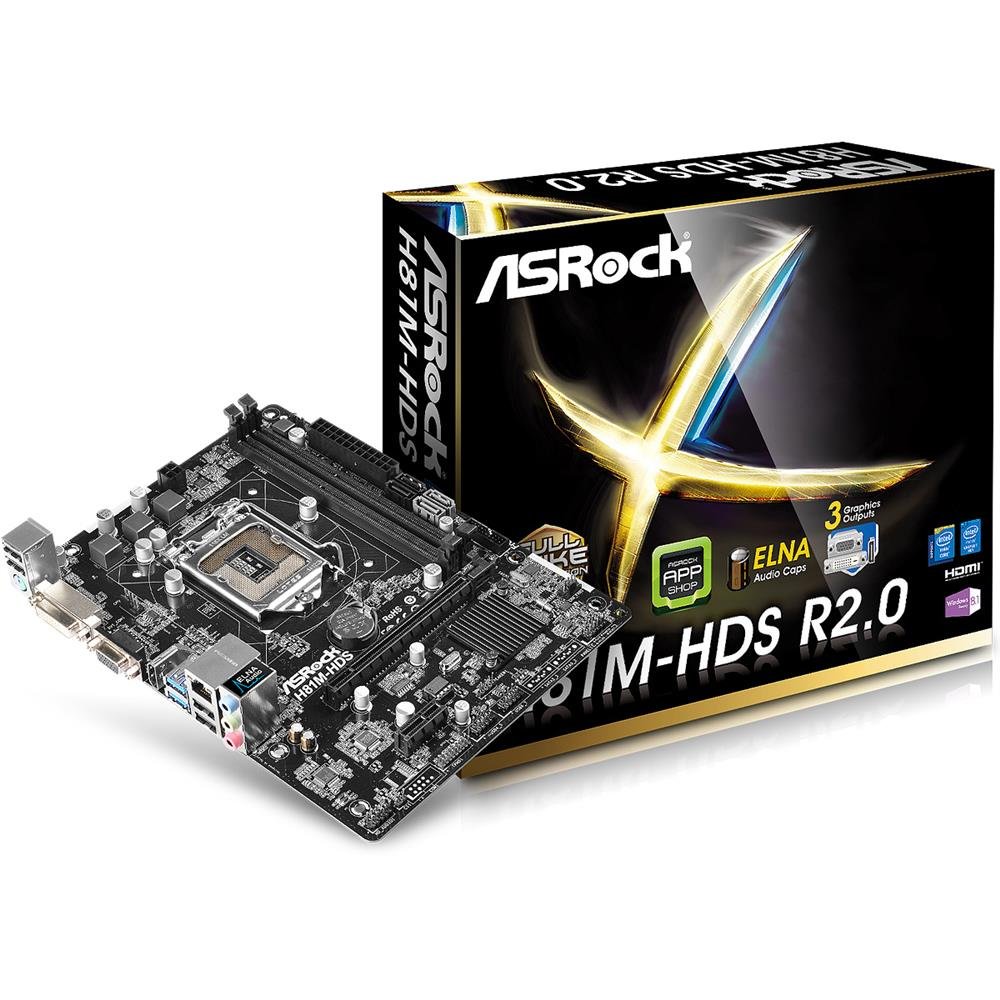
Figure 2.1: ASRock H81M-HDS R2.0 Micro ATX Motherboard. This image displays the overall layout of the motherboard, including the CPU socket, RAM slots, PCIe slots, and various connectors.
3. Setup and Installation
Before beginning installation, ensure your system is powered off and unplugged from the wall outlet. Wear an anti-static wrist strap to prevent electrostatic discharge (ESD) damage to components.
3.1. Installing the CPU
- Locate the LGA 1150 CPU socket on the motherboard.
- Gently push down the load lever and pull it out to open the CPU socket cover.
- Align the triangular mark on the CPU with the mark on the socket. Carefully place the CPU into the socket without forcing it.
- Close the load plate and push the load lever back into place until it clicks.
3.2. Installing the CPU Cooler
Follow the instructions provided with your CPU cooler for proper installation. Ensure thermal paste is applied correctly between the CPU and the cooler's base.
3.3. Installing Memory (RAM)
- Open the clips at both ends of the DDR3 DIMM slots.
- Align the notch on the memory module with the key in the DIMM slot.
- Insert the memory module firmly into the slot until the clips snap into place. For dual-channel operation, install modules in matching colored slots (if applicable, refer to motherboard diagram for specific slots).
3.4. Mounting the Motherboard
- Install the I/O shield into the rear opening of your computer case.
- Place the motherboard into the case, aligning the screw holes with the standoffs.
- Secure the motherboard with screws, ensuring it is firmly seated but not overtightened.
3.5. Connecting Power
- Connect the 24-pin ATX power connector from your power supply to the corresponding header on the motherboard.
- Connect the 4-pin ATX 12V power connector (CPU power) to its header.
3.6. Connecting Storage Devices
Connect your SATA hard drives or SSDs to the SATA3 (6Gb/s) or SATA2 (3Gb/s) ports using SATA data cables. Connect power cables from the power supply to each drive.
3.7. Connecting Front Panel and USB Headers
Connect the front panel connectors (power button, reset button, HDD LED, power LED) and USB headers from your case to the corresponding pins on the motherboard. Refer to the motherboard's detailed diagram for correct pin assignments.
4. Operating Instructions
4.1. BIOS/UEFI Setup
Upon initial boot, press Del or F2 during the POST (Power-On Self-Test) to enter the UEFI Setup Utility. Here you can configure system settings such as boot order, date/time, and hardware parameters. The ASRock UEFI is designed to be user-friendly.
4.2. Driver Installation
After installing your operating system, install the necessary drivers for the motherboard's components (chipset, audio, LAN, graphics if using integrated) from the ASRock support website or the provided driver CD (if applicable). Ensure all drivers are up-to-date for optimal performance and stability.
5. Maintenance
Regular maintenance helps ensure the longevity and stable operation of your motherboard and system.
- Dust Removal: Periodically clean dust from inside your computer case, especially from CPU coolers, case fans, and heatsinks, using compressed air. Ensure the system is powered off and unplugged before cleaning.
- Cable Management: Ensure internal cables are neatly routed to improve airflow and prevent obstruction of components.
- BIOS/UEFI Updates: Check the ASRock website for BIOS/UEFI updates. Updates can improve compatibility, stability, and performance. Follow ASRock's specific instructions for BIOS flashing carefully to avoid damaging the motherboard.
- Driver Updates: Keep your system drivers updated to ensure compatibility and optimal performance with your operating system and applications.
6. Troubleshooting
If you encounter issues with your ASRock H81M-HDS R2.0 motherboard, refer to the following common troubleshooting steps:
6.1. No Power / No Boot
- Verify all power cables (24-pin ATX, 4-pin ATX 12V) are securely connected to the motherboard and power supply.
- Ensure the power supply switch is in the 'ON' position.
- Check front panel power button connections to the motherboard.
- Test with a different power supply if possible.
6.2. No Display Output
- Ensure your monitor is connected to the correct video output (VGA, DVI-D, or HDMI) on the motherboard or discrete graphics card.
- Verify the monitor is powered on and set to the correct input source.
- Reseat the RAM modules. Faulty or improperly seated RAM is a common cause of no display.
- If using a discrete graphics card, ensure it is properly seated in the PCIe slot and has adequate power connected.
6.3. RAM Issues (e.g., one slot not working)
- Ensure RAM modules are fully seated in their slots.
- Test each RAM module individually in each slot to identify a potentially faulty module or slot.
- Check the motherboard's QVL (Qualified Vendor List) for compatible memory modules.
6.4. System Instability / Random Crashes
- Check CPU and GPU temperatures to ensure they are within safe operating limits.
- Verify all drivers are correctly installed and up-to-date.
- Run memory diagnostic tools to check for RAM errors.
- Ensure your power supply provides sufficient and stable power to all components.
7. Specifications
Detailed technical specifications for the ASRock H81M-HDS R2.0 Motherboard:
| Brand | ASRock |
| Model Number | H81M-HDS R2.0 |
| CPU Socket | LGA 1150 |
| Chipset Type | Intel H81 |
| RAM Memory Technology | DDR3 |
| Memory Slots Available | 2 |
| RAM Memory Maximum Size | 16 GB |
| Memory Clock Speed | 1333 MHz (Supports up to 1600 MHz) |
| Graphics Card Interface | PCI Express |
| SATA Ports | 2x SATA3, 2x SATA2 |
| USB Ports | 4x USB 3.0 (2 rear, 2 via header), 8x USB 2.0 (4 rear, 4 via headers) |
| Video Outputs | 1x VGA, 1x DVI-D, 1x HDMI |
| Audio | Realtek ALC662 5.1-Channel HD Audio |
| LAN | Gigabit Ethernet |
| Form Factor | MicroATX |
| Item Weight | 0.6 Kilograms |
8. Warranty and Support
ASRock provides a limited warranty for its products. For specific warranty terms and conditions, please refer to the warranty card included with your product or visit the official ASRock website. Keep your proof of purchase for warranty claims.
For technical support, driver downloads, and BIOS updates, please visit the official ASRock support website:
When contacting support, please have your motherboard model (H81M-HDS R2.0) and serial number ready.