
UHPPOTE UT0111-08X
UHPPOTE UT0111-08X Wiegand 26-bit 125KHz RFID Proximity Card Reader Instruction Manual
Model: UT0111-08X
Introduction
This manual provides detailed instructions for the installation, operation, and maintenance of the UHPPOTE UT0111-08X Wiegand 26-bit 125KHz RFID Proximity Card Reader. This device is designed for use in various access control applications, including parking systems, elevators, and logistics.
Important Note: This RFID reader functions as a component of an access control system and cannot operate independently. It requires connection to a compatible access controller.
Product Overview
The UHPPOTE UT0111-08X is a middle-range RFID proximity card reader operating at 125KHz. It supports EM-ID cards and outputs data in Wiegand 26-bit format. The reading distance varies based on the card type and thickness.
Key Features:
- Data Output Format: Wiegand 26-Bit.
- Card Type Support: 125KHz EM-ID Cards (EM4100/TK4100 compatible). Does not support encrypted cards such as HID, Indala, Cobra, APCiK, Paradox, Radio, or Honeywell.
- Proximity Range: Varies from 30cm to 100cm (11.8 inches to 39.4 inches) depending on card quality and thickness.
- Applications: Primarily used for parking, elevator, and logistics access control systems.
- Construction: Plastic casing with epoxy saturation, built-in antenna and buzzer.
Reading Distance Information:
The term "Middle Range" refers to the unit's capability when used with specific long-range cards (typically 2mm thickness). For standard EM cards, the reading range is as follows:
- Special Long Range Card (2mm thickness): Up to 80-100cm (31.5-39.4 inches).
- Normal 2mm/0.08" Thickness Card: Up to 60cm (23.6 inches).
- 0.8mm/0.03" Thickness Card: Up to 40cm (15.7 inches).
- Keyfob: Approximately 30cm (11.8 inches).
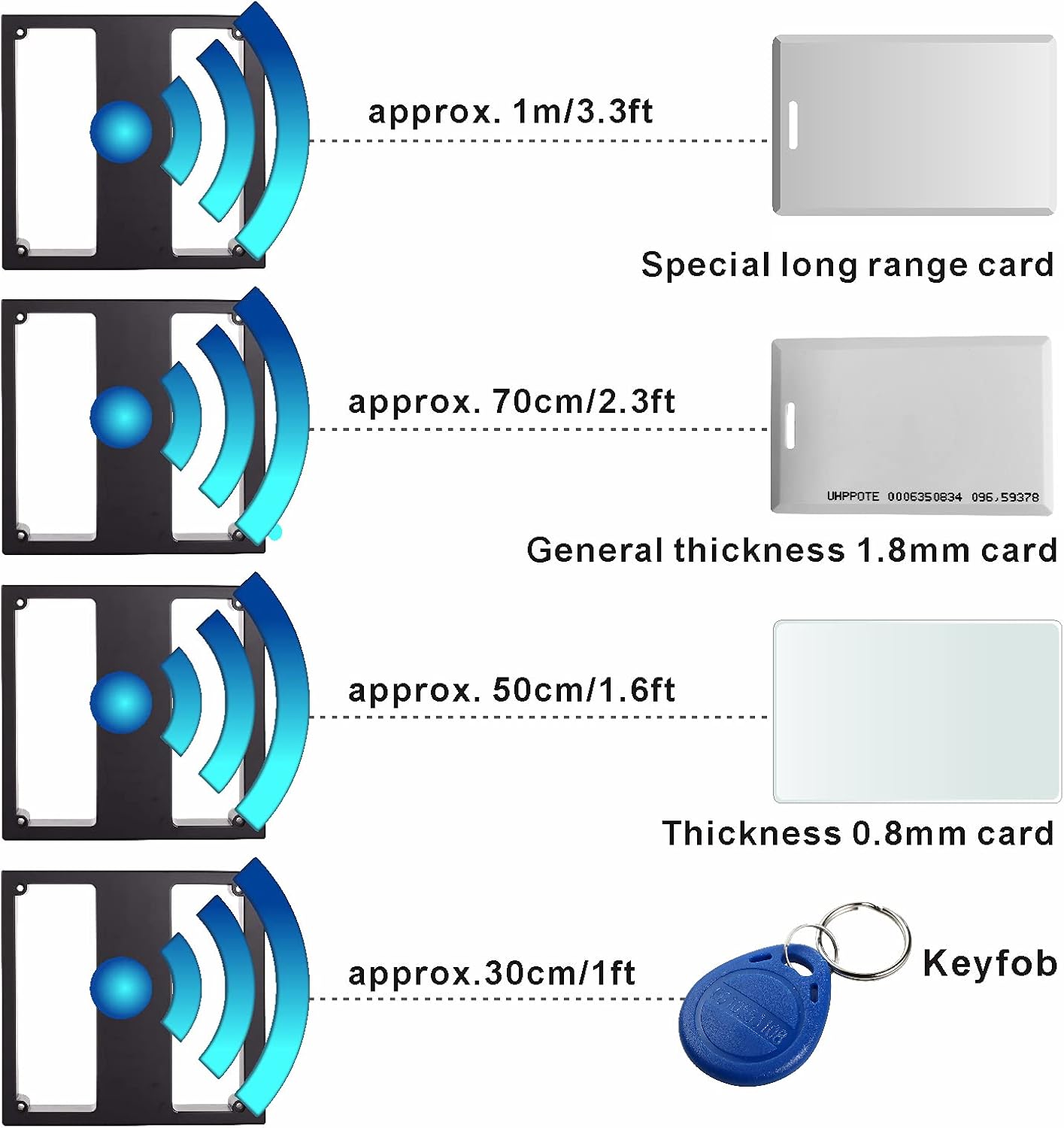
Image: This diagram illustrates the approximate reading distances for various card types and keyfobs with the UHPPOTE RFID reader. Distances range from approximately 1 meter for special long-range cards down to 30cm for keyfobs.
Specifications
| Decode Time | <0.2s |
| Communication | Wiegand 26 bit |
| Card Type | EM card, EM compatible card, EM4100/TK4100 |
| Frequency | 125kHz |
| Induction Distance | Common Card: 30-40cm (11.8-15.7 inches) Long Range Proximity Card: 80-100cm (31.5-39.4 inches) |
| Power Supply | 12VDC |
| Current Consumption | Data transfer range: max. 80mA Operating current: <200mA |
| Working Temperature | 0°C ~ 70°C (32°F ~ 158°F) |
| Working Humidity | Less than 80% |
| Dimensions (LxWxH) | 230x230x35mm (9.06x9.06x1.38 inches) |
| Material | Plastic casing & epoxy saturated |
| Built-in Features | Antenna, Buzzer |
| Item Weight | 3.08 pounds |
| Model Number | UT0111-08X |
| UPC | 701385687977 |
Setup and Installation
Proper installation is crucial for the optimal performance of the RFID reader. This device is designed to be integrated into an existing access control system.
Wiring Instructions:
Connect the reader to your access controller using the provided wiring. Ensure all connections are secure and follow the color-coded scheme below. The reader requires a 12VDC power supply.
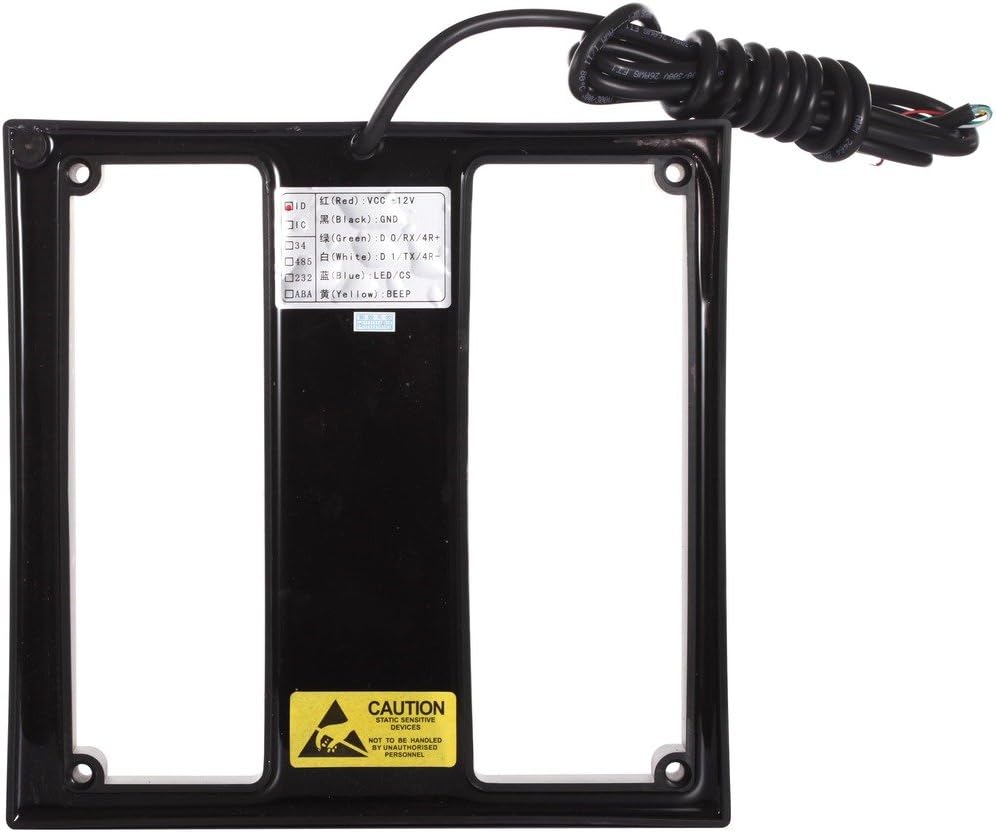
Image: Rear view of the RFID reader with clearly labeled wiring connections. The labels indicate Red for VCC +12V, Black for GND, Green for D0/RX/4R+, White for D1/TX/4R-, and Blue for LED/CS, Yellow for BEEP.
- Red: VCC +12V (Power Supply)
- Black: GND (Ground)
- Green: D0 / RX / 4R+ (Wiegand Data 0)
- White: D1 / TX / 4R- (Wiegand Data 1)
- Blue: LED / CS (LED Control / Chip Select)
- Yellow: BEEP (Buzzer Control)
Connection Diagram:
Refer to the following diagram for connecting the RFID reader to an access controller. This diagram illustrates a typical setup for a single door access control system.

Image: A detailed wiring diagram showing how to connect the RFID reader (both 'Card Reader In' and 'Card Reader Out' sections) to an access controller, including power supply, data lines (D0, D1), LED, and an exit button. It also includes an explanation of LED status indicators.
LED Status Explanation (as per diagram):
- IN: Light blink, valid card
- SYS: Light blink, CPU runs normally
- ERR: Light off, apparatus run normally
- LINK: Green light flashes, the device already connect
- ACT: Orange light flashes, the device is processing data
- POW: Red light on, go through the device
- DRV: Yellow light on, door is open
Caution: This device is static sensitive. Handle with care and ensure proper grounding during installation to prevent damage.
Operating Instructions
Once properly installed and connected to an access controller, the UHPPOTE UT0111-08X reader operates by detecting compatible 125KHz EM-ID cards or keyfobs.
- Power On: Ensure the reader is powered by a stable 12VDC source. The LED indicator on the reader should show a status indicating normal operation (refer to the LED Status Explanation in the Setup section).
- Present Card: Hold a compatible 125KHz EM-ID card or keyfob within the reader's proximity range. The optimal reading distance varies by card type and thickness (see "Reading Distance Information" in Product Overview).
- Access Granted/Denied: The reader will transmit the card's data to the connected access controller. The controller will then process this information and determine whether to grant or deny access. The reader's buzzer may sound, and the LED indicator may change to signal a successful read or access event.
- System Response: The access controller will activate the connected lock or gate mechanism if access is granted.
The decode time for a card read is typically less than 0.2 seconds, providing quick authentication.
Maintenance
The UHPPOTE UT0111-08X RFID reader is designed for durability and requires minimal maintenance. Follow these guidelines to ensure its longevity and reliable performance:
- Cleaning: Gently wipe the reader's surface with a soft, dry cloth. Avoid using abrasive cleaners, solvents, or excessive moisture, which can damage the casing or internal components.
- Environmental Conditions: Ensure the reader operates within the specified working temperature (0°C ~ 70°C) and humidity (less than 80%). Avoid exposing the device to extreme temperatures, direct sunlight for prolonged periods, or high humidity environments.
- Physical Protection: Protect the reader from physical impact or excessive vibration. The epoxy-saturated casing provides some protection, but severe impacts can still cause damage.
- Wiring Integrity: Periodically inspect the wiring connections for any signs of wear, corrosion, or loose connections. Ensure all cables are securely fastened and protected from environmental elements if installed outdoors.
- Static Electricity: As a static-sensitive device, avoid touching internal components without proper anti-static precautions.
Troubleshooting
If you encounter issues with your UHPPOTE UT0111-08X RFID reader, refer to the following common problems and solutions:
| Problem | Possible Cause | Solution |
|---|---|---|
| Reader is unresponsive / No power. | No power supply, incorrect voltage, or loose wiring. |
|
| Reader does not read cards. | Incompatible card type, card presented out of range, or interference. |
|
| Access is denied despite a successful card read. | Issue with the access controller or card programming. |
|
| Reduced reading distance. | Interference, card quality, or mounting location. |
|
Warranty and Support
For warranty information and technical support regarding your UHPPOTE UT0111-08X RFID Proximity Card Reader, please contact UHPPOTE customer service directly or refer to the official UHPPOTE website. Specific warranty terms may vary by region and purchase date.
When contacting support, please have your model number (UT0111-08X) and purchase details readily available.
Related documentsUT0111-08X


Ask a question about this manual
Ask about setup, troubleshooting, compatibility, parts, safety, or missing instructions. Manuals+ will review the question and use this page’s manual context to help answer it.