
1. Introduction
This service manual provides essential information and detailed procedures for the maintenance, repair, and overhaul of Case 446 Lawn and Garden Tractors with serial numbers preceding 9742952. It is designed for technicians and experienced owners to ensure proper operation and longevity of the equipment. Adherence to these instructions will help maintain the tractor's performance and reliability.
2. General Information
This section covers fundamental details about the Case 446 tractor, including safety precautions, general operating principles, and identification of major components. Always refer to the safety guidelines before performing any service or maintenance tasks.
Understanding the basic layout and function of your tractor is crucial for effective troubleshooting and repair. Familiarize yourself with the location of key components and their operational roles.

Image: An excerpt from the manual's table of contents, outlining sections such as General Information, Specifications, Dimensions and Clearances, Assembly Torques and Special Tools, Engine Troubleshooting, Oil System, Fuel System, and Engine Disassembly and Assembly. This image provides an overview of the manual's comprehensive coverage.
3. Specifications
Detailed technical specifications for the Case 446 Lawn and Garden Tractor are provided below. These specifications are critical for proper service, part replacement, and performance tuning. All measurements are provided in U.S. customary units with metric equivalents in parentheses.
| Description | BF | B43M | CCKA |
|---|---|---|---|
| Engine Design | Four Cycle, Air-Cooled, Two Cylinder | ||
| Horsepower (3600 rpm) | 16 | 18 | 16.5 |
| Displacement (cubic inches) | 40.3 | 43.7 | 49.8 |
| Displacement (cubic centimeters) | (660.4) | (717.7) | (816.1) |
| Bore | 3.25" (82.5mm) | 3.25" (82.5mm) | 3.25" (82.5mm) |
| Stroke | 2.62" (66.6mm) | 2.875" (73mm) | 3" (76.2mm) |
| Compression Ratio | 7 to 1 | 6.6 to 1 | 6.6 to 1 |
| Crankshaft | Horizontal, Ductile Iron | ||
| Valves | Mechanical, Poppet | ||
| Oil Capacity with Filter Change | 3.5 pts. (1.7 l) | 3.5 pts. (1.7 l) | 4 qt. (3.8 l) |
| Oil Capacity without Filter Change | 3.0 pts. (1.4 l) | 3.0 pts. (1.4 l) | 3.4 qt. (3.2 l) |
| Battery Charging System | 12 Volt, 15 Amp Flywheel Alternator | 20 amp CCKA | |
| Tune-Up Specifications | |||
| Tappets (Cold) Intake | .008" (0.20mm) | ||
| Tappets (Cold) Exhaust | .008" (0.20mm) | ||
| Breaker Point Gap | .020" (0.51mm) | ||
| Spark Plug Gap | .025" (0.64mm) | ||
| Ignition Timing (Cold, Static Setting) | 21°BTC | 24°BTC | |
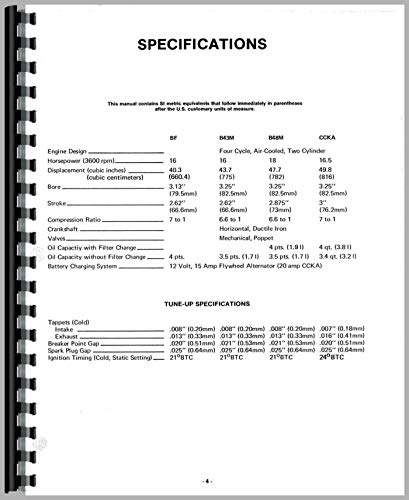
Image: A detailed table presenting engine and tune-up specifications for BF, B43M, and CCKA engine models used in the Case 446 tractor. This includes horsepower, displacement, bore, stroke, compression ratio, oil capacity, and various tune-up settings.
4. Steering System Service
This section provides an exploded view and component identification for the 600 Series steering system. Proper assembly, lubrication, and adjustment of these components are essential for safe and effective steering control.
Refer to the diagram for the correct placement and orientation of parts such as the steering column, pinion joint, sector gear, drag link, tie rod, and spindle. Ensure all fasteners are torqued to specifications and lubrication points are serviced regularly.
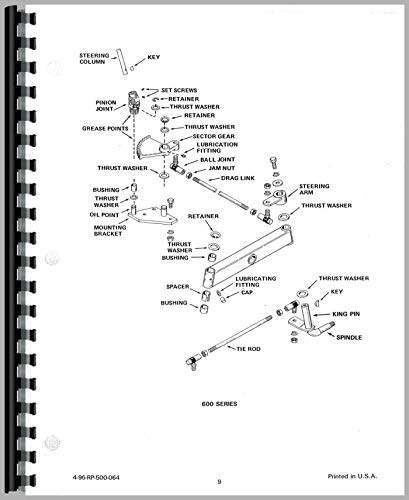
Image: An exploded diagram illustrating the components of a 600 Series steering system. Key parts shown include the steering column, pinion joint, sector gear, drag link, tie rod, spindle, and various washers, retainers, and fittings. This visual aid is crucial for assembly and repair.
5. Engine Troubleshooting
This section outlines common engine problems, their potential causes, and recommended solutions. Effective troubleshooting requires a systematic approach, starting with basic checks before moving to more complex diagnostics.
- Engine Fails to Start: Check fuel supply, ignition system (spark plug, points, coil), battery charge, and starter motor.
- Engine Runs Poorly/Lacks Power: Inspect air filter, fuel filter, carburetor settings, spark plug condition, and valve clearances.
- Excessive Smoke: Diagnose based on smoke color (blue for oil, black for rich fuel, white for coolant/water).
- Overheating: Verify cooling fins are clean, oil level is correct, and engine is not overloaded.
6. Oil System
The oil system is vital for engine lubrication and cooling. This section details oil specifications, capacity, and procedures for oil changes and filter replacement. Regular maintenance of the oil system prevents premature engine wear.
- Oil Type: Refer to the specifications table for recommended oil viscosity based on ambient temperature.
- Oil Capacity: See Section 3, Specifications, for exact oil capacities with and without filter changes.
- Oil Change Procedure: Drain old oil when the engine is warm, replace the oil filter, and refill with the specified amount of new oil.
- Checking Oil Level: Ensure the tractor is on a level surface and check the dipstick before each use.
7. Fuel System
This section covers the fuel system components, including the fuel tank, fuel lines, fuel filter, and carburetor. Proper fuel system maintenance ensures efficient engine operation and prevents fuel-related issues.
7.1. Fuel System for BF, B43M, B48M Engines
Specific details for the fuel system components and service procedures applicable to BF, B43M, and B48M engine models. This includes carburetor adjustments, fuel filter replacement, and fuel line inspection.
7.2. Fuel System for CCKA Engines
Specific details for the fuel system components and service procedures applicable to CCKA engine models. Pay close attention to any differences in carburetor design or fuel delivery mechanisms compared to other engine types.
- Fuel Type: Use fresh, clean unleaded gasoline with the recommended octane rating.
- Fuel Filter: Replace the fuel filter annually or more frequently if operating in dusty conditions.
- Carburetor Service: Clean and adjust the carburetor as needed to ensure proper fuel-air mixture.
8. Engine Disassembly and Assembly
This section provides step-by-step instructions for the complete disassembly and reassembly of the engine. It includes procedures for removing and installing major engine components, such as the cylinder head, pistons, crankshaft, and camshaft.
Careful attention to detail, proper tooling, and adherence to torque specifications are crucial during engine work. Always refer to the specific torque values provided in the manual for all fasteners.
- Drain all fluids (oil, fuel).
- Remove external components (carburetor, exhaust, starter, alternator).
- Disassemble cylinder head, valves, and pushrods.
- Remove oil pan, connecting rods, and pistons.
- Extract crankshaft and camshaft.
- Inspect all components for wear and damage.
- Reassemble in reverse order, applying new gaskets and seals as required.
- Torque all fasteners to specified values.
9. Maintenance Schedule
Regular maintenance is key to the longevity and reliable operation of your Case 446 tractor. Follow this schedule for routine checks and service tasks.
- Before Each Use: Check engine oil level, tire pressure, and inspect for loose fasteners or leaks.
- Every 25 Hours or Annually: Change engine oil and filter, clean air filter, check spark plug, inspect battery terminals.
- Every 50 Hours or Annually: Lubricate steering components, check drive belts, inspect fuel lines.
- Every 100 Hours or Annually: Replace fuel filter, inspect and adjust valve clearances, clean cooling fins.
10. Warranty and Support
For information regarding product warranty, please refer to the original purchase documentation or contact your authorized Case dealer. This service manual is intended to assist with repairs and maintenance and does not supersede any warranty terms or conditions.
For technical support or to order genuine replacement parts, please contact your local Case service center or visit the official Case website. Always use genuine parts to ensure compatibility and performance.


