
1. Product Overview
The Velleman K4401 is an electronic kit designed to generate a variety of sound effects. This kit requires assembly and provides an engaging way to learn about basic electronics while creating a functional sound module. Once assembled, the unit can produce 8 distinct sound effects, with adjustable pitch via a potentiometer.
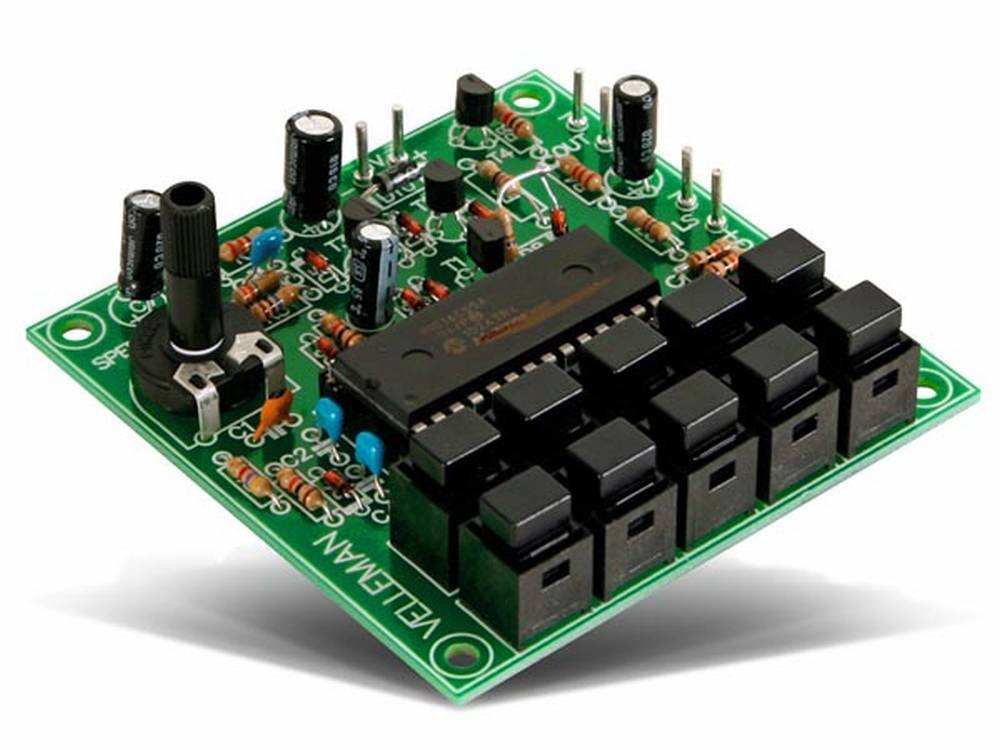
Image: The assembled Velleman K4401 Sound Effects Generator Kit circuit board, showing various electronic components, buttons, and a potentiometer.
2. Assembly Instructions
This product is supplied as a kit and requires soldering and assembly. Please ensure you have the necessary tools and basic soldering skills before proceeding.
2.1 Required Tools (Not Included):
- Soldering iron suitable for electronics
- Electronic solder
- Small cutting pliers
- Multimeter (recommended for testing)
2.2 Important Notes Before Assembly:
- The wiring diagram and detailed assembly instructions are NOT included in the kit packaging. You must obtain the official wiring diagram from the Velleman.eu website. Refer to this diagram for precise component placement and power connection details.
- The kit does NOT include a speaker or an enclosure (housing). These must be sourced separately if desired.
2.3 General Assembly Order:
It is recommended to solder components in order of height, starting with the lowest profile components first. This helps prevent damage and makes assembly easier.
- Solder the IC (Integrated Circuit) support.
- Solder diodes and resistors.
- Solder small capacitors.
- Solder polarized capacitors (ensure correct polarity).
- Solder push-buttons.
- Solder transistors.
- Solder the potentiometer.
- Insert the IC into its support, ensuring correct orientation.
Always double-check your solder joints for good connection and inspect for any short circuits before applying power.
3. Operating Instructions
Once the Velleman K4401 kit is correctly assembled and connected to a power source (refer to the official wiring diagram for power requirements, typically 9-12V DC) and a speaker, you can begin operating it.
3.1 Powering On:
Connect the appropriate DC power supply to the designated terminals on the circuit board as indicated in the wiring diagram. Ensure correct polarity to prevent damage.
3.2 Generating Sound Effects:
- The kit features multiple push-buttons. Each button corresponds to a different sound effect. Press a button to activate a specific sound.
- The kit is capable of producing 8 distinct sound effects.
3.3 Adjusting Pitch:
The assembled circuit includes a potentiometer. Rotate this potentiometer to adjust the pitch or tone of the generated sound effects. Experiment with different settings to achieve desired audio characteristics.
4. Maintenance
To ensure the longevity and proper functioning of your Velleman K4401 Sound Effects Generator Kit, follow these general maintenance guidelines:
- Keep Clean: Regularly clean the circuit board with a soft, dry brush to remove dust and debris. Avoid using liquids directly on the board.
- Keep Dry: Protect the circuit from moisture and humidity, which can cause corrosion and short circuits.
- Inspect Connections: Periodically check solder joints for any signs of cracking or loosening. Re-solder if necessary.
- Handle Carefully: Avoid dropping or subjecting the circuit board to physical shock, which can damage components or connections.
5. Troubleshooting
If you encounter issues with your Velleman K4401 kit, consider the following troubleshooting steps:
5.1 No Sound Output:
- Check Power: Ensure the power supply is correctly connected, providing the specified voltage (e.g., 9-12V DC) and that its polarity is correct.
- Speaker Connection: Verify that the speaker is properly connected to the output terminals and is functional.
- Solder Joints: Carefully inspect all solder joints for cold joints, bridges, or incomplete connections. Re-solder any suspicious joints.
- Component Orientation: Confirm that polarized components (diodes, electrolytic capacitors, IC) are inserted with the correct orientation as per the wiring diagram.
- IC Seating: If an IC socket is used, ensure the IC is fully and correctly seated in the socket.
5.2 Incorrect or Distorted Sound:
- Potentiometer Setting: Adjust the potentiometer to see if the sound changes or improves.
- Component Values: Double-check that all resistors and capacitors have been installed with their correct values as specified in the wiring diagram.
- Short Circuits: Look for any accidental solder bridges or stray wire strands that might be causing short circuits between traces or component leads.
If problems persist, consult the detailed wiring diagram and assembly guide available on the Velleman website or contact Velleman technical support.
6. Specifications
| Feature | Specification |
|---|---|
| Model Number | K4401 |
| Product Dimensions (assembled board) | 0.98 x 4.76 x 7.87 inches (approx.) |
| Item Weight | 0.14 Kilograms (approx.) |
| Manufacturer | Velleman |
| Output Wattage | 1 Watts |
| Voltage | 240 Volts (Note: This may refer to an AC adapter input or internal component rating. Refer to the official wiring diagram for specific DC operating voltage requirements, typically 9-12V DC.) |
| Frequency | 50 Hz (Note: This may refer to an AC adapter input or internal clock frequency. Refer to the official wiring diagram for specific details.) |
7. Warranty and Support
For detailed warranty information regarding the Velleman K4401 Sound Effects Generator Kit, please refer to the official Velleman website or contact your point of purchase. Warranty terms typically cover manufacturing defects but may not cover issues arising from incorrect assembly or component damage during the building process.
For technical support, assembly diagrams, or further assistance, please visit the official Velleman website.


