
Introduction
This manual provides comprehensive service, repair, and maintenance information for Harley-Davidson FXD Evolution motorcycles manufactured between 1991 and 1998. It is designed for both the professional mechanic and the do-it-yourself enthusiast, offering detailed instructions and illustrations to guide you through various procedures. The content covers all aspects of the motorcycle, from routine maintenance to complex engine and transmission overhauls, ensuring your Harley-Davidson remains in optimal condition.
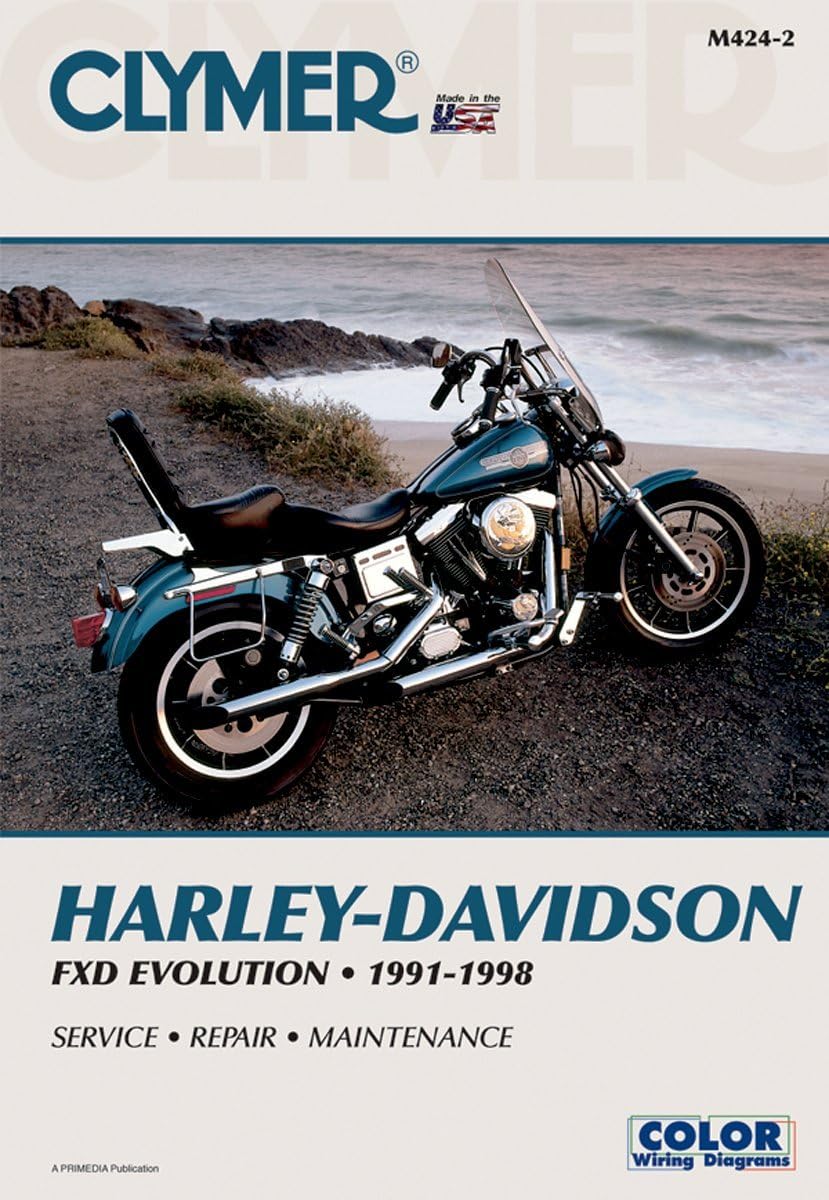
This image displays the front cover of the Clymer M4242 Repair Manual, featuring a Harley-Davidson FXD Evolution motorcycle from the 1991-1998 series parked on a sandy beach. The cover clearly indicates 'HARLEY-DAVIDSON FXD EVOLUTION • 1991-1998 SERVICE • REPAIR • MAINTENANCE' and highlights 'COLOR Wiring Diagrams'.
General Information and Safety
Before beginning any work on your motorcycle, it is crucial to review all safety warnings and general information provided in this manual. Always wear appropriate safety gear and use the correct tools for each task. Adhering to safety guidelines will prevent injury and damage to the motorcycle.
- Read all instructions thoroughly before starting any procedure.
- Ensure the motorcycle is stable and secure on a suitable stand before performing any maintenance or repair.
- Disconnect the battery's negative terminal before working on electrical components to prevent accidental shorts.
- Use only specified parts, fluids, and lubricants to maintain performance and prevent damage.
- Always allow the engine and exhaust system to cool down before working on them to avoid burns.
Using This Manual
This manual is organized into chapters, each covering a specific system or component of the Harley-Davidson FXD Evolution motorcycle. To effectively utilize this resource, familiarize yourself with its structure.
- Each chapter begins with a general information section, followed by specific repair and maintenance procedures.
- Illustrations and photographs are provided to clarify steps and component locations.
- Torque specifications are included where applicable to ensure proper fastener tightening.
- Color wiring diagrams are provided for electrical system troubleshooting and repair.
- Refer to the index at the back of the manual for quick location of specific topics.
Maintenance Procedures
Regular maintenance is essential for the longevity, reliability, and performance of your motorcycle. This section outlines routine service tasks that should be performed at recommended intervals.
Engine Oil and Filter Change
- Warm the engine to operating temperature, then shut it off.
- Place a drain pan beneath the oil drain plug. Remove the drain plug and allow the oil to drain completely.
- Remove the old oil filter using an appropriate filter wrench.
- Apply a thin coat of new engine oil to the gasket of the new filter. Install the new filter and tighten to specification.
- Reinstall the drain plug with a new washer and tighten to specification.
- Fill the engine with the recommended type and quantity of new engine oil.
- Start the engine and check for leaks. Verify the oil level after a short run.
Spark Plug Inspection and Replacement
- Remove the spark plug wires.
- Using a spark plug socket, carefully remove the spark plugs.
- Inspect the electrodes for wear, fouling, or damage. Compare with examples in the manual.
- Measure the spark plug gap and adjust if necessary, or replace with new, correctly gapped plugs.
- Install new or cleaned spark plugs, tightening to the specified torque.
- Reconnect the spark plug wires securely.
Drive Belt Adjustment and Inspection
- Inspect the drive belt for cracks, fraying, or missing teeth.
- Check the belt tension according to the specifications provided in the manual, typically at a specific point with a measured force.
- Adjust the rear axle position as needed to achieve the correct belt tension.
- Ensure the rear wheel is properly aligned after adjustment.
- Tighten all axle and adjustment fasteners to their specified torque values.
Troubleshooting Guide
This section assists in diagnosing common problems and provides potential solutions. For detailed diagnostic procedures, refer to the relevant chapters in this manual.
Engine Starting Issues
- Engine cranks but won't start: Check fuel supply, spark plugs, ignition system, and compression.
- Engine won't crank: Inspect battery charge, starter motor, starter relay, and wiring connections.
- Hard starting when cold: Verify choke operation, fuel mixture, and spark plug condition.
Braking System Problems
- Spongy brake lever/pedal: Bleed the brake system to remove air, check for fluid leaks.
- Poor braking performance: Inspect brake pads for wear, rotors for damage, and brake fluid level.
- Brakes dragging: Check for seized calipers, sticky pistons, or improper adjustment.
Electrical System Malfunctions
- Lights not working: Check bulbs, fuses, wiring connections, and switches.
- Battery not charging: Inspect stator, voltage regulator, and battery terminals.
- Intermittent electrical issues: Examine wiring harnesses for chafing, corrosion, or loose connections.
Specifications
Key technical specifications for the Harley-Davidson FXD Evolution (1991-1998) covered by this Clymer M4242 repair manual.
| Feature | Detail |
|---|---|
| Manufacturer | Clymer |
| Model | M4242 |
| Item Weight | 2 pounds |
| Product Dimensions | 9.9 x 6.8 x 1.2 inches |
| Item Model Number | M4242 |
| Special Features | Reusable, Color Wiring Diagrams |
| Covered Models | Harley-Davidson FXD Evolution (1991-1998) |
Warranty and Support
For specific warranty information regarding your Clymer repair manual, please refer to the documentation provided with your purchase or contact Clymer directly. Warranty terms typically cover manufacturing defects.
For technical support or inquiries related to the content of this manual, including clarifications on procedures or diagrams, please visit the official Clymer website or contact their customer service department. They can provide assistance with product-specific questions.
Official Clymer Website: www.clymer.com


