
1. Introduction
The Coleman PMP400 400 Watt Power Inverter is designed to convert your vehicle's 12-volt DC power into standard 110/120-volt AC household power. This device allows you to operate various AC-powered appliances and electronics from your car or truck, providing 400 watts of continuous power and up to 800 watts of peak power for starting demanding loads. It features dual grounded AC outlets for connecting multiple devices.
Important Safety Information: Always read and understand all instructions and warnings before using this product. Improper use can result in damage to the inverter, vehicle, or personal injury. Keep this manual for future reference.
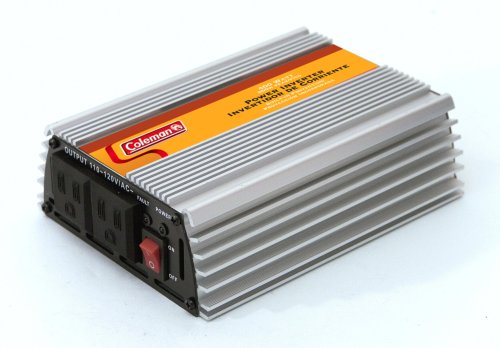
Image of the Coleman PMP400 400 Watt Power Inverter, showing its compact design and power outlets.
2. Package Contents
- Coleman PMP400 400 Watt Power Inverter
- 12-volt power port adapter cable
- Direct battery hook-up cables
- User Manual
3. Key Features
- Converts 12-volt DC vehicle power to 110/120-volt AC household power.
- Provides 400 watts of continuous power.
- Offers 800 watts of peak power for high-demand devices.
- Equipped with dual grounded AC outlets, each with protective covers.
- Flexible power input: connect via vehicle's 12-volt power port or directly to the battery.
- Integrated safety features: short circuit protection, overload protection, over and under voltage protection.
4. Setup Instructions
The Coleman PMP400 Power Inverter can be connected to your vehicle's power system in two ways:
4.1. Connecting via 12-Volt Power Port (Cigarette Lighter Socket)
- Ensure the inverter's power switch is in the "OFF" position.
- Insert the 12-volt power port adapter cable firmly into your vehicle's 12-volt accessory socket.
- Connect the other end of the adapter cable to the DC input port on the inverter.
- Place the inverter on a stable, dry surface, ensuring adequate ventilation around the unit.
- Proceed to Section 5: Operating Instructions.
Note: This connection method is suitable for loads up to approximately 150 watts, depending on your vehicle's fuse rating for the 12-volt power port. For higher power demands, use the direct battery connection.
4.2. Direct Battery Connection
- Ensure the inverter's power switch is in the "OFF" position.
- Locate your vehicle's 12-volt battery. Ensure the vehicle is turned off.
- Connect the red positive (+) cable from the inverter to the positive (+) terminal of the battery.
- Connect the black negative (-) cable from the inverter to the negative (-) terminal of the battery.
- Ensure all connections are secure and free from corrosion.
- Place the inverter on a stable, dry surface, ensuring adequate ventilation around the unit.
- Proceed to Section 5: Operating Instructions.
Warning: Always connect the positive (+) terminal first, then the negative (-) terminal. When disconnecting, remove the negative (-) terminal first. Incorrect connection can cause sparks or damage.
5. Operating Instructions
- After connecting the inverter as described in Section 4, ensure the inverter's power switch is still in the "OFF" position.
- Plug your AC-powered device(s) into the grounded AC outlets on the inverter. Ensure the total wattage of all connected devices does not exceed 400 watts continuous power.
- Turn the inverter's power switch to the "ON" position. The power indicator light should illuminate.
- Turn on your connected AC device(s).
- When finished, turn off your AC device(s), then turn the inverter's power switch to the "OFF" position.
- Disconnect the inverter from the power source when not in use to prevent battery drain.
Power Considerations: The inverter provides 400 watts of continuous power. Some devices, especially those with motors (e.g., power tools, refrigerators), may require a higher surge (peak) power to start. The PMP400 can provide up to 800 watts of peak power for these brief starting periods.
6. Maintenance
- Cleaning: Periodically clean the exterior of the inverter with a soft, dry cloth. Do not use abrasive cleaners or solvents.
- Ventilation: Ensure the ventilation openings on the inverter are clear of dust and debris to prevent overheating.
- Connections: Regularly check all electrical connections (12-volt power port or battery terminals) for tightness and corrosion. Clean any corrosion with a wire brush if necessary.
- Storage: When not in use, store the inverter in a cool, dry place, away from direct sunlight and moisture.
7. Troubleshooting
| Problem | Possible Cause | Solution |
|---|---|---|
| Inverter not turning on / No power output |
|
|
| Overload indicator on / Inverter shuts down |
|
|
| Over-temperature warning / Inverter shuts down |
|
|
| Low voltage warning / Inverter shuts down |
|
|
The Coleman PMP400 includes built-in protections for short circuit, overload, over-voltage, and under-voltage conditions. If the inverter shuts down, identify and resolve the issue before attempting to restart it.
8. Specifications
| Brand | Coleman |
| Model Number | PMP400 |
| Continuous Power | 400 Watts |
| Peak Power | 800 Watts |
| Input Voltage | 12 Volts DC |
| Output Voltage | 120 Volts AC |
| Total Power Outlets | 2 (Grounded AC) |
| Power Source | Battery Powered |
| Item Weight | 10 Pounds |
| Color | Gray |
| UPC | 662230004007 |
9. Warranty and Support
Warranty: The Coleman PMP400 400 Watt Power Inverter is covered by a Limited 2 Year Warranty. This warranty covers defects in materials and workmanship under normal use. Please retain your proof of purchase for warranty claims.
Customer Support: For technical assistance, troubleshooting beyond this manual, or warranty inquiries, please contact Coleman customer service. Refer to the official Coleman website or product packaging for the most current contact information.
You can visit the official Coleman website for more information: www.coleman.com


