1. Introduction
The V315 OBD2 Universal Diagnostic Scanner is a powerful and compact tool designed to assist in diagnosing issues in OBD2 compliant vehicles. It functions as a code reader, diagnostic scanner, and battery voltage tester, providing essential information to help identify and resolve vehicle problems. This manual provides detailed instructions for setup, operation, and maintenance of your V315 scanner.

2. Product Features
- Wide Compatibility: Supports gasoline vehicles manufactured after 1996 (USA), 2002 (EU), and 2008 (Asia).
- Full OBD2 Functions: Read/Clear Codes, Reset Check Engine Lights, Analyze Freeze Frames, Test Battery Voltage, Live Data Stream, Run Component Tests.
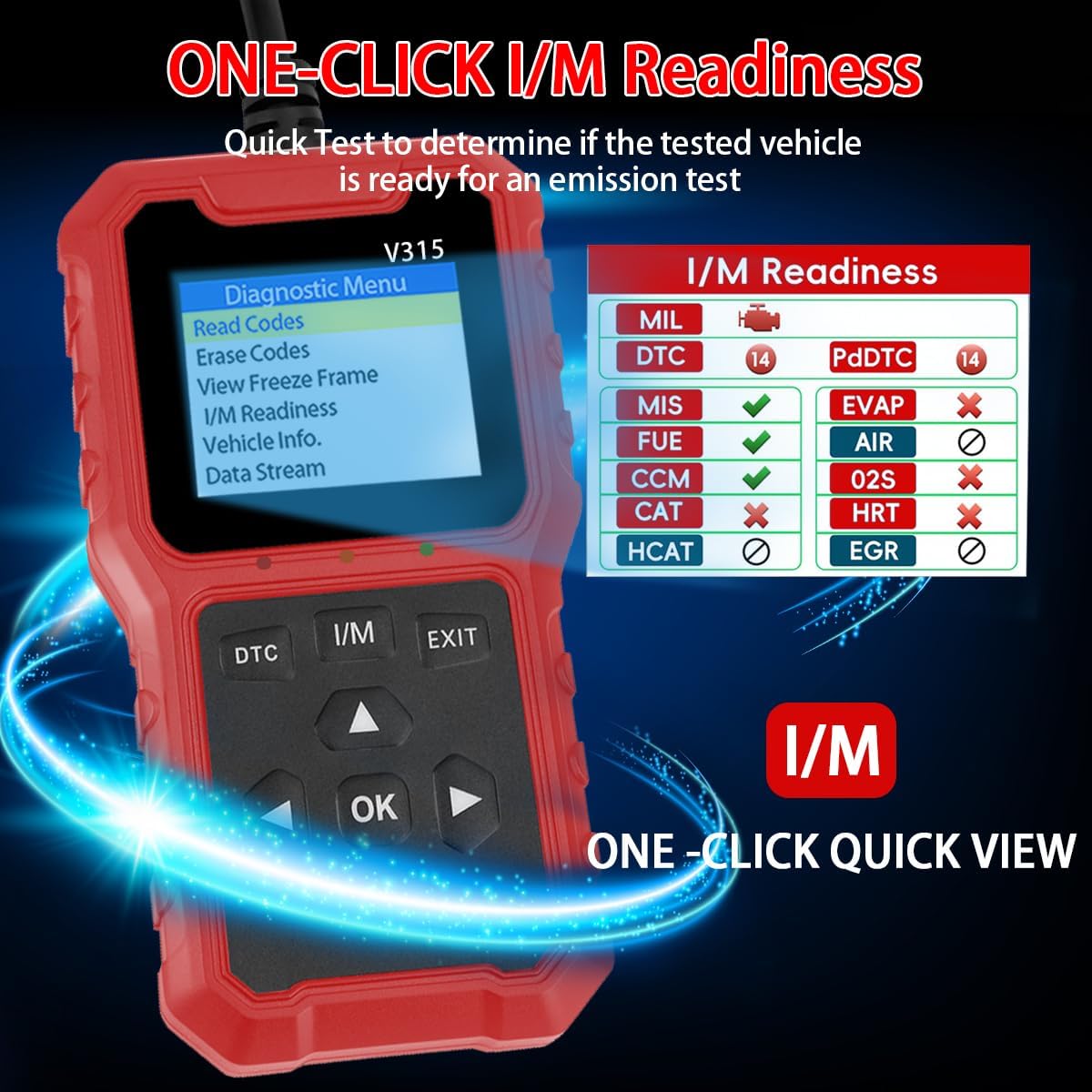
- I/M Readiness: Quick test to determine if the vehicle is ready for an emission test.
- Real-Time Data: Tracks over 20 data streams including fuel pressure and coolant temperature.
- User-Friendly Design: 2.8-inch LCD screen, durable 16-pin OBDII plug, soft silicone buttons.
- Multi-Language Support: Includes English, German, Italian, Spanish, Japanese, Portuguese, Dutch, French.

3. Setup Guide
3.1 Connecting the Scanner
- Locate your vehicle's 16-pin Data Link Connector (DLC). This is usually found under the dashboard on the driver's side.
- Ensure the vehicle's ignition is OFF before connecting the scanner.
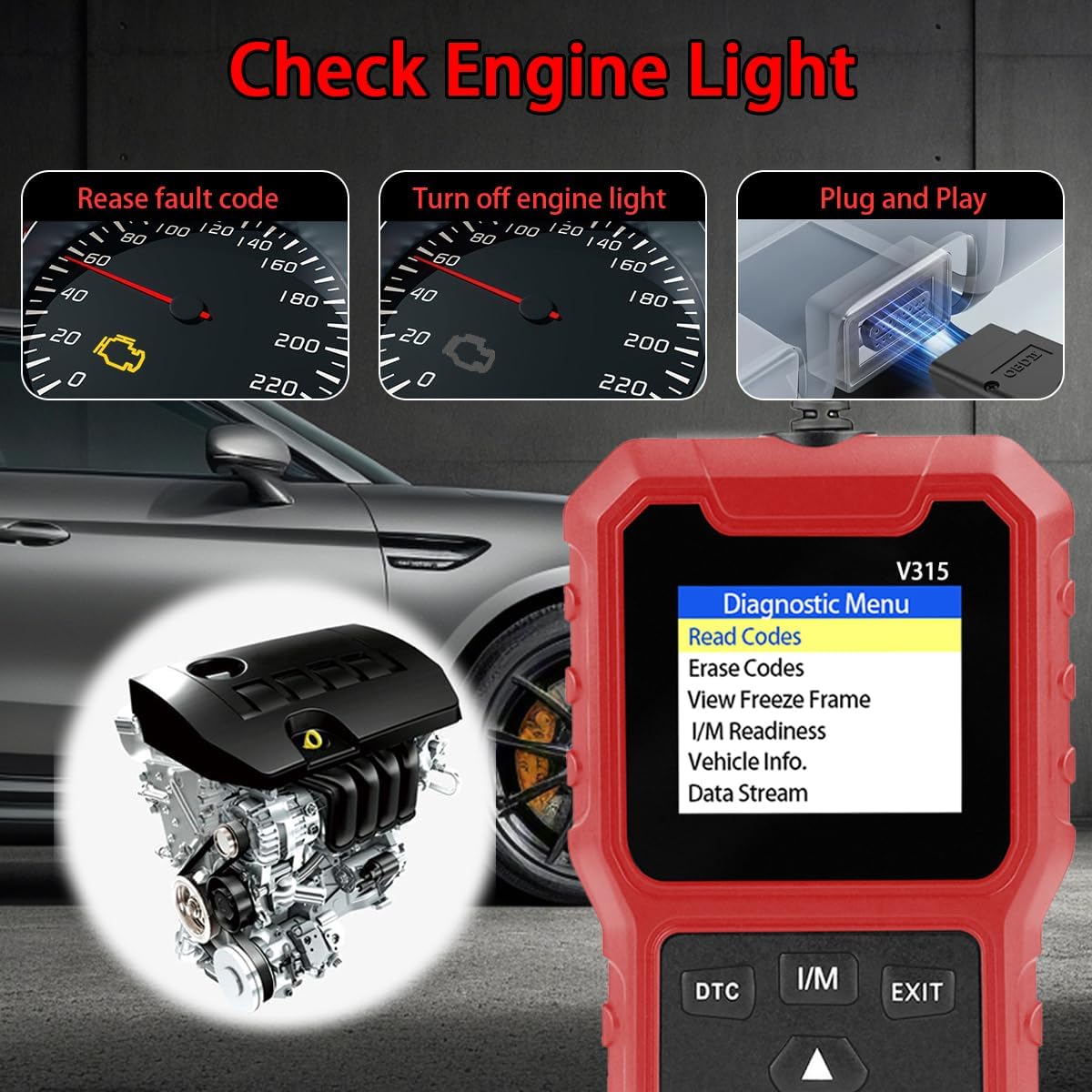
- Firmly plug the V315 scanner's OBDII connector into the vehicle's DLC port.
- Turn the vehicle's ignition to the ON position (engine can be off or running, depending on the test). The scanner will power on automatically.

3.2 Language Selection
Upon first use or after a reset, you may be prompted to select your preferred language. Use the arrow buttons to navigate and the 'OK' button to confirm your selection.
4. Operating Instructions
The V315 scanner features a simple button layout for easy navigation:
- DTC: Direct access to Diagnostic Trouble Codes.
- I/M: Direct access to I/M Readiness status.
- EXIT: Returns to the previous menu or exits a function.
- OK: Confirms selections.
- Arrow Buttons (Up/Down/Left/Right): Navigate through menus and data.

4.1 Diagnostic Menu Functions
From the main 'Diagnostic Menu', use the arrow buttons to select and 'OK' to enter the desired function:
- Read Codes: Retrieves Diagnostic Trouble Codes (DTCs) from the vehicle's computer. These codes indicate specific issues detected by the vehicle's self-diagnostic system.
- Erase Codes: Clears DTCs from the vehicle's computer and turns off the Check Engine Light (MIL). Ensure the underlying issue is resolved before clearing codes to prevent recurrence.
- View Freeze Frame: Displays a snapshot of the vehicle's operating conditions at the moment a fault code was set. This data can help pinpoint the cause of the fault.
- I/M Readiness: Checks the status of various emission-related monitors to determine if the vehicle is ready for an emissions test.
- Vehicle Info: Retrieves vehicle identification number (VIN), calibration ID (CALID), and calibration verification number (CVN).
- Data Stream: Displays real-time operational data from the vehicle's sensors and components, such as engine RPM, vehicle speed, coolant temperature, and fuel system status.

5. Compatibility and Limitations
The V315 scanner is designed for broad compatibility but has specific limitations:
- Supported Vehicles: Gasoline cars produced after 1996 (USA), 2002 (EU), and 2008 (Asia).
- Exclusions: This scanner does NOT support hybrid vehicles, electric vehicles, or non-OBD2 compliant models.
- Unsupported Detections: The V315 does NOT support ABS (Anti-lock Braking System), SRS (Supplemental Restraint System), or TPMS (Tire Pressure Monitoring System) detection.
- Diesel Vehicles: For diesel vehicles, please verify that the specific protocols used by your vehicle are supported by the V315 scanner.

5.1 Supported Protocols
The V315 scanner supports the following OBDII communication protocols:
- SAE J1850 PWM (41.6 Kbaud)
- SAE J1850 VPW (10.4 Kbaud)
- ISO9141-2 (5 baud init, 10.4 Kbaud)
- ISO14230-4 KWP (5 baud init, 10.4 Kbaud)
- ISO14230-4 KWP (fast init, 10.4 Kbaud)
- ISO15765-4 CAN (11bit ID, 500 Kbaud)
- ISO15765-4 CAN (29bit ID, 500 Kbaud)
- ISO15765-4 CAN (11bit ID, 250 Kbaud)
- ISO15765-4 CAN (29bit ID, 251 Kbaud)
6. Specifications
| Feature | Description |
|---|---|
| Display | 2.8-inch LCD Screen |
| Interface | Standard 16-pin OBDII Connector |
| Operating Voltage | 9-16V (via vehicle OBDII port) |
| Supported Protocols | SAE J1850 PWM, SAE J1850 VPW, ISO9141-2, ISO14230-4 KWP, ISO15765-4 CAN |
| Supported Languages | English, German, Italian, Spanish, Japanese, Portuguese, Dutch, French |
| Dimensions (L x W x H) | 13.00 cm x 6.20 cm x 7.00 cm (approx. 5.12 in x 2.44 in x 2.76 in) |
| CPU | Upgraded for high-speed processing |
7. Maintenance
- Cleaning: Use a soft, damp cloth to clean the exterior of the scanner. Do not use abrasive cleaners or solvents.
- Storage: Store the device in a dry, cool environment away from direct sunlight and extreme temperatures.
- Cable Care: Avoid bending or twisting the OBDII cable excessively. Always grasp the connector when plugging or unplugging, not the cable itself.
- Screen Protection: The device comes with a bright acrylic screen protective cover. Avoid scratching the screen.
8. Troubleshooting
- Scanner Does Not Power On:
- Ensure the OBDII connector is securely plugged into the vehicle's DLC.
- Verify the vehicle's ignition is in the ON position.
- Check the vehicle's fuse for the OBDII port (refer to your vehicle's owner's manual).
- Communication Error:
- Confirm the vehicle is OBD2 compliant and within the supported manufacturing years.
- Ensure the ignition is ON.
- Try connecting to a different OBD2 compliant vehicle to rule out scanner malfunction.
- Check for any loose connections in the OBDII cable.
- Codes Cannot Be Cleared:
- The underlying fault causing the code may still be present. Codes cannot be cleared if the issue persists.
- Ensure the ignition is ON and the engine is OFF when attempting to clear codes.
9. User Tips
- Always consult your vehicle's owner's manual for specific information regarding your vehicle's diagnostic system and OBDII port location.
- When diagnosing a Check Engine Light, always read the codes first before attempting to clear them. This provides valuable information for troubleshooting.
- Use the 'Freeze Frame' data to understand the conditions under which a fault occurred, which can be crucial for intermittent problems.
- For diesel vehicles, double-check the supported protocols to ensure compatibility before use.
10. Warranty and Support
For any issues or questions regarding your V315 OBD2 Universal Diagnostic Scanner, please contact customer service. We are committed to providing support and will respond to inquiries within 24 hours.


