1. Okwu mmalite
Thank you for choosing the Wiltec NW-SOFT-C1 Automatic Water Softener. This device is designed to provide a continuous supply of softened water by reducing water hardness through an ion exchange process. This manual contains important information regarding the installation, operation, and maintenance of your water softener. Please read it thoroughly before use to ensure proper function and longevity of the product.
2. Ntuziaka nchekwa
- Always disconnect the power supply before performing any maintenance or service.
- Ensure the installation location is dry, well-ventilated, and protected from freezing temperatures and direct sunlight.
- The device must be installed by a qualified professional in accordance with local plumbing and electrical codes.
- Ejila ngwa ma ọ bụrụ na eriri ọkụ ma ọ bụ plọg mebiri emebi.
- Keep children and unauthorized personnel away from the unit during operation and maintenance.
- Use only regeneration salt specifically designed for water softeners.
- Ensure proper drainage for the regeneration wastewater.
3. Ngwaahịa gafereview
The Wiltec NW-SOFT-C1 is a compact and versatile automatic water softener capable of softening up to 500 liters of water per hour. It features an intuitive display for setting initial water hardness and an automatic control system for regeneration.
3.1 Atụmatụ
- Ọrụ akpaaka: Provides continuous soft water supply.
- Ngosipụta Enyi na Enyi: Easy setting of initial water hardness.
- Appliance Protection: Reduces limescale buildup, extending the lifespan of household appliances.
- Ion Exchange Technology: Utilizes special resin to remove calcium and magnesium ions.
- Automatic Resin Regeneration: Ensures consistent performance with minimal intervention.
3.2 Akụkụ na Nha
Familiarize yourself with the main components and overall dimensions of the water softener for proper placement and installation planning.
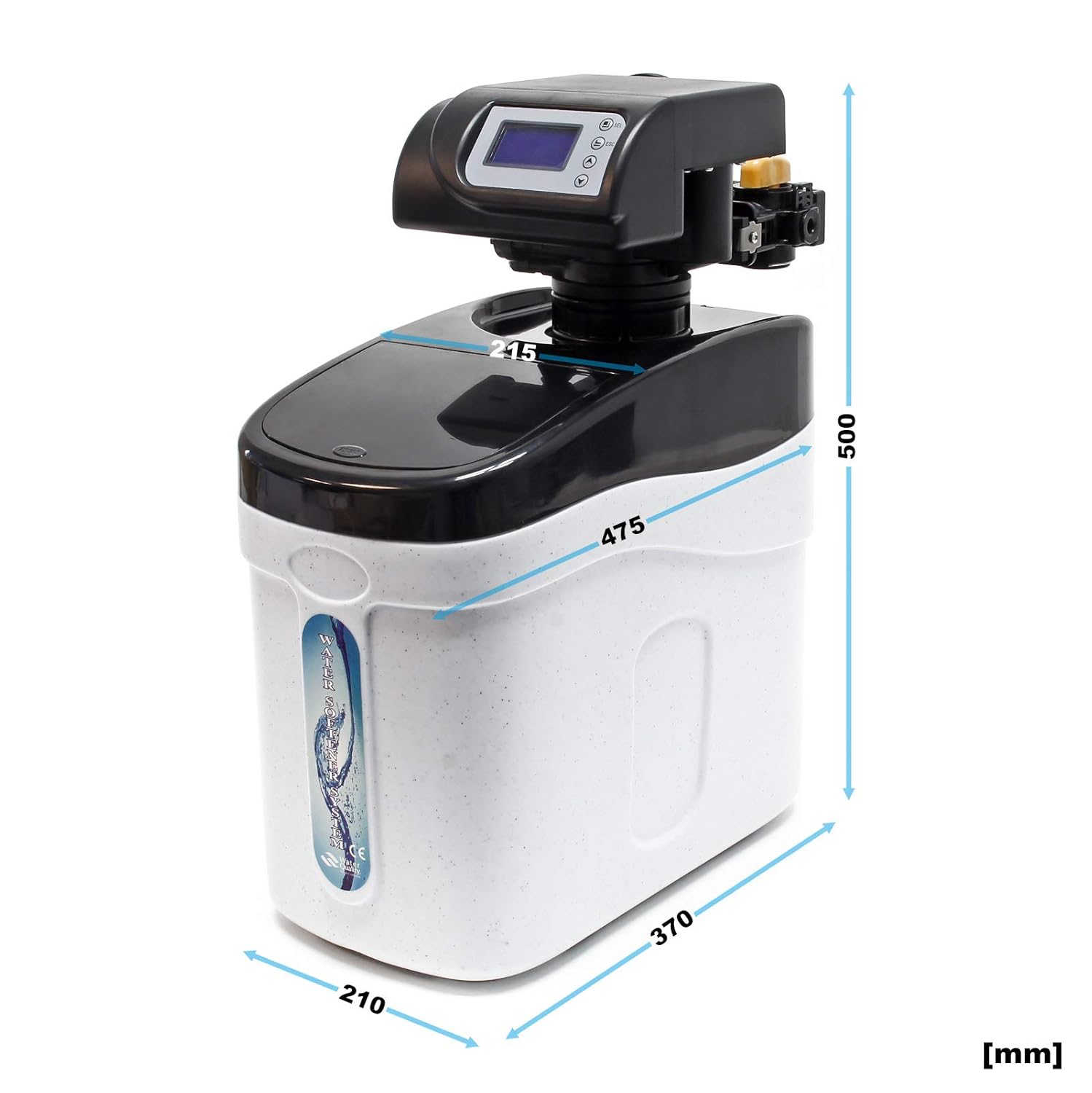
Foto 1: N'ihu view of the Wiltec NW-SOFT-C1 Water Softener with overall dimensions in millimeters. The unit measures approximately 210mm wide, 370mm deep, and 500mm high.

Foto 2: Akụkụ view of the Wiltec NW-SOFT-C1 Water Softener, showing the drain pipe connection with a diameter of 14mm and a height of 400mm.

Figure 3: Top-down internal view of the brine tank, showing internal dimensions for salt placement. The tank measures approximately 120mm by 175mm internally.
4. Ntọala na nwụnye
Proper installation is crucial for the efficient operation of your water softener. Refer to the diagram below for connection details.
4.1 Nzọụkwụ nwụnye
- Họrọ ebe: Select a suitable location near the main water supply, a drain, and a power outlet. Ensure adequate space for maintenance and salt replenishment.
- Water Supply Shut-off: Gbanyụọ isi mmiri n'ụlọ gị.
- Connect Inlet/Outlet: Connect the incoming hard water line to the softener's inlet and the softened water line to the outlet. The connections are 26.44 mm (¾") AG.
- Valve gafere: Install a bypass valve system to allow for manual bypass of the softener if needed (e.g., for outdoor watering).
- Ahịrị igbapu: Connect the drain line (Ø 14 mm) from the control valve to a suitable drain. Ensure the drain line has an air gap to prevent back-siphonage.
- Brine Line: Connect the brine line from the control valve to the brine well inside the salt tank.
- Njikọ ike: Tinye ihe nkwụnye ọkụ n'ime oghere eletrik gbadoro ụkwụ.
- Add Salt: Jupụta brine tank na mmiri nro nnu nnu.
- Mmalite mbụ: Slowly open the main water supply valve to fill the softener with water. Check for leaks.
- Program Controller: Set the initial water hardness level on the display according to your local water supply data.
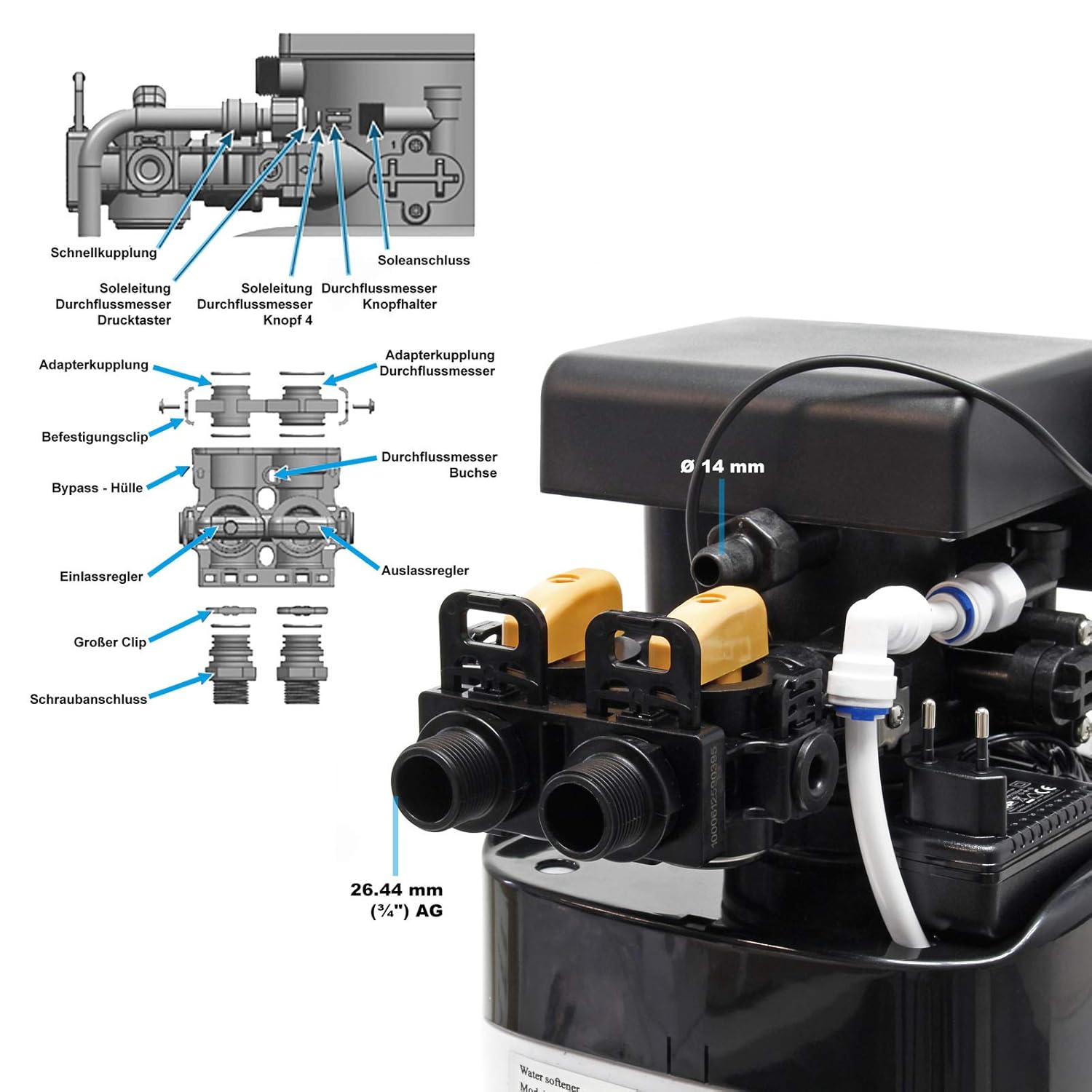
Figure 4: Detailed diagram showing the various connection points and components for installation, including quick couplings, brine line, bypass housing, inlet/outlet regulators, and screw connections. The main connections are 26.44 mm (¾") AG.
5. Ntuziaka ọrụ
The Wiltec NW-SOFT-C1 operates automatically once configured. The control panel allows for initial setup and monitoring.
5.1 Mmemme Mmalite
- Upon first power-up, the display will prompt you to set the current time and date.
- Navigate through the menu using the control buttons to find the water hardness setting.
- Enter your local water hardness value (e.g., in dH or ppm). This value is critical for the softener to calculate regeneration cycles accurately.
- Confirm settings. The system will then automatically manage the softening process and regeneration cycles.
5.2 How Water Softening Works (Ion Exchange)
The water softener utilizes a resin bed to remove hardness minerals. Hard water containing calcium (Ca²⁺) and magnesium (Mg²⁺) ions passes through the resin, which contains sodium (Na⁺) ions. The resin attracts and holds the calcium and magnesium ions, releasing sodium ions into the water. This process effectively softens the water.

Figure 5: Illustration of the ion exchange reaction. Calcium (Ca²⁺) and Magnesium (Mg²⁺) ions are exchanged for Sodium (Na⁺) ions on the ion exchange resin (cation exchanger).

Figure 6: Internal schematic showing the flow of water and the regeneration process. Hard water enters, passes through the resin bed in the pressure tank, becomes soft water, and exits. During regeneration, brine solution flushes the resin, and wastewater is drained. Key components include the automatic central control valve, brine hose, safety brine valve, float, suction lance, exchange resin, and cabinet tank.
6. Nlekọta
Regular maintenance ensures optimal performance and extends the life of your water softener.
6.1 Salt Level Monitoring and Refill
- Check the salt level in the brine tank regularly, typically once a month.
- Ensure the salt level is always above the water level in the brine tank.
- Refill the tank with high-quality water softener salt (pellets, crystals, or blocks) when the level is low. Do not use rock salt or table salt.
6.2 Automatic Regeneration
The system automatically initiates regeneration cycles based on water usage and programmed hardness. During regeneration, a brine solution flushes the accumulated hardness minerals from the resin, recharging it with sodium ions. This process typically takes about an hour.
- Ensure there is always enough salt for regeneration.
- Do not interrupt a regeneration cycle.
6.3 Nhicha
- Periodically clean the brine tank to remove any salt residue or sludge. This can be done annually or as needed.
- Jiri mgbasa ozi hichapụ mpụta nke otuamp akwa . Ejila ihe nhicha abrasive.
7. Nchọpụta nsogbu
This section addresses common issues you might encounter with your water softener.
| Nsogbu | Ihe nwere ike ime | Ngwọta |
|---|---|---|
| Water is still hard. | Low salt level in brine tank. Incorrect water hardness setting. valvụ gafere emeghe. Resin bed exhausted or fouled. | Add salt to the brine tank. Verify and adjust the water hardness setting on the display. Ensure the bypass valve is in the service position. Initiate a manual regeneration. If problem persists, contact support. |
| Softener not regenerating. | Enweghị ike na unit. Control valve malfunction. Low salt level. | Lelee njikọ ọkụ na ihe nkwụsị sekit. Check salt level and refill if necessary. Contact support if the control valve is faulty. |
| Salt bridge in brine tank. | Salt has solidified, preventing brine formation. | Carefully break up the salt bridge with a broom handle or similar tool. Avoid damaging the brine well or float assembly. |
| Water pressure drop. | Clogged filters (if pre-filter installed). Resin bed fouled. | Clean or replace pre-filters. Initiate a manual regeneration. |
8. Nkọwapụta
Technical data for the Wiltec NW-SOFT-C1 water softener.
| Njirimara | Nkọwapụta |
|---|---|
| Nọmba nlereanya | NW SOFT C1 |
| Ọnụego mgbaba | 500 lita kwa elekere |
| Brine tank ike | 10 kg salt (implied by product title) |
| Akụkụ (L x W x H) | 21.5 x 47.5 x 50 cm |
| Ibu | 10.5 kilogram |
| Isi Iyi Ike | Igwe ọkụ eletrik |
| Usoro ntinye | Ntighari |
| Ụzọ nchacha | Ion Exchange |
| Ihe onwunwe | Resin |
| Njirimara Pụrụ Iche | Automatic resin regeneration |

Figure 7: Technical information table comparing various Wiltec water softener models. For the NW-SOFT-C1, it shows capacity at 10°dH (1500L), 15°dH (1000L), 20°dH (800L), nominal flow (0.3m³/h), max pressure (6.0 bar), min pressure (1.0 bar), pressure drop (0.6 bar), salt consumption per regeneration (0.8 kg), and regeneration time (30 min).
9. Akwụkwọ ikike na nkwado
For warranty information, please refer to the documentation provided with your purchase or contact Wiltec customer service. Keep your proof of purchase for any warranty claims.
If you encounter issues not covered in the troubleshooting section or require further assistance, please contact Wiltec customer support. Contact details can typically be found on the manufacturer's websaịtị ma ọ bụ akwụkwọ ọnụahịa ịzụrụ ihe gị.


