
Introduction
Thank you for choosing RI RESIONE products. This manual provides essential information for the safe and effective use of your F80 Elastic 3D Printer Resin and 3D Resin Detergent. Please read these instructions carefully before use to ensure proper handling, optimal printing results, and safe cleaning practices.
F80 Elastic 3D Printer Resin Overview
The RI RESIONE F80 Elastic Resin is engineered for 3D printing applications requiring flexibility and resilience. It is particularly suitable for creating models that need to withstand deformation and return to their original shape.
Key Characteristics:
- Soft Touch: Prints exhibit a Shore hardness of 50-60A, providing a soft and tactile feel.
- High Elasticity: The resin produces prints that are full of elasticity, allowing for significant bending and compression.
- Good Resilience: Printed objects can quickly recover their original shape after being deformed, making them ideal for functional parts.
- Low Temperature Resistance: F80 prints maintain their softness even in cold environments below 10°C (50°F), though elasticity may slightly decrease with lower temperatures.
- Application: The pink F80 flexible resin is specifically well-suited for manufacturing dental gum models due to its unique properties.

Image: A black twisted resin print being held and bent, illustrating its soft touch and elasticity. The print has a Shore hardness of 50-60A.

Image: A 3D printed tire model showcasing its good resilience. An inset image shows the tire being compressed, highlighting its ability to recover shape.

Image: A bottle of RESIONE F80 Elastic Resin, illustrating its low temperature resistance. The image shows that prints remain soft even below 10°C.
RI RESIONE 3D Resin Detergent Overview
The RI RESIONE 3D Resin Detergent is formulated to provide an effective and safe cleaning solution for 3D printed resin parts, offering advantages over traditional cleaning agents like alcohol or IPA.
Key Advantages:
- Preserves Print Integrity: Unlike alcohol or IPA, this detergent prevents softening, deformation, brittle breaks, or cracking of fine details and thin walls, even after prolonged soaking. It fully protects the print's structural integrity, mechanical properties, and dimensional stability.
- Effective Cleaning: Ensures a dry, clean finish without leaving any white residue, which can be a common issue with IPA or alcohol.
- Designed for Home Use:
- Passed RoHS and SVHC tests, confirming compliance with environmental and safety standards.
- Features a mild, low-irritation formula with very low volatility, reducing unpleasant fumes.
- Classified as non-flammable, making it safer for storage and use in home or small studio environments.
- Cost-Effective: The detergent can clean a greater volume of 3D printed parts compared to an equivalent volume of alcohol or IPA.

Image: A bottle of RESIONE 3D Resin Detergent, highlighting its features such as low odor, low irritation, effective cleaning, and no damage to prints. It also shows compliance with RoHS and SVHC standards.
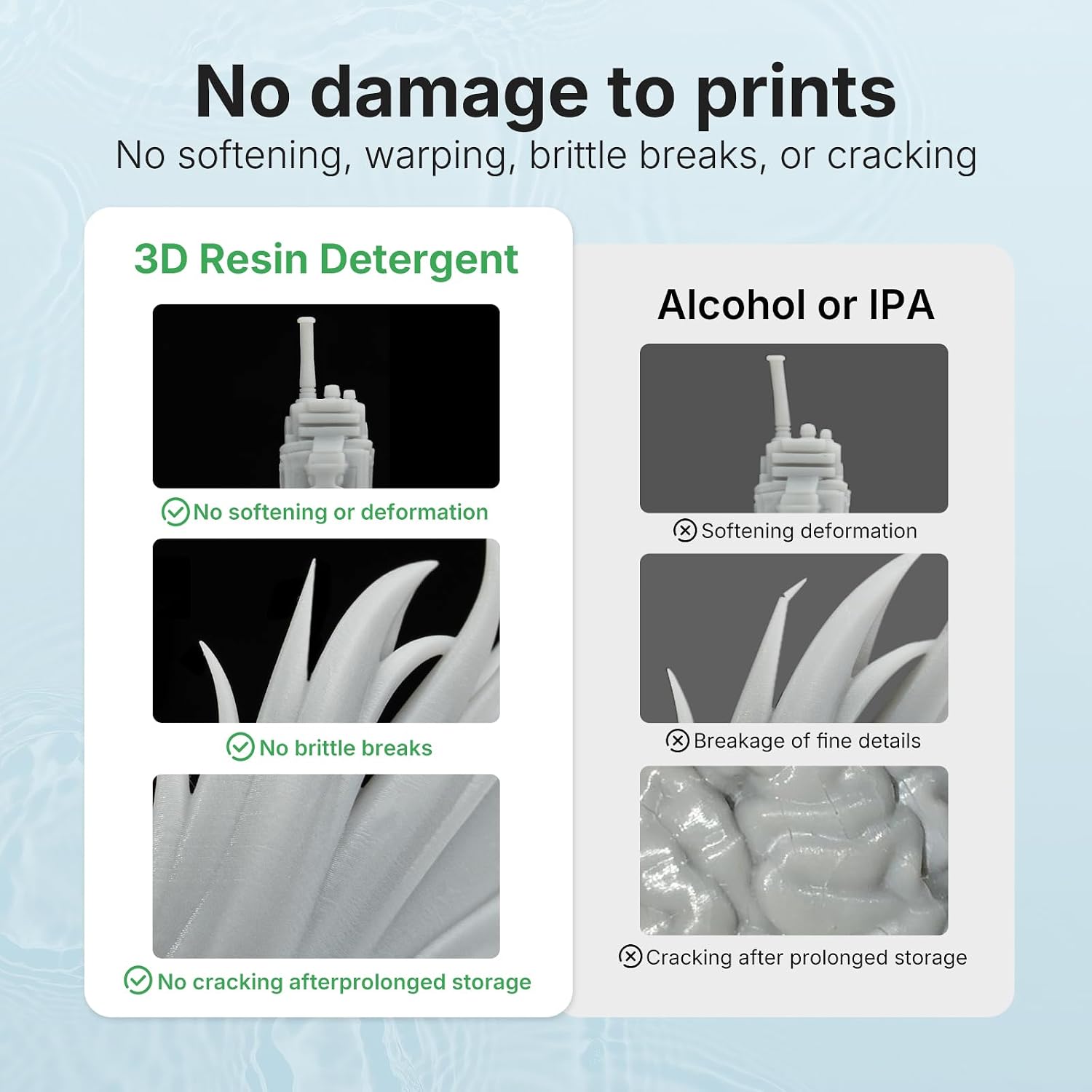
Image: A visual comparison demonstrating that the 3D Resin Detergent prevents softening, deformation, brittle breaks, and cracking in prints, unlike alcohol or IPA.

Image: Illustrates the effective cleaning capability of the detergent, resulting in dry and non-sticky prints without white residue, contrasting with potential whitening from other cleaning methods.

Image: Depicts the 3D Resin Detergent in a home or small studio setting with a 3D printer and cleaning setup, highlighting its low volatility, low irritation, and non-flammable properties for safe home use.

Image: A comparative graphic demonstrating the affordability and efficiency of RESIONE 3D Resin Detergent, showing it can clean more 3D printed parts than the same volume of alcohol or IPA.
Safety Precautions
Always prioritize safety when handling 3D printer resin and cleaning agents. Failure to follow these precautions can result in injury or damage.
- Ventilation: Use both resin and detergent in a well-ventilated area.
- Personal Protective Equipment (PPE): Always wear appropriate PPE, including nitrile gloves, safety glasses, and a respirator (if recommended for resin handling).
- Skin Contact: Avoid direct skin contact. If contact occurs, wash immediately with soap and water.
- Eye Contact: In case of eye contact, flush thoroughly with water for at least 15 minutes and seek immediate medical attention.
- Ingestion: Do not ingest. If swallowed, do not induce vomiting. Seek immediate medical attention.
- Storage: Store resin and detergent in their original containers, tightly sealed, in a cool, dry, dark place, away from direct sunlight and heat sources. Keep out of reach of children and pets.
- Disposal: Dispose of uncured resin and used detergent according to local regulations. Uncured resin is hazardous waste. Cured resin is generally safe for regular waste disposal.
- Flammability: While the 3D Resin Detergent is classified as non-flammable, always exercise caution around open flames or ignition sources.
Setup
Preparing Your Workspace:
- Ensure your 3D printing area is clean, well-ventilated, and free from direct sunlight.
- Gather all necessary safety equipment: nitrile gloves, safety glasses, and a clean work surface.
- Have paper towels or absorbent cloths readily available for spills.
- Prepare your resin 3D printer according to its manufacturer's instructions.
Operating Instructions: F80 Elastic 3D Printer Resin
Before Printing:
- Shake Bottle: Gently shake the resin bottle for at least 1 minute to ensure all components are well mixed.
- Temperature: Ensure the resin and ambient temperature are within the recommended range (typically 20-25°C or 68-77°F) for optimal performance.
- Pour Resin: Carefully pour the desired amount of F80 Elastic Resin into the printer's resin vat. Avoid overfilling.
- Printer Settings: Refer to your 3D printer's manual and RESIONE's recommended settings for F80 Elastic Resin. Start with exposure times suitable for flexible resins.
During Printing:
- Monitor the printing process.
- Avoid exposing the resin vat to direct UV light during printing.
After Printing:
- Remove Print: Carefully remove the printed model from the build plate using a plastic scraper to avoid damage.
- Clean Print: Proceed to the "Operating Instructions: RI RESIONE 3D Resin Detergent" section for cleaning your print.
- Post-Cure: After cleaning and drying, post-cure the print using a UV curing station or natural sunlight until fully hardened. Curing times vary based on UV intensity and print thickness. Ensure the print is completely dry before post-curing to prevent white residue.
Operating Instructions: RI RESIONE 3D Resin Detergent
Cleaning Your 3D Prints:
- Prepare Cleaning Station: Pour the RI RESIONE 3D Resin Detergent into a suitable cleaning container or ultrasonic cleaner.
- Wash Print: Submerge the freshly printed part in the detergent. Gently agitate the part or use an ultrasonic cleaner for 2-5 minutes, depending on print size and complexity. Ensure all uncured resin is removed from the surface and crevices.
- Rinse with Water: After washing with the detergent, rinse the printed parts thoroughly with clean tap water to remove any detergent residue.
- Dry Print: Blow-dry the surface of the print using compressed air or allow it to air dry completely. Ensure no moisture remains before proceeding to post-curing.
- Post-Cure: Once dry, perform post-curing as described in the "Operating Instructions: F80 Elastic 3D Printer Resin" section.
Maintenance
Resin Handling and Storage:
- Unused Resin: Filter any unused resin from the vat back into its original bottle using a resin filter funnel. This removes any cured particles.
- Bottle Storage: Tightly seal the resin bottle and store it in a cool, dark place away from direct sunlight and UV light.
- Vat Cleaning: Clean the resin vat and build plate thoroughly after each print session or when changing resin types.
Detergent Handling and Storage:
- Used Detergent: Used detergent can be reused multiple times until its cleaning effectiveness diminishes. Store it in a sealed container.
- Disposal: Dispose of spent detergent according to local environmental regulations. Do not pour down drains.
- Bottle Storage: Keep the detergent bottle tightly sealed and store in a cool, dry place, out of reach of children and pets.
Troubleshooting
| Problem | Possible Cause | Solution |
|---|---|---|
| Prints are too soft or sticky after curing. | Insufficient post-curing; print not fully dry before curing. | Increase post-curing time. Ensure print is completely dry after washing and before curing. |
| Prints fail to adhere to the build plate. | Build plate not level; insufficient bottom exposure time; cold resin/environment. | Re-level the build plate. Increase bottom exposure time in slicer settings. Ensure resin and room temperature are optimal. |
| Prints have white residue after cleaning. | Incomplete rinsing after detergent; detergent residue left on print. | Rinse prints thoroughly with clean water after washing with detergent. Ensure prints are completely dry before post-curing. |
| Detergent not cleaning effectively. | Detergent is saturated with uncured resin. | Replace the used detergent with fresh detergent. |
Specifications
| Feature | Detail |
|---|---|
| Brand | RI RESIONE |
| Product Name | F80 Elastic 3D Printer Resin & 3D Resin Detergent |
| Model (Resin) | F80 |
| Resin Type | Elastic Photopolymer Resin |
| Resin Hardness | 50-60A Shore Hardness |
| Detergent Compliance | RoHS, SVHC compliant |
| Detergent Flammability | Non-flammable |
| Net Content | 3.6KG (Combined Resin & Detergent) |
| ASIN | B0G6X5Y1YT |
Warranty and Support
For any questions, technical assistance, or support regarding your RI RESIONE F80 Elastic 3D Printer Resin or 3D Resin Detergent, please contact RI RESIONE customer service through the official website or your purchase platform.
Specific warranty details may vary by region and retailer. Please refer to your purchase documentation for information on product warranty and return policies. RI RESIONE is committed to providing high-quality products and support to ensure your satisfaction.