
Introduction
This manual provides detailed instructions for the Qubick Wireless Controller, designed for use with Nintendo Switch, NS2, and PC. Please read this manual carefully before using the product to ensure proper operation and to maximize your gaming experience. Keep this manual for future reference.
Product Overview
The Qubick Wireless Controller features advanced wireless technology, Hall Effect triggers, precise analog sticks, and a Six-Axis motion sensor for immersive gameplay. It includes programmable back buttons, adjustable vibration, and multiple connectivity modes.
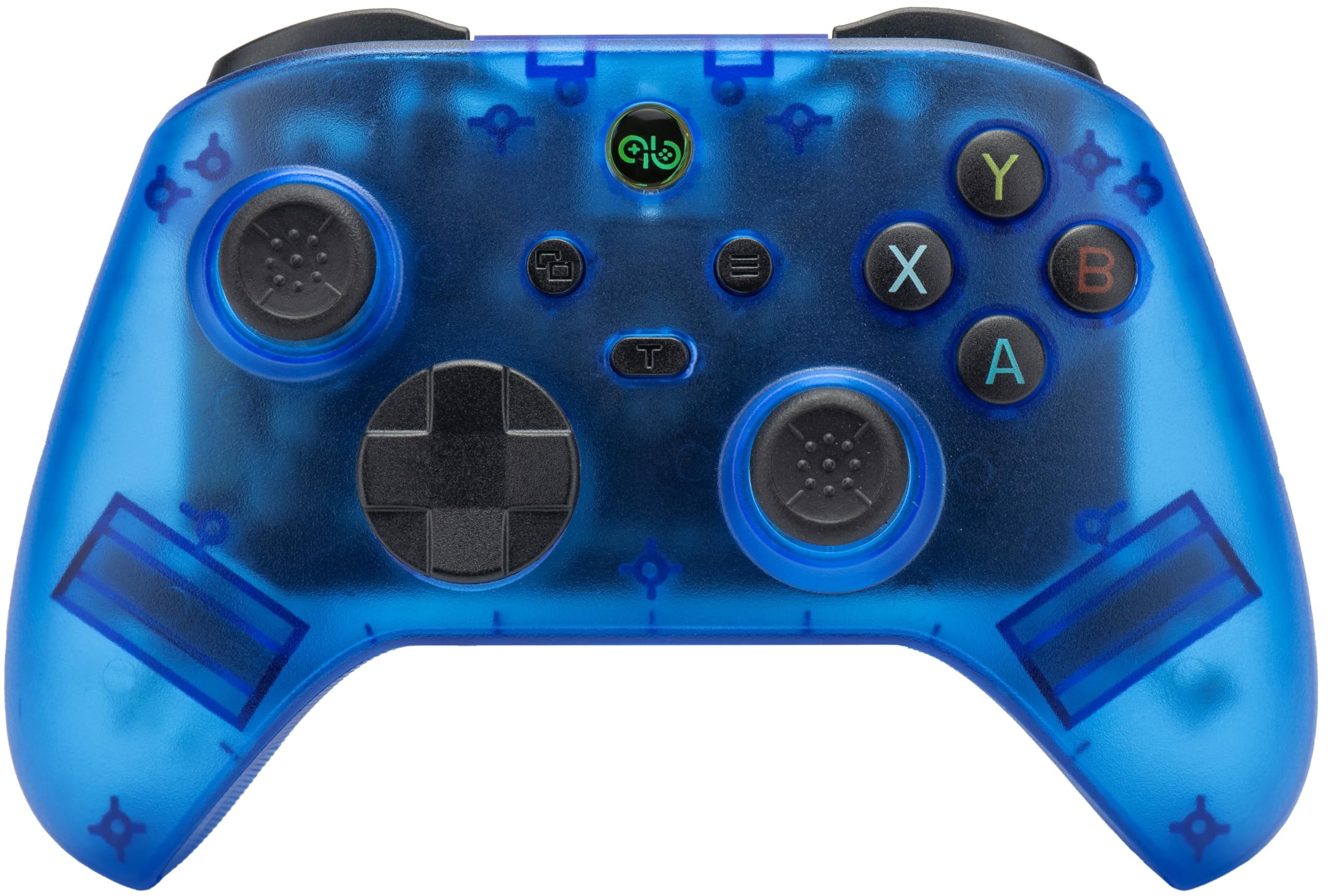
Image: Front view of the Qubick Wireless Controller, showcasing its transparent blue casing, dual analog sticks, D-pad, and face buttons (A, B, X, Y).
Setup
1. Initial Charging
Before first use, fully charge the controller. Connect the supplied USB Type-C cable to the controller's charging port and the other end to a USB power source (e.g., console, PC, or USB wall adapter). The LED indicators will show charging status.
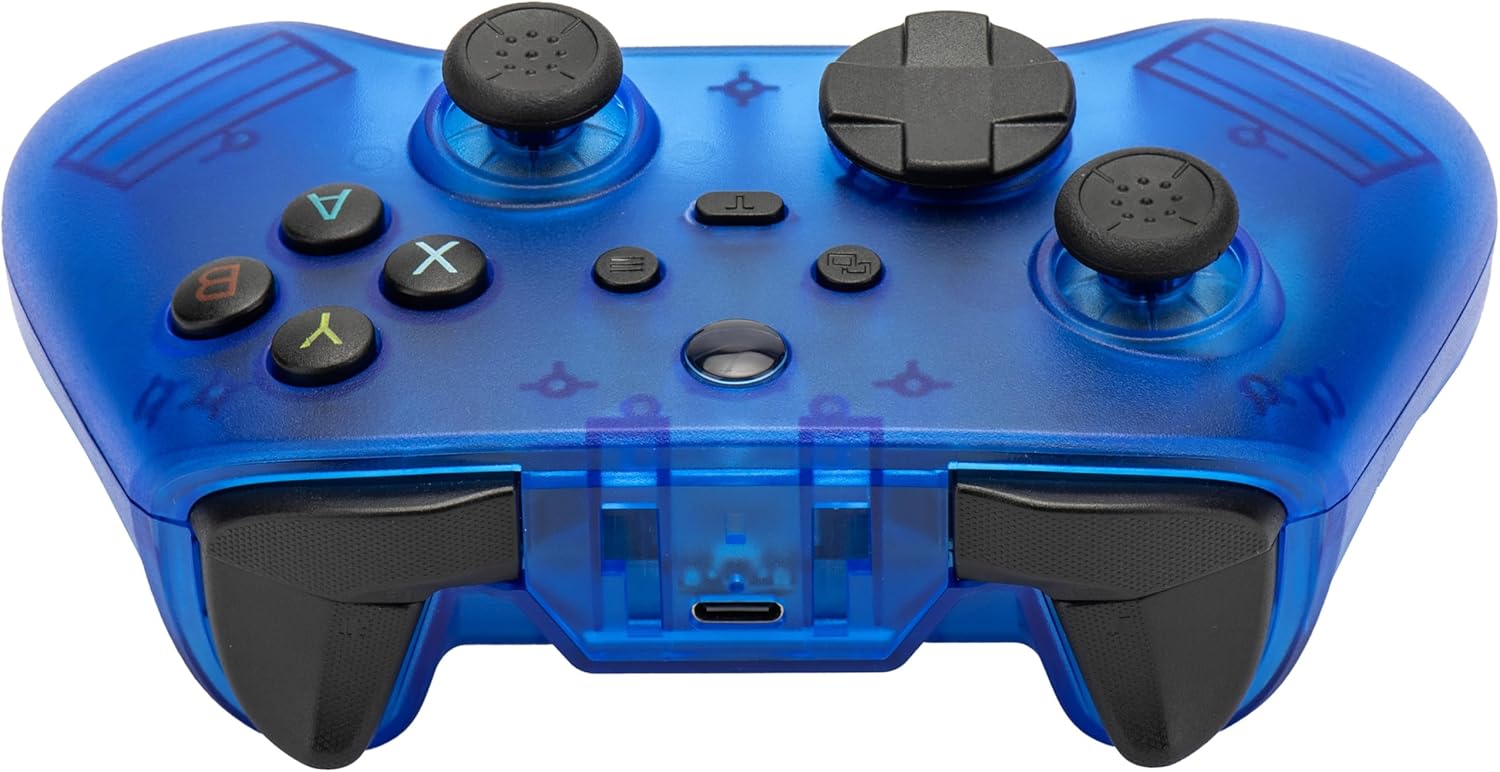
Image: Front view of the Qubick Wireless Controller, highlighting the USB Type-C charging port located at the top center.
2. Pairing with Nintendo Switch
- On your Nintendo Switch console, go to the HOME Menu.
- Select 'Controllers' > 'Change Grip/Order'.
- Press and hold the pairing button on the Qubick Wireless Controller until the LED indicators begin to flash rapidly.
- Once paired, the controller's LED will remain solid, indicating a successful connection.
3. Pairing with PC
- Ensure the controller is in the correct PC mode (Xinput). Use the mode change button if necessary.
- Connect the controller to your PC via the USB Type-C cable, or follow Bluetooth pairing instructions if your PC supports it.
- For Bluetooth, go to your PC's Bluetooth settings, enable Bluetooth, and search for new devices. Select the Qubick Wireless Controller when it appears.
4. Mode Switching
The controller supports multiple modes: V3, MFi, Xinput, Switch, and 2.4G. Use the dedicated mode change button to cycle through these options to match your device's requirements.
Operating Instructions
1. Button Layout
Familiarize yourself with the controller's buttons:
- Analog Sticks: Left and Right for movement and camera control.
- D-Pad: Directional input.
- Face Buttons (A, B, X, Y): Primary action buttons.
- Shoulder Buttons (L, R) and Triggers (ZL, ZR): Additional action inputs.
- Home Button: Returns to the console's home screen.
- Plus (+) / Minus (-) Buttons: System functions.
- Screenshot Button: Captures screenshots.
- M1 / M2 Buttons: Programmable back buttons.

Image: Angled front view of the Qubick Wireless Controller, showing the arrangement of all primary buttons and analog sticks.
2. Turbo and Auto Turbo Function
The controller supports Turbo and Auto Turbo functions for rapid button presses.
- To activate Turbo: Press and hold the desired action button, then press the Turbo button. The button will now rapidly repeat its input when held down.
- To activate Auto Turbo: Press the desired action button, then press the Turbo button twice. The button will now rapidly repeat its input without being held down.
- To deactivate Turbo/Auto Turbo: Repeat the activation steps for the specific button, or clear all Turbo settings by holding the Turbo button for 5 seconds.
3. Vibration Adjustment
The dual-motor vibration system has 3 intensity levels. To adjust, press and hold the vibration adjustment button (refer to controller diagram for location) and use the D-pad Up/Down to cycle through intensity levels.
4. Six-Axis Motion Sensor Calibration
If motion controls feel inaccurate, you can recalibrate the Six-Axis sensor. Refer to the specific instructions provided in the console's system settings or the full online manual for detailed calibration steps.
5. Programmable Back Buttons (M1/M2)
The M1 and M2 buttons on the back of the controller can be programmed to replicate other button inputs.

Image: Back view of the Qubick Wireless Controller, clearly showing the M1 and M2 programmable buttons on the grips.
- To program: Press and hold the 'Program' button (usually a small button near M1/M2) until the indicator light flashes.
- Press the M1 or M2 button you wish to program.
- Press the button (or sequence of buttons) you want M1/M2 to emulate.
- Press the 'Program' button again to save the setting. The indicator light will stop flashing.
6. LED Indicators
The controller features LED indicators to display its status:
- Flashing LEDs: Indicates pairing mode or low battery.
- Solid LED(s): Indicates successful connection and player number (for Switch).
- Pulsing LED: Indicates charging in progress.
- LED Off (when connected to power): Indicates fully charged.
Maintenance
1. Cleaning
Use a soft, dry cloth to clean the controller. For stubborn dirt, slightly dampen the cloth with water. Do not use harsh chemicals or abrasive cleaners, as these can damage the surface.
2. Storage
Store the controller in a cool, dry place away from direct sunlight and extreme temperatures. Avoid placing heavy objects on the controller.
3. Battery Care
To prolong battery life, avoid fully discharging the controller frequently. If storing for an extended period, charge the battery to approximately 50% every few months.
Troubleshooting
- Controller not connecting:
Ensure the controller is charged. Verify it is in the correct mode for your device (Switch, Xinput for PC). Re-attempt the pairing process. If using Bluetooth, ensure your device's Bluetooth is enabled and discoverable. - Buttons or sticks unresponsive:
Check if the controller is properly connected. Restart the controller and the console/PC. If the issue persists, a factory reset (if available, refer to online manual) might be necessary. - Charging issues:
Ensure the USB Type-C cable is securely connected to both the controller and the power source. Try a different USB port or charging cable. - Vibration not working or too weak/strong:
Adjust the vibration intensity as described in the 'Operating Instructions' section. Ensure the game you are playing supports vibration feedback. - Motion controls inaccurate:
Perform a Six-Axis motion sensor calibration as described in the 'Operating Instructions' section.
Specifications
| Brand | Qubick |
| Model | Wireless Controller (NSW) |
| Compatibility | Nintendo Switch, NS2, PC |
| Connectivity | Advanced Wireless Technology |
| Triggers | Hall Effect Technology |
| Analog Sticks | Precise Analog Sticks |
| Motion Sensor | Six-Axis with Calibration Function |
| Vibration | Dual Motor with 3 Intensity Levels |
| Battery | Integrated 400 mAh Li-ion Rechargeable Battery |
| Charging Port | USB Type-C |
| Programmable Buttons | M1 / M2 Back Buttons |
| Dimensions | Approximately 16 x 12 x 8 cm |
| Weight | Approximately 350 g |
Warranty and Support
For warranty information, technical support, or to download the latest version of this manual, please visit the official Qubick website.
Official Manuals and Support: https://www.qubick.it/manuali
This product is manufactured by Cidiverte.
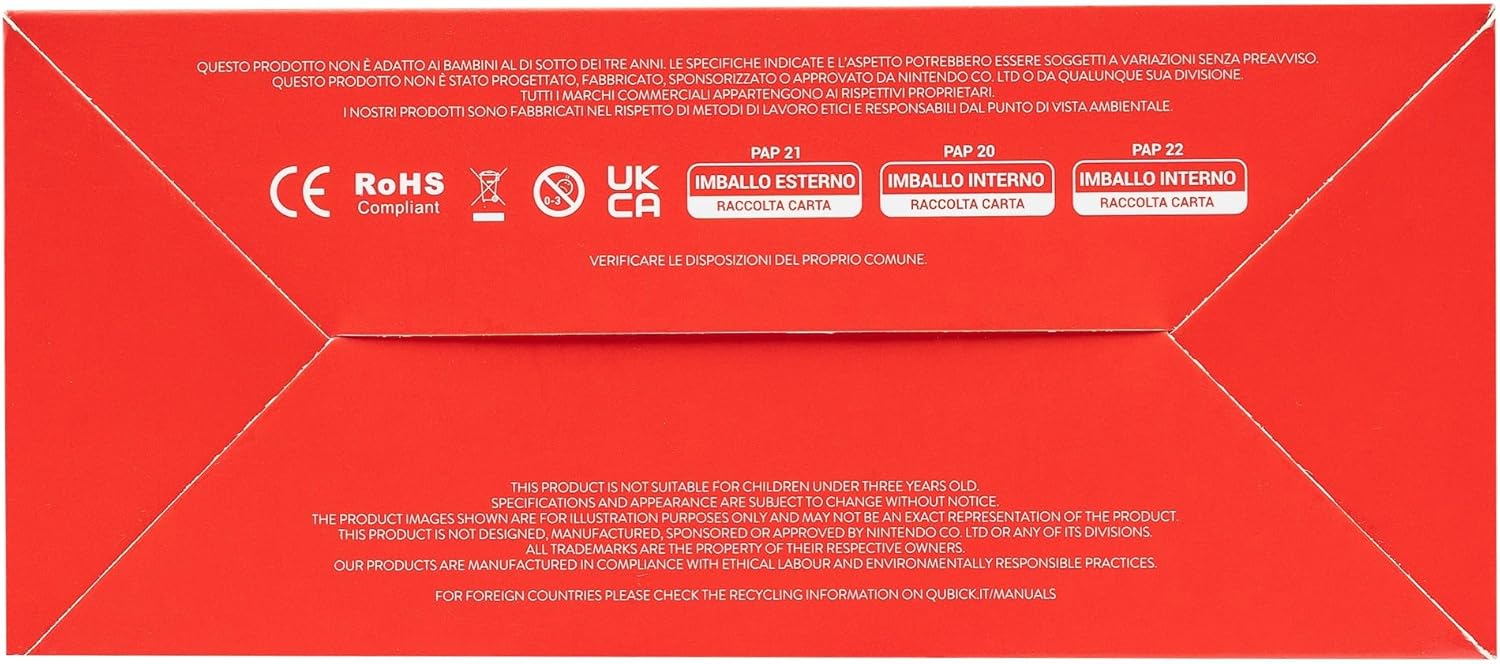
Image: Packaging of the Qubick Wireless Controller, displaying multilingual product information and a QR code linking to the online manual.
Image: Product packaging bottom, showing CE, RoHS, UKCA compliance marks and recycling information for cardboard packaging.


