
WERCHTAY LiFePO4
WERCHTAY 12V 200Ah LiFePO4 Deep Cycle Battery User Manual
Model: LiFePO4
1. Introduction
Thank you for choosing the WERCHTAY 12V 200Ah LiFePO4 Deep Cycle Battery. This manual provides essential information for the safe and efficient use of your battery. Please read it thoroughly before installation and operation. This product is designed for various deep cycle applications, including RVs, solar systems, marine, and off-grid power storage.
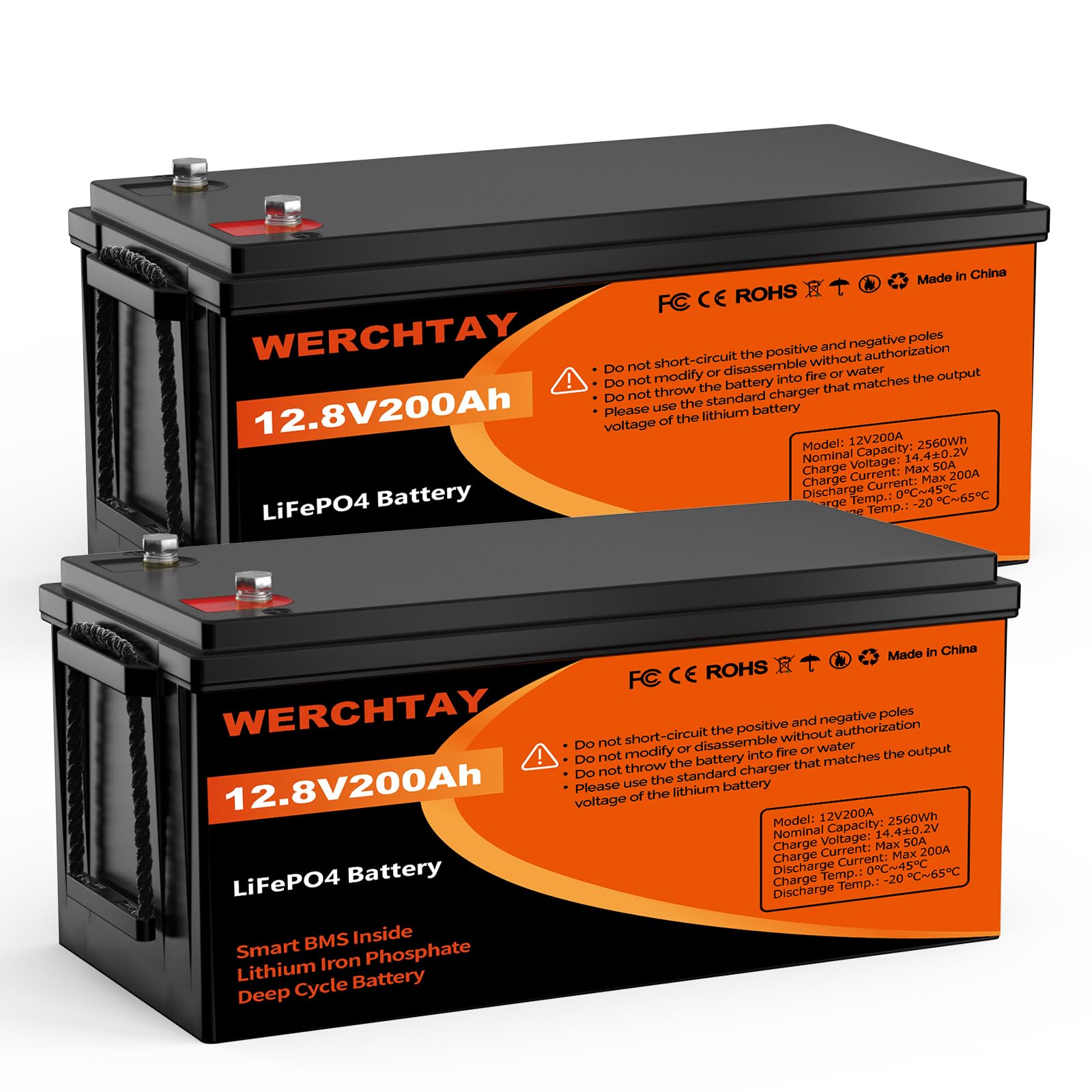
Image: Two WERCHTAY 12V 200Ah LiFePO4 Deep Cycle Batteries. The product package typically includes two such units.
2. Safety Information
WARNING: Failure to follow these safety instructions may result in fire, electric shock, injury, or damage to the battery and other property.
- Always wear appropriate personal protective equipment (PPE), including safety glasses and insulated gloves, when handling batteries.
- Do not short-circuit the battery terminals. This can cause severe damage to the battery and pose a fire hazard.
- Do not open, disassemble, or modify the battery. There are no user-serviceable parts inside.
- Keep the battery away from heat sources, open flames, and flammable materials.
- Ensure adequate ventilation during charging and discharging to prevent heat buildup.
- Do not immerse the battery in water or expose it to excessive moisture.
- Operate and store the battery within the specified temperature ranges (Charge: 0°C ~ 45°C; Discharge: -20°C ~ 65°C).
- Use only compatible chargers designed for LiFePO4 batteries with the correct voltage and current specifications.
- In case of fire, use a Class D fire extinguisher. Water may not be effective.
- Dispose of batteries according to local regulations. Do not dispose of with household waste.
3. What's in the Box
Your WERCHTAY 12V 200Ah LiFePO4 Deep Cycle Battery package typically includes:
- Two (2) WERCHTAY 12V 200Ah LiFePO4 Batteries
- User Manual (this document)
Note: Additional accessories such as cables or chargers are sold separately.
4. Specifications (Per 200Ah Unit)
| Feature | Specification |
|---|---|
| Battery Capacity | 200 Ah |
| BMS (Battery Management System) | 200 A |
| Nominal Voltage | 12.8 V |
| Nominal Energy Capacity | 2560 Wh |
| Charge Voltage | 14.4 ± 0.2 V |
| Maximum Charge Current | 50 A |
| Maximum Discharge Current | 200 A |
| Charge Temperature Range | 0°C ~ 45°C (32°F ~ 113°F) |
| Discharge Temperature Range | -20°C ~ 65°C (-4°F ~ 149°F) |
| Dimensions (L x W x H) | 52 x 23.68 x 22.10 cm (20.47 x 9.32 x 8.7 inches) |
| Weight | 20.48 kg (45.15 lbs) |
| Cycle Life | Over 5000 cycles at 80% Depth of Discharge (DoD) with 80% capacity retention |
| Expected Lifespan | 15+ years |
| Certifications | UN38.3, CE |
| Model Number | LiFePO4 |
| Manufacturer Part Number | LiFePO4-100-300AH |
5. Setup and Installation
5.1 Unpacking and Initial Inspection
- Carefully remove the battery from its packaging.
- Inspect the battery for any visible damage during shipping. If damage is found, contact customer support immediately.
- Verify that all components listed in Section 3 are present.
5.2 Mounting
The WERCHTAY LiFePO4 battery can be safely mounted in any position (upright, on its side, or inverted) due to its acid-free construction and stable chemical structure. Ensure the mounting location is:
- Secure and stable to prevent movement or vibration.
- Well-ventilated to dissipate any heat.
- Protected from direct sunlight, extreme temperatures, and moisture.
5.3 Electrical Connections
Before making any connections, ensure all power sources are disconnected and wear appropriate safety gear.
- Terminal Connections: Connect positive (+) terminals to positive (+) and negative (-) terminals to negative (-). Ensure connections are tight and secure to prevent arcing and overheating.
- Series/Parallel Configuration: This battery supports connecting up to 4 batteries in series or parallel to achieve higher voltage or capacity.
- Parallel Connection (for increased capacity at 12V): Connect all positive terminals together and all negative terminals together. Ensure all batteries are at a similar state of charge before connecting in parallel.
- Series Connection (for increased voltage): Connect the positive terminal of one battery to the negative terminal of the next. For example, for a 24V system, connect two 12V batteries in series.
- Charging Connection: Connect a compatible LiFePO4 charger to the battery terminals. Ensure the charger's output voltage matches the battery's nominal voltage (14.4 ± 0.2 V).
6. Operating Instructions
6.1 Charging
- Use a dedicated LiFePO4 battery charger. Do not use chargers designed for lead-acid batteries unless they have a specific LiFePO4 mode.
- The recommended charge voltage is 14.4 ± 0.2 V.
- The maximum charge current is 50 A. Exceeding this can damage the battery.
- Charge the battery within the temperature range of 0°C to 45°C. The BMS will prevent charging outside this range.
6.2 Discharging
- The maximum continuous discharge current is 200 A.
- Discharge the battery within the temperature range of -20°C to 65°C. The BMS will prevent discharging outside this range.
- LiFePO4 batteries are designed for deep cycling and can be discharged to a low state of charge without significant damage, thanks to the integrated BMS.
6.3 Battery Management System (BMS) Protection
The integrated 200A BMS provides comprehensive protection for the battery, ensuring its longevity and safe operation. The BMS protects against:
- Over-charge: Prevents charging beyond the safe voltage limit.
- Over-discharge: Prevents discharging below the safe voltage limit.
- Over-current: Limits current during both charging and discharging to prevent damage.
- Short-circuit: Automatically disconnects the battery in case of a short circuit.
- Over-temperature: Disconnects the battery if internal temperature exceeds safe limits (e.g., above 65°C).
- Low-temperature: Prevents charging when the temperature drops below 0°C and prevents discharging when the temperature drops below -20°C, protecting the battery cells.
7. Maintenance
WERCHTAY LiFePO4 batteries require minimal maintenance, but following these guidelines will ensure optimal performance and lifespan:
- Regular Inspection: Periodically check the battery terminals for corrosion or loose connections. Clean terminals with a dry cloth if necessary.
- Cleaning: Keep the battery casing clean and free of dust and debris. Use a soft, dry cloth. Do not use solvents or abrasive cleaners.
- Storage: If storing the battery for an extended period, ensure it is charged to approximately 50-70% of its capacity. Store in a cool, dry place, away from direct sunlight and extreme temperatures. Disconnect the battery from all loads and chargers during storage.
- Avoid Deep Discharge During Storage: While the BMS protects against over-discharge, prolonged storage at a very low state of charge can reduce battery life.
8. Troubleshooting
If you encounter issues with your WERCHTAY LiFePO4 battery, refer to the following common problems and solutions:
| Problem | Possible Cause | Solution |
|---|---|---|
| Battery not charging |
|
|
| Battery not discharging/no power output |
|
|
| Battery gets hot during operation |
|
|
If the problem persists after attempting these solutions, please contact WERCHTAY customer support.
9. Warranty Information
WERCHTAY is committed to providing high-quality products. This product comes with a guarantee of 15-year availability of spare parts in the EU, reflecting our confidence in its durability and long-term support.
For specific warranty terms and conditions, please refer to the product's purchase documentation or contact WERCHTAY customer support.
10. Customer Support
For technical assistance, warranty claims, or any questions regarding your WERCHTAY 12V 200Ah LiFePO4 Deep Cycle Battery, please contact our customer support team.
Contact Information:
- Email: support@werchtay.com (Example email, please replace with actual contact if available)
- Website: www.werchtay.com (Example website, please replace with actual contact if available)
Please have your product model number (LiFePO4) and purchase details ready when contacting support.
Ask a question about this manual
Ask about setup, troubleshooting, compatibility, parts, safety, or missing instructions. Manuals+ will review the question and use this page’s manual context to help answer it.