Introduction
This manual provides detailed instructions for the installation, operation, and maintenance of your VEVOR 300A Dual Battery Isolator Kit. This Voltage Sensitive Relay (VSR) is designed to manage charging between your main and auxiliary batteries, ensuring your starter battery remains charged while providing power to accessories from the auxiliary battery. It is compatible with both lithium and lead-acid battery types and features an LCD screen for real-time voltage display.
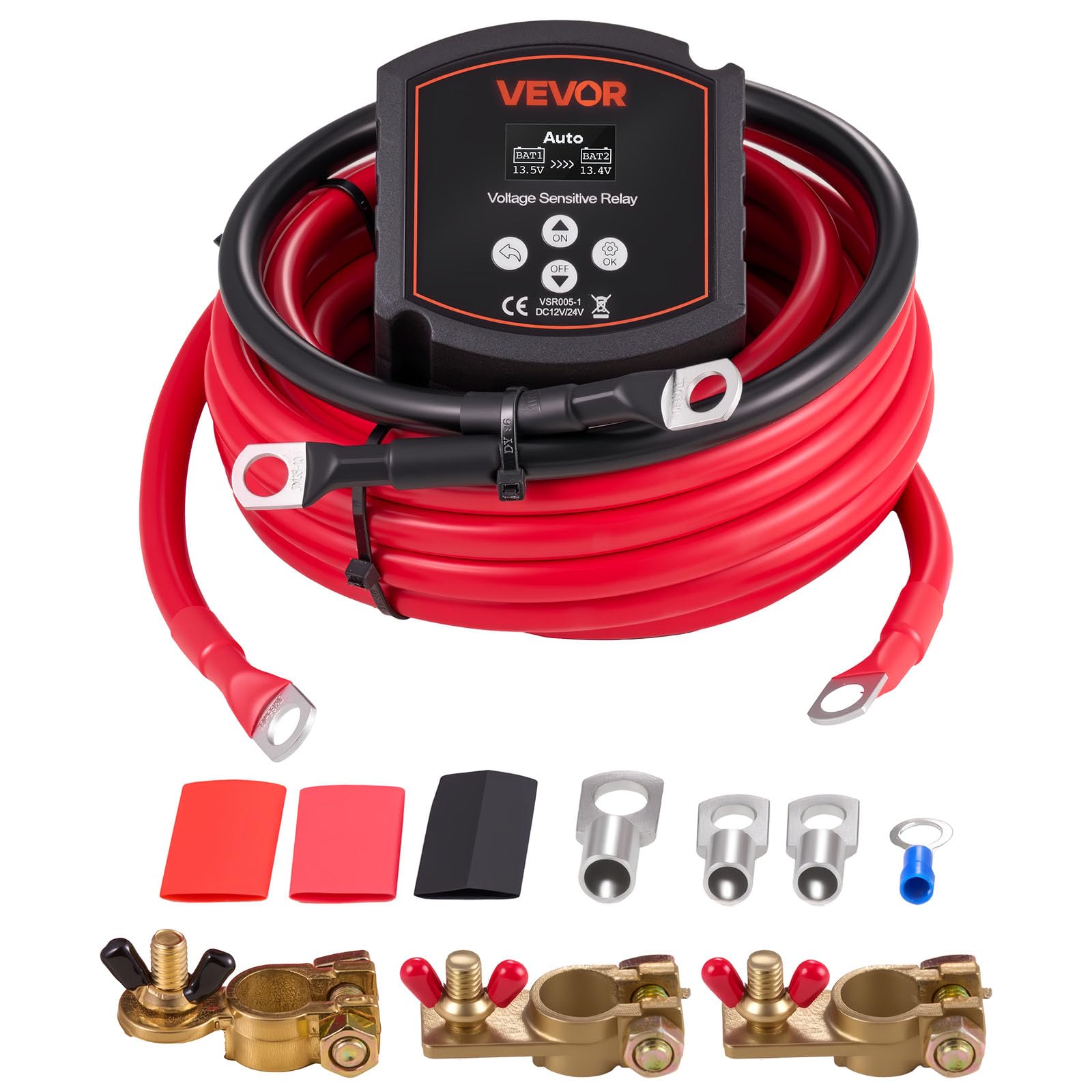
Image: The VEVOR 300A Dual Battery Isolator Kit, showcasing the main isolator unit, red and black power cables, and various connectors.
Package Contents
Verify that all items listed below are included in your package:
- 1 x 300A Smart Lithium Battery Isolator (with mounting screws)
- 1 x 20 ft (6 m) 2 AWG Red Cable
- 1 x 2 ft (0.6 m) 2 AWG Black Ground Cable
- 3 x Pure Copper Connectors
- 2 x Heat Shrink Tubes
- 4 x Cable Lugs
- 6 x Zip Ties
- 1 x User Manual (this document)
- 1 x Accessory Kit

Image: A visual representation of all components included in the VEVOR 300A Dual Battery Isolator Kit, including the isolator, cables, connectors, and mounting hardware.
Specifications
| Feature | Specification |
|---|---|
| Model | VSR005-1 |
| Current Rating | 300 Amps |
| Coil Voltage | 12 Volts (DC) |
| Minimum Switching Voltage | 12.2 Volts (DC) |
| Operation Mode | Automatic, Manual |
| Connector Type | Screw |
| Contact Material | Copper |
| Product Dimensions | 3.54 x 3.54 x 3.15 inches |
| Item Weight | 7.28 pounds |
Safety Information
Always observe the following safety precautions during installation and operation:
- Disconnect all power sources before installation or maintenance.
- Wear appropriate personal protective equipment, including safety glasses and gloves.
- Ensure proper ventilation when working with batteries.
- Avoid short circuits. Connect positive to positive and negative to negative terminals correctly.
- Do not immerse the isolator in water or expose it to excessive moisture.
- Consult a qualified professional if you are unsure about any installation steps.
Setup and Installation
Follow these steps to properly install your VEVOR Dual Battery Isolator Kit:
1. Mounting the Isolator
Choose a dry, secure location near your main battery, away from direct heat or moving parts. Use the provided mounting screws to secure the isolator unit.

Image: A detailed view of the VEVOR isolator's connection points, showing the positive terminals for the main and auxiliary batteries and the ground wire connection.
2. Wiring Connections
- Connect Main Battery: Connect the positive terminal of your main (starter) battery to the "START BATT POSITIVE+" terminal on the isolator using the provided red 2 AWG cable.
- Connect Auxiliary Battery: Connect the positive terminal of your auxiliary (secondary) battery to the "SECOND BATT POSITIVE+" terminal on the isolator using the remaining red 2 AWG cable.
- Connect Ground: Connect the provided black 2 AWG ground cable from the isolator's ground terminal to a suitable chassis ground point or the negative terminal of your main battery.
- Secure Connections: Ensure all connections are tight and secure. Use the provided heat shrink tubes and cable lugs for a professional and protected installation.

Image: A schematic showing the wiring of the main and auxiliary batteries to the VEVOR dual battery isolator, including fuse placement for safety.

Image: A close-up of the included premium copper cables, highlighting their robust construction and pre-attached terminals for efficient power transfer.
Operation
Automatic Mode
The VSR automatically connects the main and auxiliary batteries for charging when the main battery voltage reaches 13.3V (or a user-defined "ON" voltage). Once the main battery is fully charged, the VSR will then allow the auxiliary battery to charge. When the engine is off and the main battery voltage drops below 12.8V (or a user-defined "OFF" voltage), the VSR disconnects the batteries to prevent the auxiliary battery from draining the main battery.

Image: The VEVOR isolator unit displaying its compatibility with both Lithium and Lead-Acid battery types, along with key features like 300A high current and dual voltage display.
Manual Mode
The isolator features a manual override mode. In case your main battery is depleted, you can manually engage the VSR to draw power from the auxiliary battery to assist in starting the vehicle. Refer to the LCD screen and control buttons for manual mode activation.

Image: The VEVOR Iso-Pro 300 Dual Battery Kit, highlighting its design for seamless battery management and maximized power efficiency.
LCD Display and Settings
The integrated LCD screen displays the real-time voltage of both batteries (BAT1 and BAT2) within a range of 4.5V-20V. Use the control buttons (ON, OFF, OK, UP, DOWN) to navigate menus and adjust settings such as "ON" voltage, "OFF" voltage, and delay time (3-60 seconds) to prevent frequent switching.

Image: The VEVOR isolator's adjustable delay setting feature, which helps extend the service life of the isolator and battery by preventing continuous switching.
Protection Features
The VSR includes built-in overvoltage and undervoltage protection, automatically cutting off power to safeguard your batteries and connected devices. Its durable housing is shockproof and dustproof, suitable for various environments like RVs, trucks, boats, or off-grid systems.

Image: The VEVOR isolator's durable and sturdy housing, designed to withstand tough off-road conditions and provide waterproof, shock-resistant, and dust-resistant protection.
Maintenance
To ensure optimal performance and longevity of your VEVOR Dual Battery Isolator Kit:
- Regularly inspect all wiring connections for tightness and corrosion. Clean any corroded terminals.
- Keep the isolator unit clean and free from dust and debris.
- Periodically check battery voltages to ensure proper charging and discharge cycles.
- Ensure the area around the isolator is well-ventilated.
Troubleshooting
If you encounter issues with your dual battery isolator, consider the following:
- No voltage display: Check power connections to the isolator. Ensure the main battery has sufficient charge.
- Auxiliary battery not charging: Verify all wiring connections are correct and secure. Check the "ON" voltage setting on the isolator; the main battery must reach this voltage before the auxiliary battery begins charging.
- Main battery draining: Ensure the "OFF" voltage setting is correctly configured to disconnect the batteries when the engine is off. Inspect for any parasitic draws on the auxiliary battery circuit.
- Frequent switching: Adjust the delay time setting on the isolator to prevent rapid connection/disconnection.
For further assistance, please contact VEVOR customer support.
Warranty and Support
VEVOR products are designed for durability and performance. For warranty information, technical support, or service inquiries, please refer to the official VEVOR website or contact their customer service department. Keep your purchase receipt for warranty claims.


