
Introduction
The TOPPING DX9 Discrete is a high-performance, fully balanced 1-Bit DAC and headphone amplifier designed for exceptional audio fidelity. It features a self-developed Discrete 1-Bit PSRM architecture, a six-channel NFCA headphone amplifier, and a hybrid relay volume control system. This manual provides detailed instructions for setting up, operating, and maintaining your DX9 Discrete to ensure optimal performance and longevity.
Safety Information
- Do not disassemble or modify the device. Unauthorized modifications may result in electric shock or product malfunction.
- Keep the device away from water, moisture, and extreme temperatures.
- Ensure proper ventilation to prevent overheating. Do not block ventilation openings.
- Use only the power adapter supplied with the device.
- Avoid placing heavy objects on the device.
- Disconnect the power cable during lightning storms or when unused for long periods.
Package Contents
Please check the package contents upon unboxing:
- TOPPING DX9 Discrete Unit x 1
- Remote Control x 1
- AC Cable x 1
- USB Cable x 1
- Bluetooth Antenna x 1
- 6.35mm to 3.5mm Adaptor x 1
- Product Information Card x 1
- Quick Start Guide x 1

Image: Contents list of the TOPPING DX9 Discrete, showing the main unit, remote control, various cables, Bluetooth antenna, and adapters.
Product Overview
Front Panel
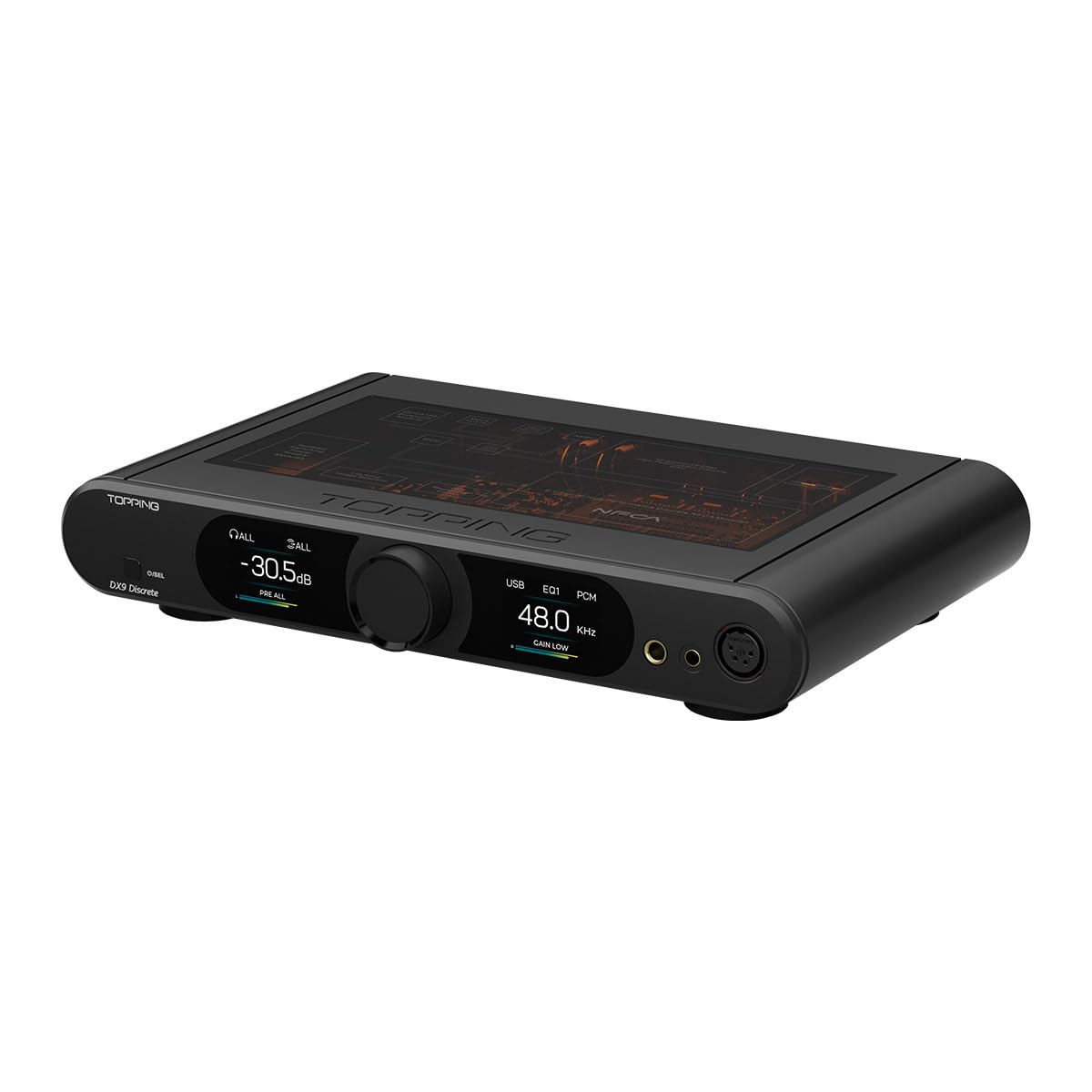
Image: Front and rear views of the TOPPING DX9 Discrete. The front panel features a display, control knob, and headphone outputs. The rear panel shows various input and output ports.
- Display: Shows current input, sample rate, volume, and other settings.
- Control Knob: Multi-functional knob for volume adjustment, menu navigation, and selection.
- 6.35mm Headphone Output: Standard single-ended headphone jack.
- 4.4mm Headphone Output: Balanced headphone jack.
- XLR-4 Headphone Output: Balanced headphone jack.
- O/SEL Button: Power on/off and menu selection.
Rear Panel
- XLR Line Out (L/R): Balanced analog audio output.
- RCA Line Out (L/R): Single-ended analog audio output.
- IIS-LVDS Input: Digital audio input for high-resolution audio.
- AES Input: AES/EBU digital audio input.
- Optical 1/2 Input: Optical digital audio inputs.
- Coaxial 1/2 Input: Coaxial digital audio inputs.
- USB Input: USB-B port for connecting to a computer.
- Bluetooth Antenna Port: For connecting the included Bluetooth antenna.
- 12V Trigger In/Out: For synchronized power control with other devices.
- AC Power Input: For connecting the AC power cable.
- Power Switch: Main power switch for the device.
Setup
1. Connecting Power
Connect the supplied AC power cable to the AC power input on the rear panel of the DX9 Discrete, then plug the other end into a wall outlet. Ensure the power switch is in the OFF position before connecting.
2. Connecting Audio Sources
- USB: Connect your computer or other USB audio source to the USB input port using a USB cable.
- Optical/Coaxial/AES/IIS-LVDS: Connect your digital audio sources to the corresponding input ports.
- Bluetooth: Screw the provided Bluetooth antenna onto the Bluetooth antenna port. Enable Bluetooth on your source device and pair with "TOPPING DX9 Discrete".
3. Connecting Audio Outputs
- Line Out (XLR/RCA): Connect to your power amplifier or active speakers using XLR or RCA cables.
- Headphone Outputs (6.35mm/4.4mm/XLR-4): Connect your headphones to the desired output jack on the front panel. Use the appropriate adapter if necessary.
Operating Instructions
1. Basic Operation
- Power On/Off: Flip the main power switch on the rear panel to ON. Press the O/SEL button on the front panel or the remote control to power on/off the device from standby.
- Volume Control: Rotate the control knob on the front panel or use the volume buttons on the remote control to adjust the volume.
- Input Selection: Press the control knob on the front panel or the input selection button on the remote control to cycle through available inputs.
2. Display Settings
The DX9 Discrete features dual 2.0” Aurora UI displays. You can customize various display settings:
- Theme: Choose from various color themes for the display.
- Brightness: Adjust the display brightness.
- VU Style: Select different VU meter styles (e.g., FFT, Classic VU).

Image: Various display options and themes shown on the TOPPING DX9 Discrete's Aurora UI.
3. Advanced Settings
Access the setup menu by pressing and holding the control knob when the device is off, then power it on. Rotate the knob to navigate and press to select.
- PCM Filter: Select different PCM digital filters to fine-tune the sound characteristics.
- Automatic Standby: Configure the device to automatically enter standby mode after a period of inactivity.
- Line Out Channel: Adjust settings for the line output channels.
- Output Mode: Switch between DAC, Pre-amplifier, or Headphone Amplifier modes.
- Headphone Amp Gain: Adjust the gain level for the headphone amplifier to match your headphones' sensitivity.
- Bluetooth Settings: Manage Bluetooth pairing and connection options.
4. PEQ Function
The DX9 Discrete features a high-precision ten-band parametric equalizer (PEQ). This allows for detailed customization of frequency response. You can adjust gain, bandwidth, and target curves via desktop software and store multiple profiles.

Image: Screenshot of the desktop software interface for the ten-band parametric equalizer (PEQ) on the TOPPING DX9 Discrete, showing adjustable frequency bands, gain, and Q-factors.
5. Crossfeed Function
Utilize the advanced convolution-based crossfeed processing to recreate natural spatial cues and reduce the 'in-head' effect often experienced with headphones. An enhanced BS2B mode is included for a more speaker-like listening experience.
Maintenance
- Clean the device with a soft, dry cloth. Do not use liquid cleaners or aerosols.
- Keep the device free from dust and debris.
- Store the device in a cool, dry place when not in use.
Troubleshooting
| Problem | Possible Cause | Solution |
|---|---|---|
| No sound output | Incorrect input/output selection, loose cables, low volume. | Verify input/output settings, check all cable connections, increase volume. |
| Device does not power on | Power cable not connected, main power switch off. | Ensure power cable is securely connected, flip main power switch to ON. |
| Bluetooth connection issues | Antenna not connected, device not in pairing mode, interference. | Attach Bluetooth antenna, ensure device is in Bluetooth input mode, try re-pairing. |
| Distorted audio | Input signal too high, incorrect gain setting, faulty cable. | Reduce source volume, adjust headphone amp gain, try a different cable. |
Specifications
- Product Dimensions: 13.4 x 8.8 x 2.4 inches
- Item Weight: 5 pounds
- DAC Architecture: Discrete 1-Bit PSRM (16 elements per channel)
- Dynamic Range: 131 dB
- SNR: 131 dB
- THD+N: < 0.00006%
- Headphone Amplifier: Six-channel discrete NFCA, up to 7080 mW x2 @ 32Ω
- Volume Control: Hybrid Relay-Resistor Network
- Equalization: Ten-Band Parametric EQ
- Jitter Suppression: CPLD, as low as –160 dB
- Bluetooth: 5.1 (LDAC, aptX HD, AAC)
- Inputs: USB, IIS, AES, Coaxial, Optical, Bluetooth
- Outputs: Balanced XLR, RCA Line/Preamp, 6.35mm, 4.4mm, XLR-4 Headphone Ports
- Connectors: NEUTRIK
- Display: Dual 2.0” Aurora UI
Warranty and Support
TOPPING provides a limited warranty for the DX9 Discrete against defects in materials and workmanship under normal use. The warranty period typically covers one year from the date of purchase. Please refer to the product information card included in your package or visit the official TOPPING website for detailed warranty terms and conditions.
For technical support, troubleshooting assistance, or warranty claims, please contact TOPPING customer service through their official website or the retailer from whom you purchased the product. Keep your proof of purchase for warranty validation.
Additional Information
Discrete 1-Bit PSRM Architecture
The DX9 Discrete utilizes TOPPING’s self-developed PSRM module, featuring 16 discrete elements per channel. This design achieves an impressive 131 dB dynamic range and 131 dB SNR, contributing to exceptional clarity and musical realism.

Image: Detailed view of the self-developed PSRM architecture within the DX9 Discrete, highlighting the 16-element module for each channel.
Fully Balanced DAC & Headphone Amp
Independent DAC and amplifier power circuits ensure ultimate channel separation and ultra-low noise. The six-channel discrete NFCA headphone amplifier delivers up to 7080 mW x2 @ 32Ω, providing effortless control for a wide range of headphones.

Image: Internal view of the TOPPING DX9 Discrete, showcasing the six-channel discrete NFCA high-performance headphone amplifier module and independent DAC/headphone amp circuits.
Ultra-Low Jitter
A CPLD paired with a precision clock optimizes the digital signal and performs dual-stage purification, achieving deep jitter suppression and reducing artifacts to near zero for clearer, more defined vocals and instruments. The AK4118 receiver handles coaxial, optical, and AES inputs, delivering an ultra-clean digital signal with jitter as low as 50 ps RMS, supporting up to 768 kHz PCM and DSD512.

Image: Block diagram illustrating the CPLD jitter suppression and precision clock system within the TOPPING DX9 Discrete.
Official Product Video
Video: An official product video from TOPPING showcasing the DX9 Discrete DAC and Headphone Amplifier, highlighting its design and features.


