
Introduction
This manual provides essential instructions for the safe operation and maintenance of your Ameta S20 4K GPS Drone. Please read this manual thoroughly before operating the drone to ensure proper function and to prevent damage or injury. The Ameta S20 is a lightweight drone equipped with a 4K camera, GPS positioning, and intelligent flight modes, designed for both beginners and experienced users.
Product Overview
Package Contents
The Ameta S20 package includes the following items:
- Ameta S20 Drone
- Remote Control with WiFi
- 2 x Standard Batteries
- Spare Propellers
- Charging Cable
- Screwdriver
- User Manual (this document)
- Quick Start Guide
- Carrying Case
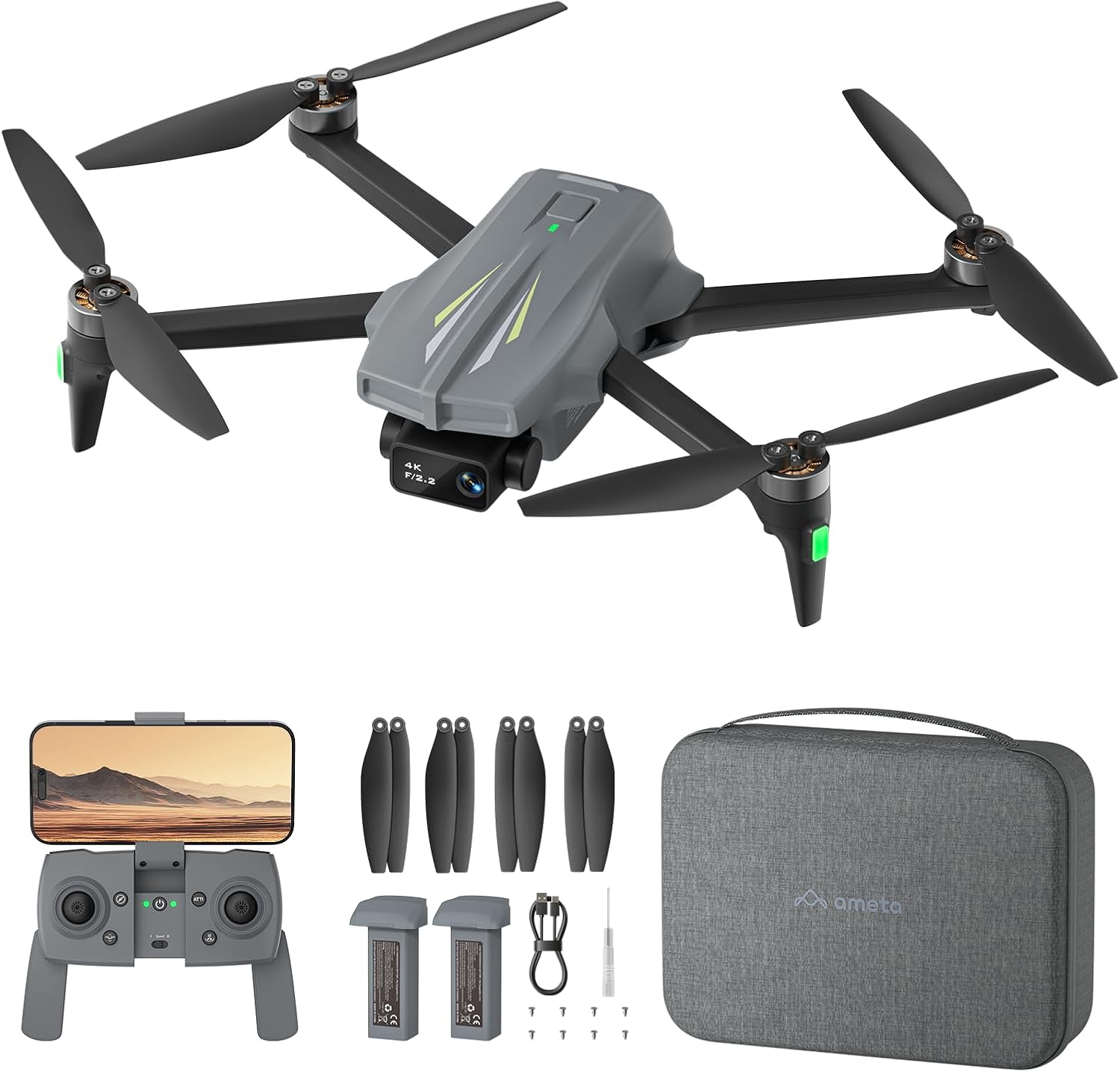
Image: Ameta S20 Drone, remote control, two batteries, spare propellers, charging cable, screwdriver, and carrying case.
Key Features
- 4K UHD Camera: Captures high-resolution photos (3840 x 2160 pixels) and videos (1920 x 1080 @30fps) with a 90° adjustable lens and IMX175 sensor.
- 5G WiFi Transmission: Provides stable and real-time FPV (First Person View) up to 300m.
- GPS Positioning: Ensures stable flight and enables intelligent return-to-home functions.
- Extended Flight Time: Two 3000 mAh modular batteries offer up to 50 minutes of total flight time (25 minutes per battery).
- Beginner-Friendly: Features like one-click takeoff/landing, altitude hold, and beginner mode simplify operation.
- Intelligent Flight Modes: Includes Waypoint Flight, GPS Follow, Circle Fly, Rocket, Far, Panorama, Time-lapse, and Gesture Selfie for creative capture.
- Lightweight Design: Weighs less than 249g, qualifying for Class C0 certification in many regions, reducing regulatory requirements.
- Brushless Motors: Offers increased power, quieter operation, and enhanced stability.

Image: Close-up of the Ameta S20 drone's 4K UHD camera with 90-degree adjustable angle.
Setup
1. Battery Charging and Installation
- Ensure the drone and remote control are powered off.
- Connect the charging cable to the drone battery and a suitable USB power adapter (not included).
- Charge the batteries until the indicator lights show a full charge.
- Insert the charged battery into the drone's battery compartment, ensuring it clicks securely into place.
- Insert batteries into the remote control as per its specific instructions.

Image: The Ameta S20 drone with its battery compartment open, showing battery installation.
2. Propeller Installation (if required)
If propellers are not pre-installed, attach them according to the markings (A and B) on the propellers and motor arms. Use the provided screwdriver to secure them firmly.
3. Remote Control and App Pairing
- Power on the drone, then power on the remote control.
- Wait for the drone and remote control to automatically pair. Indicator lights will confirm successful pairing.
- Download the official Ameta drone application from your device's app store.
- Connect your smartphone to the drone's Wi-Fi network (usually named "Ameta-S20-XXXX").
- Open the Ameta app to establish a connection and view the live camera feed.
Operating Instructions
Pre-Flight Checklist
- Ensure batteries are fully charged in both drone and remote control.
- Check that propellers are correctly installed and free from damage.
- Verify that the drone is placed on a flat, open surface.
- Confirm a strong GPS signal before flying (indicated by the app or drone lights).
- Check local regulations for drone operation.
Basic Flight Controls
- One-Click Takeoff/Landing: Press the designated button on the remote control or in the app to automatically take off or land.
- Altitude Hold: The drone maintains a stable altitude automatically, simplifying flight control.
- Speed Modes: Select between two speed modes (Beginner/Normal) for varying flight responsiveness.

Image: The Ameta S20 drone performing an automatic one-click takeoff.
Intelligent Flight Modes (GPS Required)
These modes require an active GPS signal for optimal performance.
- Return to Home (RTH): The drone automatically returns to its takeoff point when activated, or in cases of low battery or signal loss.
- Waypoint Flight: Plan a flight path by setting multiple waypoints on the app's map. The drone will follow this pre-defined route.
- Circle Fly: The drone orbits around a designated point, capturing smooth, dynamic footage.
- GPS Follow: The drone tracks your smartphone's GPS, following your movements automatically.
- Rocket: The drone ascends vertically while recording.
- Far: The drone flies away from the user while recording.
- Panorama: Captures multiple images to stitch into a panoramic photo.
- Time-lapse: Records a series of photos over time to create a time-lapse video.
- Gesture Selfie: Use specific hand gestures to trigger photo or video recording.

Image: The Ameta S20 drone initiating its automatic Return to Home function, flying back to its starting point.
Camera Operation
- Photo/Video Capture: Use the dedicated buttons on the remote control or within the app to take photos or start/stop video recording.
- Adjustable Lens: The camera lens can be adjusted by 90° via the remote control or app to capture different angles.
- FPV View: The 5G WiFi transmission provides a live feed to your smartphone for real-time viewing and framing.
Maintenance
Cleaning
Regularly clean the drone body, camera lens, and motors with a soft, dry cloth. Avoid using liquids or solvents that could damage components.
Propeller Replacement
Inspect propellers for cracks or damage before each flight. If a propeller is damaged, replace it immediately using the provided spare propellers and screwdriver. Ensure the correct 'A' and 'B' propellers are installed on the corresponding motor arms.
Battery Care
Store batteries in a cool, dry place. Do not overcharge or fully discharge batteries. If storing for extended periods, charge them to approximately 50-60% capacity.
Troubleshooting
| Problem | Possible Cause | Solution |
|---|---|---|
| Drone does not power on. | Low or uncharged battery; improperly installed battery. | Charge the battery fully. Ensure the battery is correctly inserted and secured. |
| Remote control does not connect to drone. | Drone or remote not powered on; pairing failed; interference. | Ensure both devices are on. Re-attempt pairing process. Move to an area with less interference. |
| Poor camera feed or no FPV. | Weak Wi-Fi signal; incorrect Wi-Fi connection; app not open. | Ensure phone is connected to the drone's Wi-Fi. Move closer to the drone. Restart the app and drone. |
| Drone drifts during flight. | Improper calibration; strong winds; weak GPS signal. | Perform IMU and compass calibration. Fly in calm weather. Ensure strong GPS signal. |
| Return to Home (RTH) not working correctly. | Weak or no GPS signal; RTH point not set. | Ensure a strong GPS signal before takeoff. The RTH point is usually the takeoff location. |
Specifications
| Feature | Detail |
|---|---|
| Model Name | DR-ATS22G (Ameta S20) |
| Weight | 185 g (Less than 249g, Class C0 certified) |
| Dimensions (Folded) | 13.5 x 8 x 5 cm (approx.) |
| Dimensions (Unfolded) | 33 x 28 x 5 cm (approx.) |
| Camera Resolution (Photo) | 4K (3840 x 2160 Pixels) |
| Camera Resolution (Video) | 1920 x 1080 @30fps |
| Camera Sensor | IMX175 |
| Lens Adjustment | 90° adjustable |
| Connectivity | 5G WiFi |
| Flight Time | Up to 50 minutes (with 2 batteries, 25 mins each) |
| Battery Type | Non-standard battery (3000 mAh modular) |
| Special Features | Automatic Landing, Integrated GPS, One-Button Return, Automatic Tracking, Extended Flight Time |
| Age Range | Child, Adult |

Image: Diagram showing the folded and unfolded dimensions of the Ameta S20 drone.
Safety Guidelines
- Local Regulations: Always consult and comply with local drone flying laws and regulations before operation. The Ameta S20 is Class C0 certified, meaning it weighs less than 249g, which may exempt it from certain registration requirements in some regions.
- Flight Environment: Fly in open areas, away from people, animals, buildings, and obstacles. Avoid flying near airports or restricted airspace.
- Weather Conditions: Do not fly in strong winds, rain, snow, or fog. Optimal flight conditions are calm and clear.
- Line of Sight: Always maintain visual line of sight with your drone during flight.
- Battery Safety: Use only original or approved batteries and chargers. Do not puncture, drop, or short-circuit batteries.
- Propeller Safety: Keep hands and face clear of rotating propellers. Ensure propellers are securely attached before flight.
- Emergency Procedures: Familiarize yourself with the Return to Home function for emergency situations.

Image: A person holding the Ameta S20 drone, demonstrating its compact and lightweight design, which is under 249g.
Warranty and Support
For warranty information, technical support, or service inquiries, please refer to the contact details provided in your product packaging or visit the official Ameta website. Keep your purchase receipt as proof of purchase for warranty claims.
For further assistance, you may contact Ameta customer service through their official channels.


