
1. Introduction
Thank you for choosing the HASWING W40 Electric Trolling Motor. This manual provides essential information for the safe and efficient operation, installation, and maintenance of your new trolling motor. Designed for kayaks, the W40 offers reliable propulsion for both saltwater and freshwater fishing environments. Please read this manual thoroughly before using the product to ensure optimal performance and safety.
2. Safety Information
- Always wear a personal flotation device (PFD) when operating the motor on water.
- Ensure the emergency kill switch is properly connected to the operator and the motor before starting. In case of an emergency or if you fall overboard, the kill switch will immediately cut power to the motor.
- Keep hands, feet, and clothing clear of the propeller at all times, especially when the motor is in operation.
- Disconnect the motor from the battery when not in use, during charging, or before performing any maintenance or adjustments.
- Do not operate the motor if it is damaged or malfunctioning. Contact customer support for assistance.
- Ensure the battery is securely stored and properly ventilated. Follow all battery manufacturer guidelines for charging and handling.
- Avoid operating the motor in shallow water where the propeller may strike obstacles.
3. Package Contents
Upon unpacking, please verify that all items listed below are present:
- HASWING W40 Electric Trolling Motor
- Emergency Kill Switch (Magnetic)
- User Manual (this document)
4. Product Overview
Familiarize yourself with the components of your HASWING W40 Electric Trolling Motor.

This image displays the HASWING W40 Electric Trolling Motor from a side perspective, showcasing its compact design, propeller, and control head.
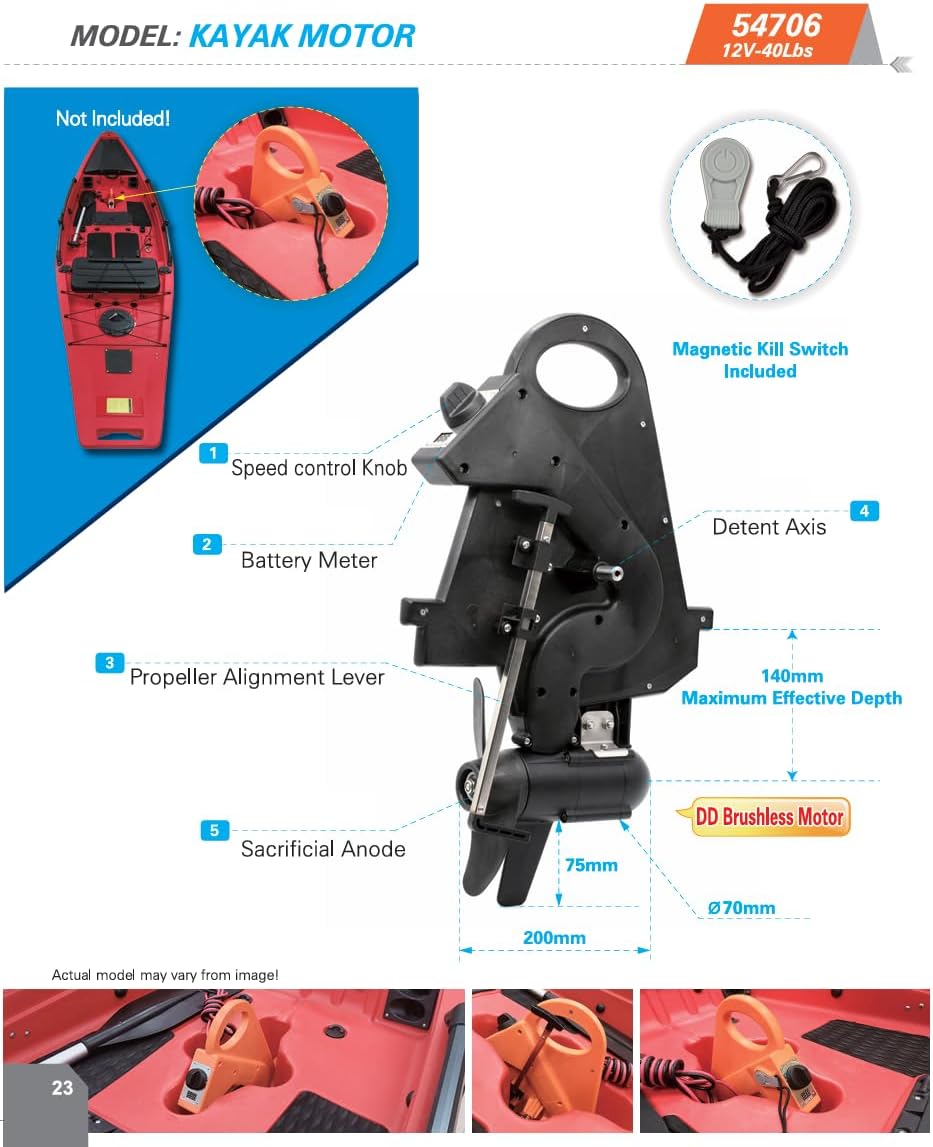
An annotated diagram illustrating key components of the HASWING W40 Kayak Motor, including the speed control knob, battery meter, propeller alignment lever, detent axis, and sacrificial anode. It also shows maximum effective depth and motor dimensions.
- Speed Control Knob: Adjusts motor speed and direction (forward/reverse).
- Battery Meter: Digital display showing real-time battery voltage.
- Propeller Alignment Lever: Used to adjust the propeller's vertical position for deployment or retraction.
- Detent Axis: Pivot point for motor angle adjustment.
- Sacrificial Anode: Protects metal components from corrosion, especially in saltwater.

This image shows a detailed view of the motor's control panel, featuring the speed control knob for 5 forward and 5 reverse settings, and a real-time digital voltage display for battery status.
5. Setup and Installation
- Mounting the Motor:
Identify the designated mounting area on your kayak. The W40 motor is designed for compatibility with various kayak brands and models. Ensure the mounting surface is stable and capable of supporting the motor's weight and thrust. Secure the motor firmly using appropriate hardware (not included unless specified by kayak manufacturer).
- Propeller Adjustment:

This image demonstrates the propeller adjusting lever. Pressing the lever down allows the propeller blades to be positioned vertically for insertion into the kayak, and pulling it up locks the propeller for operation.
To insert the motor into the kayak, press the propeller alignment lever down to position the propeller blades vertically. Once inserted, pull the lever up to lock the propeller in its operational position. Ensure the lever is fully engaged before starting the motor to prevent the propeller from spinning freely or being obstructed.
- Shaft Compatibility:

This image illustrates two types of motor shafts: 'A' for Chinese standard kayaks (12mm x 2) and 'B' for British standard kayaks (1/2 inch x 2), highlighting compatibility options.
The motor may come with different shaft options to fit various kayak standards. Verify that the correct shaft type (e.g., 12mm x 2 for Chinese standard or 1/2 inch x 2 for British standard) is installed for your kayak model.
- Battery Connection:
Connect the motor's power cables to a 12V deep cycle marine battery. Ensure correct polarity: red to positive (+), black to negative (-). Secure all connections to prevent accidental disconnection or short circuits. It is recommended to use a battery box for protection and secure placement.
6. Operating Instructions
- Engage Emergency Kill Switch:
Before starting, attach the magnetic kill switch lanyard to yourself and ensure the magnetic key is securely in place on the motor's control head.
- Check Battery Status:
Observe the digital battery status display on the control panel. This shows the real-time voltage of your 12V battery, allowing you to monitor power levels during operation.
- Adjust Speed and Direction:
Use the speed control knob to select your desired thrust. The motor offers 5 forward speeds and 5 reverse speeds. Rotate the knob clockwise for forward motion and counter-clockwise for reverse motion. Start at lower speeds and gradually increase as needed.
- Steering:
The motor's direction is controlled by the kayak's rudder or by manually adjusting the motor's orientation if it is mounted to allow for such movement.
- Stopping the Motor:
To stop the motor, turn the speed control knob to the '0' (off) position. In an emergency, pull the magnetic key from the kill switch to immediately cut power.
7. Maintenance
- After Each Use:
Rinse the motor thoroughly with fresh water, especially after use in saltwater, to prevent corrosion. Inspect the propeller for any fishing line, weeds, or debris and remove them carefully. Check all electrical connections for corrosion or looseness.
- Propeller Inspection:
Regularly inspect the propeller for damage (chips, cracks, bends). A damaged propeller can reduce efficiency and cause vibration. Replace if necessary.
- Sacrificial Anode:
Periodically check the sacrificial anode for wear. This component is designed to corrode instead of the motor's metal parts. Replace the anode when it is significantly depleted (approximately 50% of its original size).
- Battery Care:
Follow the battery manufacturer's instructions for charging, storage, and maintenance. Keep battery terminals clean and free of corrosion.
- Storage:
Store the motor in a dry, cool place when not in use. Disconnect it from the battery for long-term storage.
8. Troubleshooting
If you encounter issues with your HASWING W40 motor, refer to the following common troubleshooting steps:
- Motor Not Starting:
- Ensure the emergency kill switch magnetic key is fully engaged.
- Check battery connections for tightness and corrosion.
- Verify the battery has sufficient charge using the digital display.
- Confirm the speed control knob is not in the '0' (off) position.
- Low Thrust or Poor Performance:
- Inspect the propeller for damage, weeds, or fishing line. Clear any obstructions.
- Check battery voltage; a low battery will result in reduced power.
- Ensure the propeller alignment lever is fully engaged in the operational position.
- Excessive Vibration:
- Inspect the propeller for damage or imbalance. Replace if necessary.
- Check for any loose mounting hardware.
- Battery Display Not Working:
- Check all electrical connections to the motor and battery.
- Ensure the motor is receiving power.
If problems persist after attempting these steps, please contact HASWING customer support.
9. Specifications
| Feature | Specification |
|---|---|
| Model | W40 |
| Motor Type | Brushless |
| Voltage | 12V |
| Thrust | 40 Lbs |
| Speed Settings | 5 Forward, 5 Reverse |
| Battery Display | Digital Voltage Display |
| Safety Feature | Emergency Kill Switch |
| Usage Environment | Saltwater and Freshwater |
| Manufacturer Part Number | W40-54706 |
10. Warranty and Support
For warranty information, product support, or to purchase replacement parts, please contact HASWING customer service. Keep your purchase receipt as proof of purchase for any warranty claims. Contact details can typically be found on the manufacturer's official website or on the product packaging.


