
1. Introduction
The SMSL D200 is a high-performance Digital-to-Analog Converter (DAC) designed to deliver exceptional audio fidelity. Featuring the ROHM BD34352EKV DAC chip, a new generation XMOS XU316 USB solution, and SMSL's self-developed CK-03 clock processing circuit, the D200 supports high-resolution audio formats including PCM up to 32bit/768kHz, DSD512, and full MQA decoding. This manual provides detailed instructions for setting up, operating, and maintaining your D200 DAC.
2. Package Contents
Please check the package for the following items:
- SMSL D200 DAC Unit
- Remote Control
- Power Cord
- USB Cable (may vary by region)
- Bluetooth Antenna
3. Key Features
- Advanced DAC Chip: Utilizes the ROHM BD34352EKV DAC chip for high-quality audio conversion.
- High-Resolution Audio Support: Supports PCM up to 32bit/768kHz and DSD up to DSD512 via USB.
- MQA Decoding: Full MQA and MQA-CD decoder support via USB, Optical, and Coaxial inputs.
- XMOS XU316: Features the new third-generation XMOS XU316 for robust USB audio processing.
- CK-03 Clock Circuit: SMSL's self-developed CK-03 clock processing circuitry significantly reduces clock jitter and supports external clock input (standard 10MHz or atomic clock).
- Bluetooth Connectivity: Integrated Qualcomm Bluetooth chip with external antenna supports SBC, AAC, aptX, aptX HD, and LDAC codecs for high-quality wireless audio streaming.
- Balanced and Unbalanced Outputs: Provides XLR balanced and RCA unbalanced analog outputs.
- Integrated Pre-amplifier: Features an integrated pre-amplifier circuit with volume control.
- Linear Power Supply: Built-in linear power supply for stable and clean power delivery.
- User-Friendly Interface: 1.9-inch fully laminated tempered glass display panel for clear information and easy navigation.
4. Product Overview
4.1 Front Panel
The front panel features the display screen, a multi-function knob, and an indicator LED.
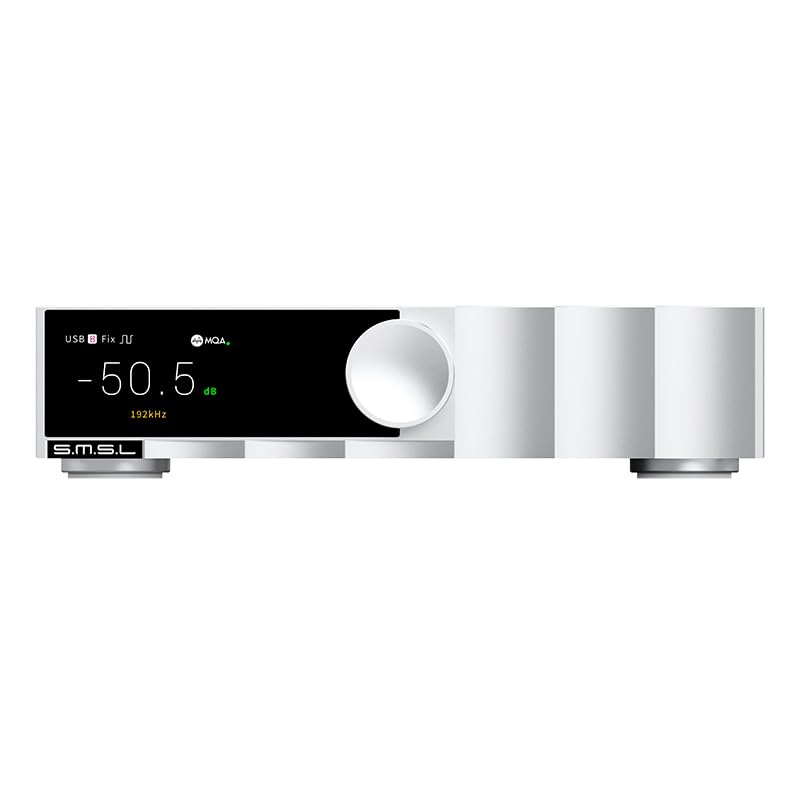
Image: Front view of the SMSL D200 DAC, showing the display with volume and sample rate, and the control knob.

Image: Detailed functional description of the front panel, labeling the display screen, function knob, and indicator LED.
4.2 Rear Panel
The rear panel provides all input and output connections, including balanced XLR, unbalanced RCA, digital inputs (Optical, Coaxial, USB), an external clock input, and the AC power inlet.
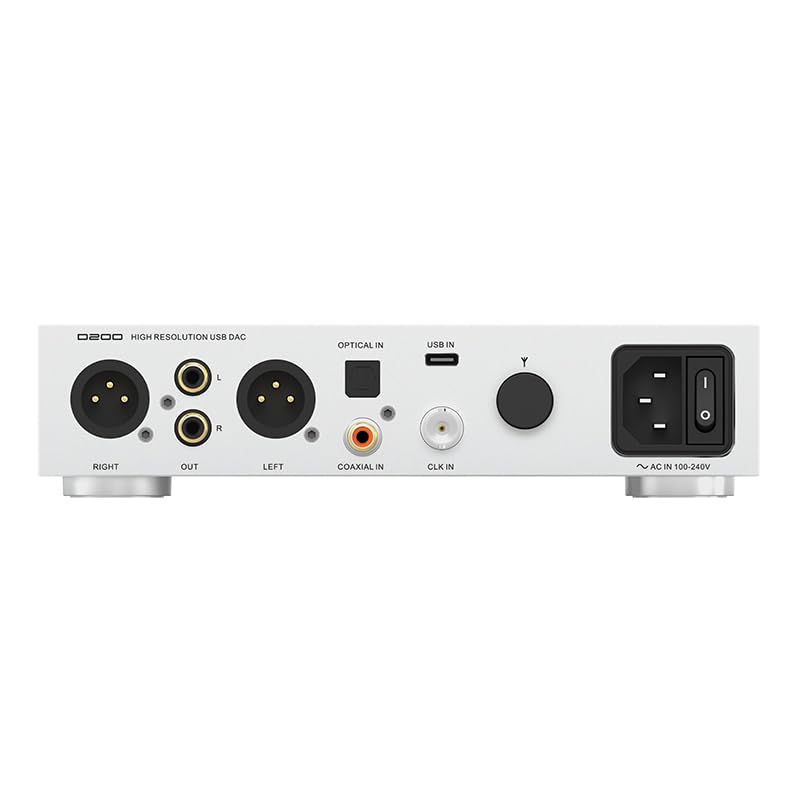
Image: Rear view of the SMSL D200 DAC, showing XLR, RCA, Optical, Coaxial, USB, Clock In, and AC In ports.
Rear Panel Connections:
- RIGHT/LEFT OUT (XLR): Balanced analog audio outputs.
- OUT (RCA): Unbalanced analog audio outputs.
- OPTICAL IN: Optical digital audio input.
- COAXIAL IN: Coaxial digital audio input.
- USB IN: USB Type-B input for connecting to a computer or other USB audio source.
- CLK IN: External clock input (BNC connector) for 10MHz clock or atomic clock.
- AC IN 100-240V: AC power input.
- Bluetooth Antenna Port: For connecting the included Bluetooth antenna.
5. Setup and Connections
5.1 Power Connection
- Ensure the D200 is placed on a stable, level surface.
- Connect the provided power cord to the AC IN port on the rear panel of the D200.
- Plug the other end of the power cord into a suitable AC power outlet (100-240V).
5.2 Audio Output Connections
Connect the D200 to your amplifier or active speakers using either the XLR or RCA outputs.
- XLR Outputs: For balanced connections, use XLR cables to connect the D200's XLR outputs to the XLR inputs of your amplifier.
- RCA Outputs: For unbalanced connections, use RCA cables to connect the D200's RCA outputs to the RCA inputs of your amplifier.
5.3 Audio Input Connections
Choose one of the following input methods:
- USB Input: Connect a USB cable from your computer (Windows, Mac, Linux) or other compatible USB audio source to the USB IN port on the D200. For Windows, a driver may be required (refer to SMSL website for downloads). Mac, Android, iOS, and Linux typically operate driverless.
- Optical Input: Connect an optical cable from your digital audio source (e.g., CD player, TV) to the OPTICAL IN port.
- Coaxial Input: Connect a coaxial cable from your digital audio source to the COAXIAL IN port.
- Bluetooth Input: Attach the provided Bluetooth antenna to the antenna port on the rear panel.
- External Clock Input: If using an external 10MHz clock or atomic clock, connect it to the CLK IN port.
6. Operating Instructions
6.1 Basic Controls
The D200 can be controlled using the front panel knob or the included remote control.
- Front Panel Knob:
Rotate: Adjusts volume (in playback mode) or navigates menu options.
Short Press: Enters the menu or confirms a selection.
Long Press: Exits the menu or switches the unit on/off. - Remote Control: Provides full control over input selection, volume, menu navigation, and playback functions (for Bluetooth).
6.2 Menu Navigation
To access the settings menu, short press the front panel knob or press the 'Menu' button on the remote. Rotate the knob or use the up/down arrows on the remote to navigate. Short press the knob or 'OK' button to select an option.

Image: Screenshot of the D200's settings menu, showing options like Inputs, Clock In, Outputs, PCM Filter, DSD Filter, Sound Color, Pre Mode, FN Key For, Language, Audio Phase, Dimmer, Brightness, Reset.
Key menu options include:
- INPUTS: Select the active audio input (USB, Optical, Coaxial, Bluetooth, Clock In).
- CLOCK IN: Configure external clock settings.
- OUTPUTS: Select output mode.
- PCM FILTER: Choose between Slow Roll-off, Sharp Roll-off, or Filter Off for PCM playback.
- DSD FILTER: Select Narrow, Normal, or Wide filter for DSD playback.
- SOUND COLOR: Adjust sound characteristics (e.g., Sound 1, Sound 2, Sound 3, Sound 4).
- PRE MODE:
PRE AMP: Output volume is controlled by the D200.
FIXED CHOOSE: Output volume is fixed to the currently set DAC mode volume.
FIXED: Output volume is fixed to the maximum volume of DAC mode. - FN KEY FOR: Customize the function of the FN key on the remote.
- LANGUAGE: Select display language.
- AUDIO PHASE: Adjust audio phase.
- DIMMER: Adjust display brightness.
- BRIGHTNESS: Adjust display brightness.
- RESET: Restore factory settings.

Image: Explanations for PCM Filter, DSD Filter, Sound Color, and Pre Mode settings.
6.3 Bluetooth Operation Guide
To connect your device via Bluetooth:
- Ensure the Bluetooth antenna is connected to the D200.
- Select 'Bluetooth' as the input source on the D200.
- On your mobile device, search for Bluetooth devices and select 'SMSL D200'.
- Once paired, audio from your device will stream to the D200. The D200 supports Bluetooth song information and lyrics display.
6.4 MQA Playback
The D200 is a full MQA decoder. When playing MQA audio files via USB, Optical, or Coaxial inputs, the D200 will automatically detect and unfold the MQA stream, delivering the original studio master quality. The display will indicate MQA playback status.
7. Specifications
| Parameter | Value |
|---|---|
| Inputs | USB / Optical / Coaxial / Bluetooth |
| Outputs | RCA / XLR |
| Line Output Amplitude (XLR) | 5 Vrms |
| Line Output Amplitude (RCA) | 2.5 Vrms |
| THD+N | 0.00019% (-114dB) (UN-WTD) |
| Dynamic Range (XLR) | 123dB |
| Dynamic Range (RCA) | 121dB |
| SNR (XLR) | 123dB |
| SNR (RCA) | 121dB |
| USB Transfer Mode | USB 2.0 Asynchronous |
| USB Compatibility | Windows 7/8/8.1/10/11 (Driver Required), Mac OSX 10.6 above, Android, iOS, Linux (Driverless) |
| MQA Decoder | USB / Optical / Coaxial |
| USB PCM Sampling Rates & Bit Depth | 44.1~768kHz (32bit) |
| USB DSD Sampling Rates & Bit Depth | 2.8224-22.5792MHz (1bit) |
| USB DoP Sampling Rates & Bit Depth | 2.8224~11.2896MHz (1bit) |
| Optical/Coaxial PCM Sampling Rates & Bit Depth | 44.1~192kHz (24bit) |
| Optical/Coaxial DoP Sampling Rates & Bit Depth | 2.8224MHz (1bit) |
| Bluetooth Codecs | SBC, AAC, aptX, aptX HD, LDAC |
| Power Consumption | <10W |
| Standby Power Consumption | <0.5W |
| Dimensions (WxHxD) | 200 x 47.9 x 197.9mm |
| Weight | 1.214kg / 2.68lbs |
Note: Measurements may have slight errors; refer to the actual product.
8. Troubleshooting
If you encounter issues with your D200, please refer to the following common solutions:
- No Power: Ensure the power cord is securely connected to both the D200 and a working power outlet. Check the power switch on the rear panel.
- No Sound:
Verify the correct input source is selected on the D200.
Check all audio cable connections between the D200 and your amplifier/speakers.
Ensure the volume level on the D200 and your amplifier is not set to minimum or muted.
If using USB, ensure the correct driver is installed (for Windows) and the D200 is selected as the output device in your computer's sound settings. - Distorted Sound:
Check cable connections for looseness or damage.
Ensure the sampling rate of your audio source matches the D200's capabilities for the selected input.
Try resetting the D200 to factory settings via the menu. - Bluetooth Connection Issues:
Ensure the Bluetooth antenna is properly attached.
Make sure the D200 is in Bluetooth input mode.
Unpair and re-pair the D200 from your mobile device's Bluetooth settings.
If problems persist, please contact SMSL customer support.
9. Maintenance
To ensure the longevity and optimal performance of your SMSL D200:
- Cleaning: Use a soft, dry cloth to clean the exterior of the unit. Avoid using abrasive cleaners, solvents, or chemical sprays.
- Placement: Place the unit in a well-ventilated area, away from direct sunlight, heat sources, and excessive moisture. Ensure adequate space around the unit for airflow.
- Handling: Handle the unit with care. Avoid dropping or subjecting it to strong impacts.
- Power Off: When not in use for extended periods, it is recommended to power off the unit and unplug it from the mains.
10. Warranty and Support
The SMSL D200 comes with a standard manufacturer's warranty. Please refer to the warranty card included in your package or visit the official SMSL website for detailed warranty terms and conditions.
For technical support, troubleshooting assistance, or service inquiries, please contact your authorized SMSL dealer or SMSL customer service directly. Contact information can typically be found on the SMSL official website.


