Introduction
This instruction manual provides essential information for the safe and proper assembly, operation, and maintenance of your JPNTECH 12-Inch 2-Cycle Gas Chainsaw, Model J-2500. Please read this manual thoroughly before using the chainsaw to ensure your safety and the longevity of the product. Keep this manual for future reference.

Image: JPNTECH 12-Inch 2-Cycle Gas Chainsaw, Model J-2500, shown in orange and grey with a 12-inch guide bar.
Important Safety Instructions
WARNING: Failure to follow these safety instructions can result in serious injury or death.
- Always wear appropriate personal protective equipment (PPE) including a helmet, eye protection, hearing protection, gloves, and safety boots.
- Ensure the work area is clear of bystanders, children, and pets.
- Do not operate the chainsaw when fatigued, under the influence of alcohol, drugs, or medication.
- Inspect the chainsaw before each use for loose parts, damage, or fuel leaks.
- Handle fuel with extreme care. Refuel in a well-ventilated area with the engine off and cool.
- Maintain a firm grip with both hands on the chainsaw handles.
- Be aware of kickback and how to avoid it.
- Never operate the chainsaw indoors or in poorly ventilated areas.
- Keep all parts of your body away from the saw chain when the engine is running.
Chainsaw Components
Familiarize yourself with the various parts of your JPNTECH chainsaw:
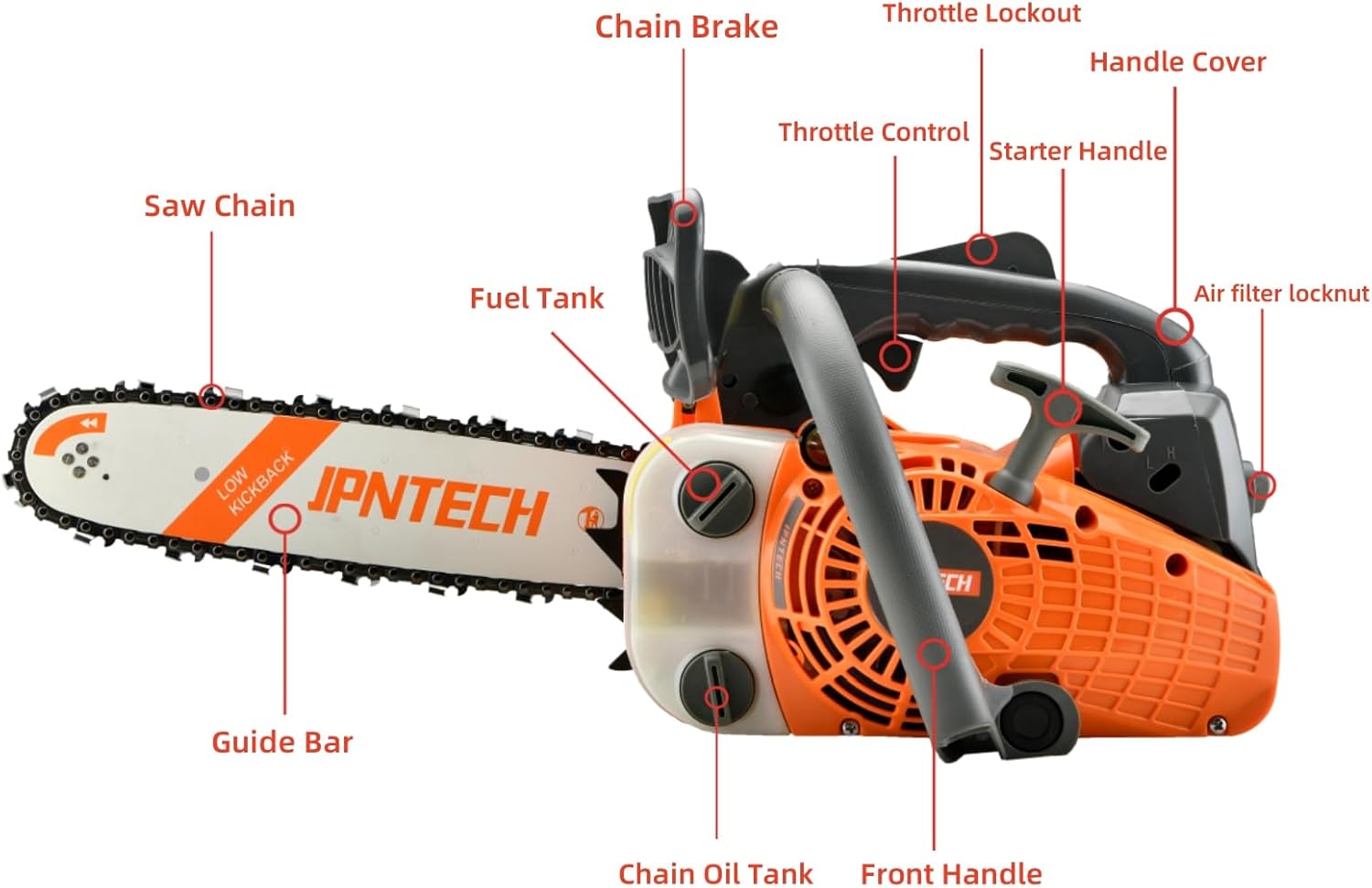
Image: Labeled diagram of the JPNTECH chainsaw, highlighting key components such as the saw chain, guide bar, fuel tank, chain oil tank, front handle, throttle control, throttle lockout, starter handle, chain brake, and handle cover.
- Saw Chain: The cutting element of the chainsaw.
- Guide Bar: Supports and guides the saw chain.
- Fuel Tank: Holds the gasoline and 2-cycle oil mixture.
- Chain Oil Tank: Holds the lubricant for the saw chain and guide bar.
- Front Handle: Provides a grip for the non-dominant hand.
- Throttle Control: Controls engine speed and chain movement.
- Throttle Lockout: Safety feature that prevents accidental throttle engagement.
- Starter Handle: Used to pull-start the engine.
- Chain Brake: Safety device to stop the chain quickly in case of kickback.
- Handle Cover: Protects the user's hand.
- Bumper Spike: Helps to pivot the chainsaw during cutting.
Setup and Assembly
Before operating your chainsaw, proper assembly is crucial. Follow these steps carefully:
1. Unboxing and Contents Check
Carefully remove all components from the packaging. Verify that all parts and accessories are present according to the packing list.

Image: Display of JPNTECH chainsaw accessories, including a tool kit, fuel mixing bottle, funnel, and guide bar cover.
2. Chainsaw Assembly
The following video demonstrates the assembly process for the JPNTECH Chainsaw:
Video: "How to Assemble JPNTECH Chainsaw?". This video provides a step-by-step visual guide on assembling the chainsaw, including attaching the guide bar and chain, and adjusting chain tension.
- Take out the machine and remove the guide bar retaining nuts.
- Remove the brake cover.
- Assemble the bumper spike using the provided screws.
- Loop the saw chain around the drive sprocket.
- Install the guide bar onto the guide bar bolts, and fit the saw chain into the guide bar groove.
- Install the bar cover. Ensure the chain-tension pin is in the pin hole on the guide bar.
- Place the bar-retaining nuts onto the guide bar bolts and tighten them by hand.
- Turn the chain tension screw clockwise to tighten the saw chain. The chain should be snug but still able to be pulled freely around the guide bar.
- Hold the guide bar tip up and securely tighten the bar-retaining nuts with the wrench.
Operation
1. Fuel and Chain Oil
Your JPNTECH chainsaw uses a 2-cycle engine. It requires a specific mixture of gasoline and 2-cycle engine oil. Refer to the specifications section for the correct mixing ratio (typically 25:1 for this model).
- Always use fresh, unleaded gasoline with an octane rating of 89 or higher.
- Use high-quality 2-cycle engine oil specifically designed for air-cooled engines.
- Mix fuel in a separate, approved fuel container. Shake well before pouring into the chainsaw's fuel tank.
- Fill the chain oil tank with good quality bar and chain oil to ensure proper lubrication during operation.
2. Starting the Engine (Cold Start)
Follow these steps for starting a cold engine:
Video: "How to start a COLD engine?". This video provides a step-by-step visual guide on starting the chainsaw when the engine is cold, including choke and primer bulb usage.

Image: Visual guide detailing the 8 steps for a cold start, including adding fuel/oil, engaging the chain brake, setting the switch, pressing the primer bulb, pulling the choke, pulling the starter handle, pushing the choke back, and pulling the starter handle again.
- Add mixture fuel (Gasoline:2-cycle Engine Oil 25:1) and chain oil to their respective tanks.
- Make sure the chain brake is engaged (pushed forward).
- Move the O/I switch to the "I" (On) position.
- Press the primer bulb 7-10 times until it is full of fuel.
- Pull the choke knob out fully to the "On" position.
- Pull the starter handle 3-5 times until the engine briefly fires.
- Push the choke knob back to the "Off" position.
- Pull the starter handle powerfully 2-3 times to start the engine.
3. Starting the Engine (Warm Start)
If the engine is already warm, the starting procedure is simpler:
Video: "How to start a WARM engine?". This video demonstrates the quicker process for starting the chainsaw when the engine is already warm.
- Ensure the chain brake is engaged.
- Move the O/I switch to the "I" (On) position.
- Pull the starter handle powerfully until the engine starts. Choke may not be necessary.
4. General Operation Tips
- Always maintain a balanced stance and firm grip.
- Never cut above shoulder height.
- Be aware of falling branches and rolling logs.
- Avoid cutting with the tip of the guide bar to prevent kickback.
- Allow the chainsaw to reach full speed before beginning a cut.
Maintenance
Regular maintenance ensures optimal performance and extends the life of your chainsaw.
- Chain Tension: Check chain tension frequently. A properly tensioned chain should be snug against the guide bar but still allow you to pull it around by hand. Refer to step 8 of the assembly instructions for adjustment.
- Chain Sharpening: A dull chain requires more effort and can cause kickback. Sharpen the chain regularly or replace it when necessary.
- Cleaning: After each use, clean the guide bar groove, air filter, and cooling fins. Remove sawdust and debris from the engine housing.
- Spark Plug: Inspect and clean the spark plug periodically. Replace if worn or fouled.
- Fuel Filter: Check and clean or replace the fuel filter as needed.
- Storage: When storing the chainsaw for an extended period, drain the fuel tank and run the engine until it stops to clear the carburetor. Clean the chainsaw thoroughly and store it in a dry, secure location.
Troubleshooting
Here are some common issues and their potential solutions:
| Problem | Possible Cause | Solution |
|---|---|---|
| Engine won't start | No fuel, incorrect fuel mix, fouled spark plug, clogged fuel filter, engaged chain brake, incorrect starting procedure. | Check fuel level and mix. Clean/replace spark plug. Clean/replace fuel filter. Disengage chain brake. Follow cold/warm start procedure carefully. |
| Chainsaw cuts poorly | Dull chain, incorrect chain tension, worn guide bar. | Sharpen or replace chain. Adjust chain tension. Inspect and replace guide bar if necessary. |
| Engine runs but chain doesn't move | Chain brake engaged, clutch issue. | Disengage chain brake. If problem persists, consult a qualified service technician. |
| Excessive smoke | Incorrect fuel/oil mix, too much oil in fuel, old fuel. | Ensure correct 25:1 fuel mix. Use fresh fuel. |
Specifications
Technical details for the JPNTECH 12-Inch 2-Cycle Gas Chainsaw, Model J-2500:

Image: Detailed specifications for the JPNTECH chainsaw, including displacement, horsepower, bar length, chain pitch, power, idle speed, max speed, weight, fuel mixture, fuel tank capacity, and oil tank capacity.
- Brand: JPNTECH
- Model Number: J-2500
- Power Source: Gas Powered
- Displacement: 25.4 CC
- Horsepower: 1.2 HP
- Power: 0.9 KW
- Bar Length: 12 Inches
- Chain Pitch: 0.050'' 3/8LP 45DL
- Idle Speed: 3400 ± 300 RPM
- Max Speed: 11,000 ± 300 RPM
- Item Weight: 8.6 Pounds (approx. 3.9 kg)
- Product Dimensions: 23"L x 9.8"W x 9.8"H
- Fuel Mixture: 25:1 (Gasoline / 2-cycle engine oil)
- Fuel Tank Capacity: 450 ML
- Oil Tank Capacity: 230 ML
- Included Components: Installation Toolkit
Warranty and Support
For warranty information, technical support, or to purchase replacement parts, please contact JPNTECH customer service. Refer to the product packaging or the official JPNTECH website for the most current contact details.
Always use genuine JPNTECH replacement parts to ensure compatibility and maintain product performance.


