
1. Introduction
The Fockety X7 NFC Card Reader Writer is a versatile device designed for reading and writing various types of IC and ID cards. It features a 2.8-inch full-color display, multi-frequency support, and a user-friendly interface with voice prompts. This manual provides detailed instructions for setting up, operating, and maintaining your device.
2. Safety Information
- Do not expose the device to extreme temperatures, humidity, or direct sunlight.
- Avoid dropping or subjecting the device to strong impacts.
- Do not attempt to disassemble or modify the device, as this will void the warranty and may cause damage.
- Use only specified power sources (AAA batteries or USB connection).
- Keep the device away from water and other liquids.
3. Package Contents
Please check the package for the following items:
- Fockety X7 NFC Card Reader Writer
- USB Cable
- RFID Keyfobs and Blank Cards (quantity may vary)

This image illustrates the typical package contents for the Fockety X7 NFC Card Reader Writer, showing the main device, a blue USB charging/data cable, and a selection of blue RFID keyfobs and blank cards for testing and copying.
4. Product Overview
Key Features
- Wide Card Compatibility: Supports ISO 14443 A cards, EM cards, Awid cards, T5577 cards, and NTAG 213, 215, 216.
- Multi-Frequency Support: Operates across 125kHz, 250kHz, 375KHz, 500KHz, 625KHz, 750KHz, 875KHz, 1000KHz, and 13.56MHz.
- Dual Power Options: Can be powered by 4 AAA batteries (not included) or via USB connection.
- User-Friendly Design: Features a numeric keypad for direct input and full voice announcements for clear feedback.
- HD Color Display: Equipped with a vibrant 2.8-inch full-color screen and multi-language support.
Device Components

A detailed labeled diagram of the Fockety X7 NFC Card Reader Writer, pointing out key components such as the display, power button, navigation keys, scan, read, write, mode, and input buttons, along with the numeric keypad. This helps users identify each function.

This image provides a labeled view of the back of the Fockety X7 NFC Card Reader Writer, indicating the card sensing area, the loudspeaker for voice prompts, and the battery compartment designed for 4 AAA batteries. A wrist strap is also visible.
5. Setup
Power Supply
The Fockety X7 can be powered in two ways:
- AAA Batteries: Insert 4 AAA batteries into the battery compartment located on the back of the device. Ensure correct polarity.
- USB Connection: Connect the device to a computer or a USB power adapter using the provided USB cable.
Initial Power On
Press and hold the power button (⏻) to turn on the device. The 2.8-inch color screen will light up, and you will hear a voice prompt.
6. Operating Instructions
Basic Card Operations
The device allows you to read, scan, and write card data. Use the navigation buttons to move through menus and the numeric keypad for direct input.
- SCAN: Initiates a scan for card data.
- READ: Reads the data from a detected card.
- WRITE: Writes the stored data to a blank card.
- MODE: Switches between different operating modes.
- INPUT: Allows manual entry of card numbers.
- OK: Confirms selections.
- C: Deletes entries or cancels operations.
How to Copy a 125kHz Card
- Press the power button to turn on the device.
- Place the original 125kHz card on the back of the copier, within the card sensing area. The copier will display a disclaimer page. Press OK.
- Place the original card on the back of the copier again and press SCAN.
- The copier will scan and display the card number.
- Once the card has been decoded, the screen will prompt you to place a copy card and press WRITE to write the card.
Note: This device supports copying most 13.56MHz encrypted cards but does not support CPU cards.

This image shows the Fockety X7 NFC Card Reader Writer in use, with a blue card being held near its sensing area. The device's screen displays card information, indicating a successful read or decode operation.

The Fockety X7 NFC Card Reader Writer is shown with a white access card being presented to a door lock, illustrating a typical application for the device's copied cards. The reader's screen shows 'IC Type-A' and a card number.
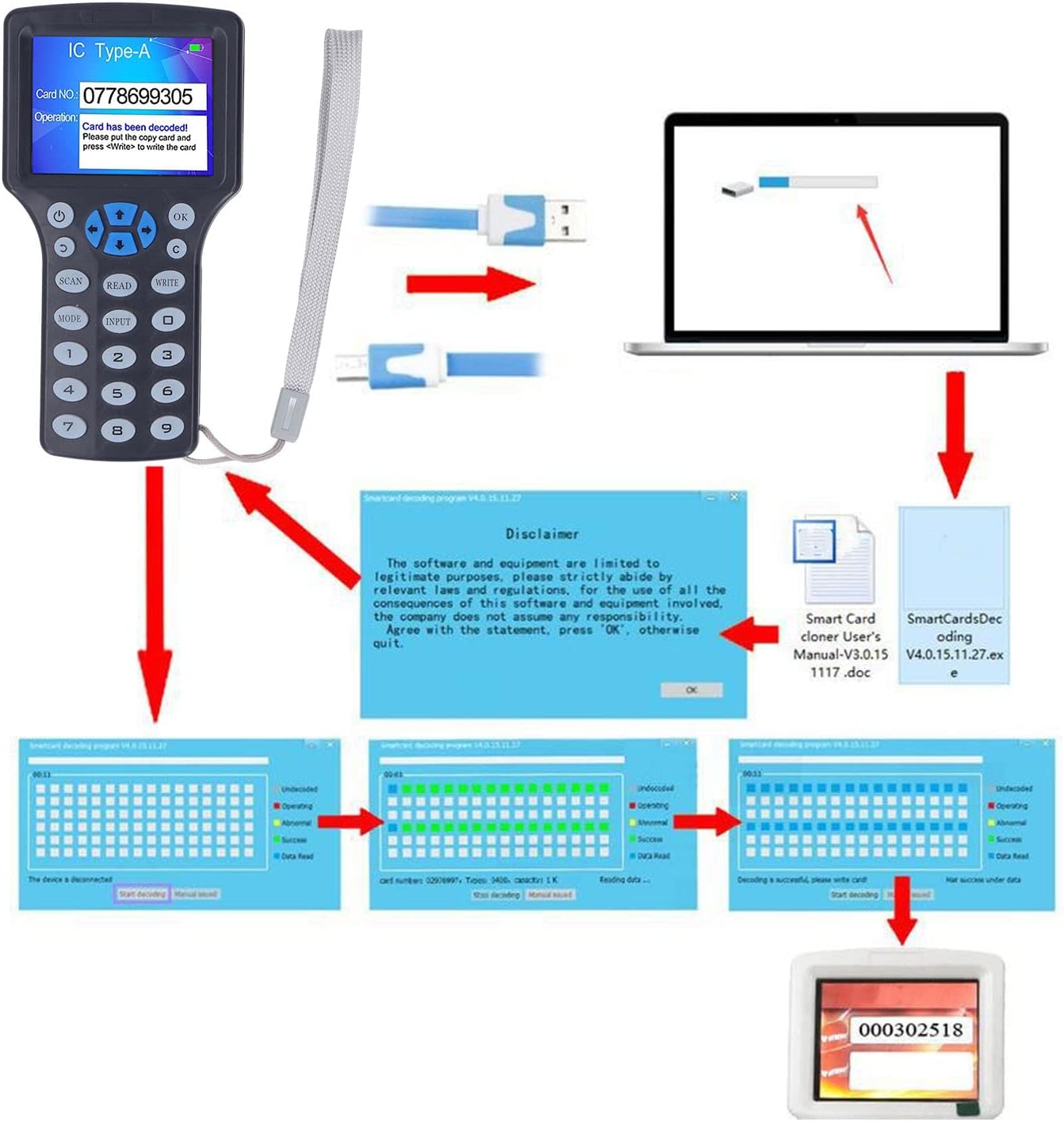
This diagram demonstrates how to connect the Fockety X7 NFC Card Reader Writer to a computer using a USB cable. It depicts the process of using the accompanying software to scan, decode, and write card data, culminating in a successful card copy.
7. Maintenance
- Cleaning: Use a soft, dry cloth to clean the device. Do not use abrasive cleaners or solvents.
- Storage: Store the device in a cool, dry place away from direct sunlight and moisture when not in use.
- Battery Replacement: If using batteries, replace all 4 AAA batteries when the low battery indicator appears on the screen.
8. Troubleshooting
- Device does not power on: Check if batteries are inserted correctly or if the USB cable is properly connected. Ensure batteries are not depleted.
- Card not detected: Ensure the card is placed correctly within the card sensing area on the back of the device. Verify the card type is supported by the device.
- Cannot write to card: Ensure you are using a compatible blank card (e.g., T5577 for 125kHz, UID card for 13.56MHz rewritable types). Some cards are read-only.
- 13.56MHz encrypted card issues: While the device handles most encrypted 13.56MHz cards, some highly encrypted or CPU cards may not be fully supported.
9. Specifications
| Item Type | Card Reader Writer |
| Material | ABS |
| Display | HD 2.8-inch Full Color Screen |
| Supported Frequencies | 125kHz, 250kHz, 375kHz, 500kHz, 625kHz, 750kHz, 875kHz, 1000kHz, 13.56MHz (for ISO1443A) |
| Supported Read Cards | EM4100, EM4200, UID Card, Ultralight, NTAG203, 1386, 1326, 1346 |
| Supported Write Cards | 1386, 1326, 1346, T5577, EM4305, UID Card |
| Power Supply | 4 x AAA Batteries (not included) or USB Power Supply |
| Supported OS (for software) | Windows 98, XP, NT, ME, 2000, 2003, Vista, 7, 8, 10, Server 2003, 2008, Mac OS X 10.5, 10.6, Linux, Android |
| Dimensions | 152mm x 80mm x 21mm (5.98in x 3.15in x 0.83in) |
| Weight | 347 g |

An image displaying the physical dimensions of the Fockety X7 NFC Card Reader Writer, with measurements provided in both millimeters and inches for length, width, and thickness, giving users a clear understanding of its size.
10. Warranty Information
This product comes with a standard manufacturer's warranty. Please refer to the product packaging or contact your retailer for specific warranty terms and conditions. The warranty typically covers defects in materials and workmanship under normal use.
11. Support
For technical support, troubleshooting assistance, or inquiries regarding your Fockety X7 NFC Card Reader Writer, please contact the retailer where you purchased the product or visit the official Fockety website for contact information.