
Introduction
This user manual provides detailed instructions for the TP-Link M8550 5G Mobile Wi-Fi Router. It covers setup, operation, maintenance, and troubleshooting to ensure optimal performance and connectivity. The M8550 offers high-speed 5G and 4G LTE internet access, tri-band Wi-Fi 6E, and a user-friendly touchscreen interface, making it suitable for various mobile and home networking needs.
Package Contents
Verify that your package contains the following items:
- TP-Link M8550 5G Mobile Wi-Fi Router
- Power Adapter
- USB-C Cable
- 4680 mAh Battery
- Quick Installation Guide
Product Overview
The TP-Link M8550 is a compact and powerful mobile Wi-Fi router designed for portable internet access. It features a touchscreen display for easy management and various ports for flexible connectivity.
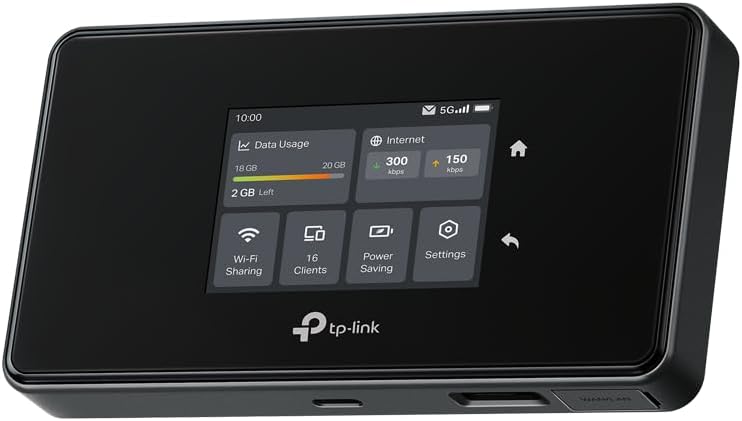
Figure 1: Front view of the TP-Link M8550 5G Mobile Wi-Fi Router, highlighting its intuitive touchscreen interface.
Physical Features
- Touchscreen Display: Provides real-time information on signal strength, connection status, data usage, connected devices, and battery level.
- USB-C Port: For charging the device.
- WAN/LAN Port: A versatile Gigabit port that can function as either a WAN input or a LAN output.
- TS-9 Antenna Connectors: Two ports for connecting external antennas to enhance signal reception.
- Nano-SIM Card Slot: For inserting your mobile network SIM card.
- MicroSD Card Slot: Supports up to 2TB for wireless file sharing.

Figure 2: Bottom view of the M8550, illustrating the USB-C charging port, external antenna connectors, and the WAN/LAN port.
Setup
1. Install SIM Card and Battery
- Open the Back Cover: Gently remove the back cover of the M8550.
- Insert Nano-SIM Card: Locate the Nano-SIM card slot. Insert your Nano-SIM card with the gold contacts facing down and the notched corner aligned correctly. Ensure it clicks into place.
- Insert Battery: Place the provided 4680 mAh battery into its compartment, ensuring the contacts align with the device's terminals.
- Replace Back Cover: Securely attach the back cover.
2. Power On the Device
Press and hold the power button (usually located on the side or top) for a few seconds until the screen illuminates. The device will boot up and attempt to connect to the mobile network.
3. Initial Configuration (Optional)
Upon first use, you may be prompted to set a PIN for your SIM card or configure basic Wi-Fi settings via the touchscreen. Follow the on-screen instructions.
Operating Instructions
Connecting Devices to Wi-Fi
The M8550 supports up to 32 devices simultaneously. To connect a device:
- Access Wi-Fi Information: On the M8550's touchscreen, navigate to the Wi-Fi information screen to find the Wi-Fi Name (SSID) and Password.
- Connect from Your Device: On your computer, smartphone, or tablet, open the Wi-Fi settings. Select the M8550's Wi-Fi Name (SSID) from the list of available networks.
- Enter Password: Input the Wi-Fi password displayed on the M8550's screen.
- Connect: Confirm the connection. Your device should now be connected to the internet via the M8550.
Using the Touchscreen Interface

Figure 3: The M8550's touchscreen provides quick access to device information and settings.
The touchscreen allows for easy monitoring and management of the router. You can view data usage, internet speed, connected clients, battery status, and adjust settings directly on the device. Swipe through the screens to access different functions and information panels.
TP-Link Tether App Management
For more comprehensive control, download the TP-Link Tether app on your smartphone. The app allows you to manage your network, monitor connected devices, set parental controls, and configure advanced settings remotely.
- Download the TP-Link Tether app from your device's app store.
- Connect your smartphone to the M8550's Wi-Fi network.
- Launch the Tether app and follow the on-screen instructions to add and manage your M8550.
Advanced Features
Wi-Fi 6E Tri-Band Connectivity
The M8550 supports Wi-Fi 6E, offering three frequency bands: 2.4 GHz, 5 GHz, and 6 GHz. This allows for stable and high-speed connections with reduced interference, even when multiple devices are connected. The device supports simultaneous use of 2.4 GHz/5 GHz or 2.4 GHz/6 GHz.

Figure 4: Overview of the M8550's key features, including 5G speeds, Wi-Fi 6E, and various connectivity options.
Gigabit WAN/LAN Port
The integrated Gigabit port can be configured as either a WAN (Wide Area Network) input, allowing you to use the M8550 as a traditional router with a wired internet source, or as a LAN (Local Area Network) output to connect a wired device.
External Antenna Support
For areas with weak cellular signal, the M8550 includes two TS-9 connectors for external antennas. Connecting compatible external antennas can significantly improve signal strength and stability.
MicroSD Card Slot
The device features a microSD card slot supporting up to 2TB. This allows for wireless sharing of files such as photos and videos with connected devices.
VPN Support
The M8550 supports VPN (Virtual Private Network) functionality, including Wireguard, to enhance network security and privacy for all connected devices.

Figure 5: The M8550's VPN feature helps secure your internet connection.
Maintenance
Battery Care
The M8550 is equipped with a 4680 mAh battery, providing up to 14 hours of operation. To maximize battery lifespan:
- Avoid extreme temperatures.
- For prolonged use while connected to AC power, consider removing the battery to prevent excessive heat buildup, as noted by some users.
- Charge the device using the provided power adapter and USB-C cable.
Firmware Updates
Regularly check for and install firmware updates to ensure optimal performance, security, and access to new features. Updates can typically be managed through the TP-Link Tether app or the device's web management interface.
Troubleshooting
No Internet Connection
- Ensure the Nano-SIM card is correctly inserted and activated with a data plan.
- Check the signal strength indicator on the touchscreen. If the signal is weak, try moving to a different location or connecting external TS-9 antennas.
- Verify that data roaming is enabled if you are in a different region.
- Restart the device.
Device Overheating
- If the device becomes excessively warm during prolonged use, especially when connected to AC power, consider removing the battery. The device can operate directly from AC power without the battery installed.
- Ensure the device is placed in a well-ventilated area and not covered.
Slow Wi-Fi Speed
- Check the number of connected devices. High numbers of concurrent users can impact performance.
- Ensure your connected devices support Wi-Fi 6E to utilize the faster 6 GHz band.
- Minimize physical obstructions between the router and your devices.
Specifications
| Brand | TP-Link |
| Model Name | M8550 |
| Operating System | TP-Link OS |
| Connectivity Technology | Ethernet, Wi-Fi |
| Special Features | Wi-Fi 6E Tri-band, WAN/LAN Port, External Antenna Support (TS-9) |
| Battery Composition | Lithium-ion |
| Battery Capacity | 4680 mAh |
| Wireless Communication Standard | 802.11ac, 802.11ax, 802.11n |
| Frequency Band Class | Tri-band (2.4 GHz, 5 GHz, 6 GHz) |
| Security Protocol | WPA2, WPA3 |
| Max Download Speed (5G) | Up to 3.4 Gbit/s |
| Max Upload Speed (5G) | Up to 900 Mbit/s |
| MicroSD Slot | Up to 2 TB |
| Max Concurrent Devices | Up to 32 |
Warranty and Support
For warranty information and technical support, please refer to the official TP-Link website or contact TP-Link customer service. Details regarding specific warranty periods and support channels are typically provided with your product documentation or available online.


