1. Introduction
The VEVOR 12V 20A DC/DC Battery Charger SDC-20A is designed to efficiently charge your auxiliary battery from your vehicle's primary battery while driving. This intelligent charger is compatible with a wide range of 12V battery types, including lead-acid, lithium, AGM, GEL, and flooded batteries. It is an ideal solution for maintaining optimal charge in backup batteries for RVs, commercial vehicles, and boats, ensuring your power needs are met on the go.
2. Safety Instructions
Please read and understand all safety instructions before installing or operating the charger. Failure to follow these instructions may result in electric shock, fire, or serious injury.
- Always wear appropriate personal protective equipment, including eye protection, when working with batteries.
- Ensure the vehicle's engine is off and the ignition is disconnected before installation.
- Disconnect the negative terminal of the starter battery before making any electrical connections.
- Install the charger in a well-ventilated area, away from flammable materials and sources of heat.
- Use appropriate wire gauges and fuses as specified in the installation section to prevent overheating and short circuits.
- Do not expose the charger to water, rain, or excessive moisture.
- Do not attempt to disassemble or repair the charger. Contact qualified service personnel for assistance.
- Ensure all connections are secure and free from corrosion.
3. Product Overview
3.1 Key Features
- Versatile Battery Compatibility: Supports lead-acid (SLA), lithium (LiFePO4), AGM, GEL, and flooded (FLD) 12V battery types.
- Multi-Stage Smart Charging: Features 2-stage charging for LiFePO4 batteries and 3-stage charging (Bulk, Absorption, Float) for lead-acid batteries, optimizing battery life and performance.
- Multiple Protections: Integrated safeguards against overvoltage, undervoltage, high temperature, reverse polarity, and short circuits. Isolated input/output protects the vehicle's electrical system.
- Lithium Battery Activation: Capable of restoring low-voltage or inactive lithium batteries.
- Compact and Durable Design: Sleek aluminum alloy casing with pre-drilled mounting holes for easy installation in various locations.
- Efficient Cooling: Built-in smart cooling fans automatically adjust speed based on temperature, ensuring stable operation and low noise.
3.2 Components
The VEVOR SDC-20A charger features robust construction and clearly marked connection points.

Image: Front view of the VEVOR SDC-20A DC/DC Battery Charger, highlighting the input/output terminals, cooling vents, and DIP switches for battery type selection. The image also illustrates the charger's high efficiency, indicating it charges 2X faster than standard 10A chargers, reaching a maximum of 20A.

Image: Top view of the VEVOR SDC-20A DC/DC Battery Charger, clearly displaying the product label with model number SDC-20A, system voltage 12-12V, charging current 20A, and maximum output power 250W.
- Input Terminals: Connect to the starter battery.
- Output Terminals: Connect to the auxiliary (house) battery.
- DIP Switches: Used to select the battery type for optimal charging.
- Cooling Fans: Integrated smart fans for heat dissipation.
- Mounting Brackets: Pre-drilled for secure installation.
4. Specifications
| Parameter | Value |
|---|---|
| Model | SDC-20A |
| Input Voltage | 12V (DC 8V-16V) |
| Charging Current | 20A |
| Maximum Output Power | 250W |
| Compatible Battery Types | Lead-acid (SLA), Lithium (LiFePO4), AGM, GEL, Flooded (FLD) |
| Casing Material | Aluminum Alloy |
| Operational Temperature | -20°C to 50°C (4°F to 122°F) |
| Net Weight | 1.22 kg (2.69 lbs) |
| Product Dimensions | 16.26 x 14.48 x 8.38 cm (6.5 x 5.7 x 3.3 inches) |
| Lead-acid Charging Voltage Range | 13.2V-14.7V |
| Lithium Charging Voltage Range | 12.6V-14.6V |
5. Setup and Installation
Proper installation is crucial for the safe and efficient operation of your VEVOR DC/DC charger.
5.1 Mounting the Charger
- Choose a dry, well-ventilated location, preferably close to the auxiliary battery.
- Ensure there is sufficient space around the charger for airflow to the cooling fans.
- Use the pre-drilled mounting holes on the charger's brackets to secure it firmly to a stable surface.
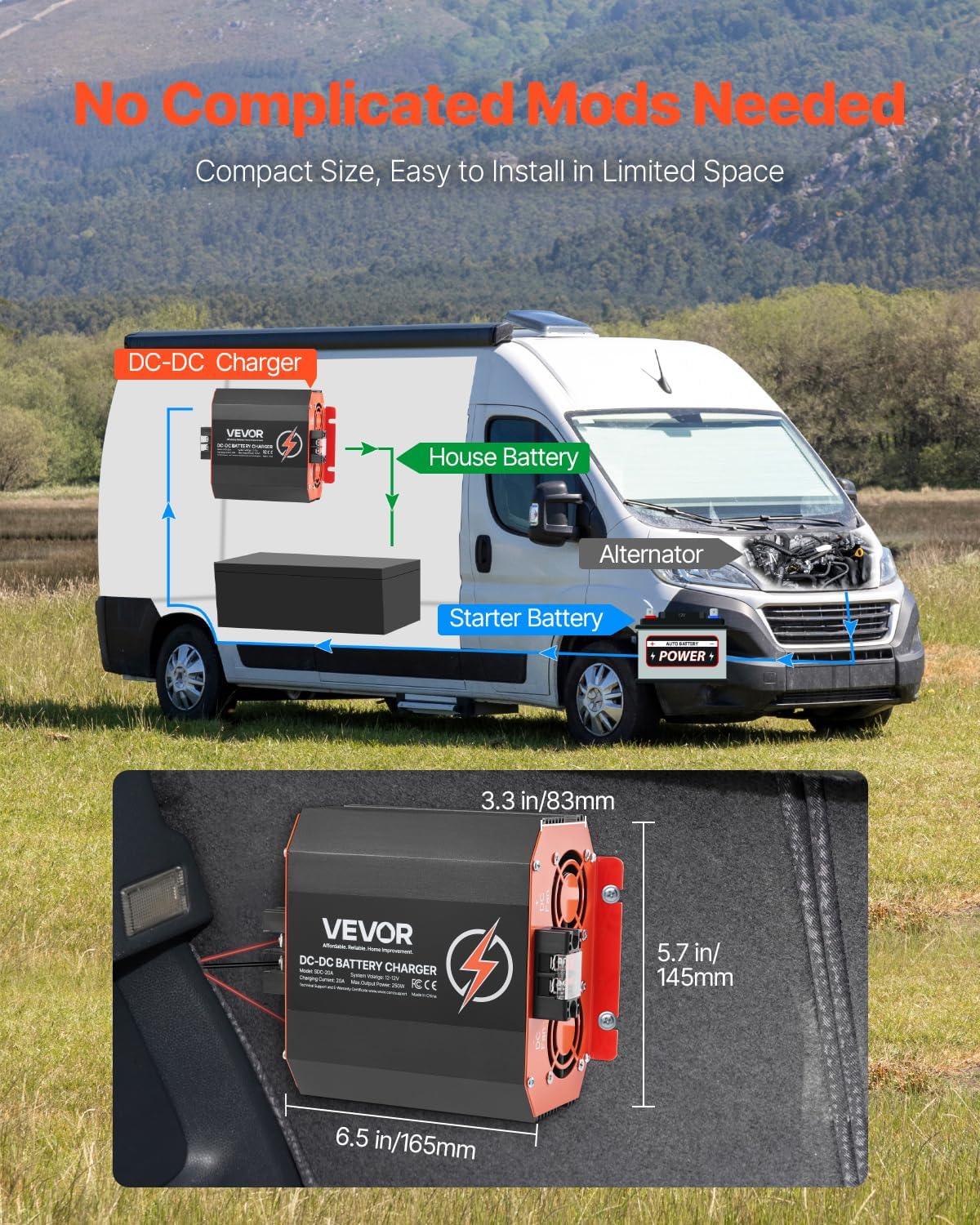
Image: Diagram showing the VEVOR SDC-20A DC/DC Battery Charger installed in a van, illustrating its compact size and ease of integration into a vehicle's electrical system. Dimensions are provided: 6.5 inches (165mm) length, 5.7 inches (145mm) width, and 3.3 inches (83mm) height.
5.2 Wiring Connections
Refer to the wiring diagram for correct connections. Always use appropriate fuses for protection.

Image: Wiring diagram illustrating the smart battery protection feature with completely isolated input and output. It shows the connection from the starter battery (DC Input) to the charger, and from the charger (DC Output) to the standby battery, with fuses on both input and output lines.
- Input Connection: Connect the positive (+) terminal of the starter battery to the charger's input positive terminal. Connect the negative (-) terminal of the starter battery to the charger's input negative terminal. Install a suitable fuse (e.g., 30A for 20A charger) on the positive input line, as close to the starter battery as possible.
- Output Connection: Connect the positive (+) terminal of the auxiliary battery to the charger's output positive terminal. Connect the negative (-) terminal of the auxiliary battery to the charger's output negative terminal. Install a suitable fuse (e.g., 30A for 20A charger) on the positive output line, as close to the auxiliary battery as possible.
- Ignition Wire (D+): For automatic operation, connect the D+ terminal on the charger to a switched ignition source (e.g., D+ terminal on the alternator or an ignition-controlled relay) that provides 12V when the engine is running. This ensures the charger only operates when the vehicle is running.
5.3 Battery Type Selection (DIP Switches)
The charger features DIP switches to select the correct battery type for optimal charging. Refer to the table below and the diagram on the charger for the correct settings.

Image: The VEVOR SDC-20A DC/DC Battery Charger connected to a 12V battery, illustrating its compatibility with various 12V battery types including Lithium (LI), Sealed Lead-Acid (SLA), AGM, GEL, and Flooded (FLD) batteries. This image emphasizes the charger's versatility in providing optimal charging curves for different battery chemistries.
| Battery Type | DIP Switch Setting | Charging Voltage Range |
|---|---|---|
| Lithium (LiFePO4) | Refer to charger label | 12.6V-14.6V |
| Lead-acid (SLA, AGM, GEL, Flooded) | Refer to charger label | 13.2V-14.7V |
Note: The exact DIP switch positions for each battery type are typically printed on the charger's label or in a dedicated diagram within the physical manual. Ensure you set these correctly before operation.
6. Operating Instructions
Once properly installed and configured, the VEVOR SDC-20A charger operates automatically.
6.1 Automatic Charging
- When the vehicle engine starts and the D+ signal is received, the charger will automatically begin charging the auxiliary battery.
- The charger will monitor the voltage of both the starter and auxiliary batteries to ensure safe and efficient charging.
- Charging will cease when the engine is turned off or the D+ signal is no longer present.
6.2 Multi-Stage Charging Process
The charger employs an intelligent multi-stage charging algorithm to optimize battery health and lifespan.

Image: Graph illustrating the intelligent multi-stage charging process (Bulk, Absorption, Float) for lead-acid batteries. It shows rapid charging in the bulk phase, stable current in the absorption phase, and a weak current maintenance in the float phase until the battery is fully charged.
- Bulk Charge: Rapidly charges the battery to approximately 80% capacity by delivering maximum current.
- Absorption Charge: Maintains a stable charging efficiency by gradually reducing current while keeping voltage constant, bringing the battery to nearly 100% charge.
- Float Charge: Applies a weak current to maintain the battery at full charge, preventing overcharging and self-discharge.
- For LiFePO4 batteries, a 2-stage process is used, typically involving a bulk charge followed by a constant voltage stage until full.
6.3 Lithium Battery Activation
The charger includes a feature to activate deeply discharged or inactive lithium batteries.

Image: Visual representation of the VEVOR SDC-20A DC/DC Battery Charger's ability to 'wake up' a lithium battery, restoring low-voltage batteries to extend their lifespan and boost performance.
If a lithium battery is deeply discharged below its protection voltage, the charger can attempt to activate it by applying a low current until the voltage rises to a safe level for normal charging to resume.
7. Maintenance
Regular maintenance ensures the longevity and optimal performance of your charger.
- Cleanliness: Keep the charger clean and free from dust and debris. Use a dry cloth to wipe the exterior. Do not use solvents or abrasive cleaners.
- Connections: Periodically check all electrical connections to ensure they are tight and free from corrosion. Loose connections can cause overheating and poor performance.
- Ventilation: Ensure the cooling vents and fans are not obstructed. Clear any blockages to allow proper airflow.
- Fuses: Inspect fuses regularly. Replace blown fuses only with fuses of the same type and rating.
8. Troubleshooting
If you encounter issues with your charger, refer to the following common troubleshooting steps:
| Problem | Possible Cause | Solution |
|---|---|---|
| Charger not operating | No D+ signal; Blown fuse; Loose connections; Input voltage too low. | Check D+ connection and ensure engine is running; Inspect and replace fuses; Tighten all wiring connections; Verify starter battery voltage is within operating range (8V-16V). |
| Slow charging or low output | Incorrect battery type setting; High resistance in wiring; Auxiliary battery deeply discharged. | Verify DIP switch settings match battery type; Check wire gauge and connections for resistance; Allow more time for charging, especially for deeply discharged batteries. |
| Overheating | Poor ventilation; Overload; Faulty cooling fan. | Ensure adequate airflow around the charger; Check for obstructions to cooling fans; Reduce load if possible; Contact support if fan is faulty. |
| Error indicator (if present) | Overvoltage, undervoltage, reverse polarity, short circuit. | Check input/output voltages; Verify correct polarity of connections; Inspect for any short circuits. Disconnect and reconnect to reset. |
If the problem persists after following these steps, please contact VEVOR customer support.
9. Warranty and Support
VEVOR products are designed for reliability and performance. For technical support, warranty information, or to register your product for an e-warranty certificate, please visit the official VEVOR support website:
Please have your model number (SDC-20A) and purchase details ready when contacting support.


