
1. Introduction and Overview
The SZJMS NF-818L is an advanced underground wire locator designed for efficiently locating and tracking buried and hidden wires. This device helps identify the precise location of break-points and the direction of underground and wall-through cables. It is ideal for various applications including pet fences, buried sprinkler valves, irrigation systems, and general electrical wire tracing.
The NF-818L features anti-interference technology, allowing it to track wires and cables up to 2-3 feet deep and up to 1600 feet long, though detection depth may vary based on environmental conditions. It includes an LED flashlight for use in dark environments and comes with headphones for accurate signal detection in noisy surroundings. Both the transmitter and receiver are powered by 3.7V 1100mAh rechargeable lithium-ion batteries, providing up to 6 hours of continuous operation.
2. What's in the Box
- 1 x NF-818L Transmitter
- 1 x NF-818L Receiver
- 1 x User Manual
- 1 x Pair of Alligator Clips (Red and Black)
- 1 x Earphones
- 1 x Qualification Certification

Image Description: A flat lay showing all components included in the SZJMS NF-818L package. This includes the main device (transmitter and receiver), a user manual, a pair of red and black alligator clips, earphones, and a qualification certificate, all neatly arranged on a white background.
3. Key Features
- Accurate Location: Locates and tracks buried and hidden wires, identifying break-points and direction.
- Deep and Long Range: Tracks wires up to 2-3 feet deep and 1600 feet long.
- Anti-interference: Designed to minimize interference for reliable detection.
- Integrated LED Flashlight: For improved visibility in low-light conditions.
- Headphone Jack: Allows for precise signal detection in noisy environments.
- Rechargeable Batteries: Both units use 3.7V 1100mAh lithium-ion batteries with up to 6 hours of operation.
- Short-Circuit Detection: Capable of identifying short-circuited cables.

Image Description: This image displays the SZJMS NF-818L wire locator, featuring both the emitter (left) with its alligator clips and the receiver (right) with its probe, set against a vibrant green grass background. The model number NF-818 is prominently displayed.
4. Safety Information
- DO NOT use this device on live circuits to prevent damage to the tester and ensure user safety.
- The underground wire tracer can only be used to locate non-energized cables or low voltage lines below 24V.
- Always ensure proper grounding when connecting the transmitter.
- Keep the device away from water and extreme temperatures.
5. Setup
- Install Batteries: Ensure both the transmitter and receiver are charged. They are powered by 3.7V 1100mAh rechargeable lithium-ion batteries.
- Power On: Hold the power button on both the transmitter and receiver for at least 3 seconds to turn them on.
- Connect Transmitter: Connect the red alligator clip of the transmitter to the cable you intend to detect. The black line does not need to be connected for basic tracing, but can be used for grounding.
- Grounding (Optional but Recommended): For optimal performance, especially in dry soil, insert a metal rod into the ground and clamp the black wire of the transmitter to it.
- Adjust Receiver: Adjust the transmitter’s power level and slowly move the receiver close to the transmitter until you can hear a clear sound.

Image Description: This image shows the emitter unit of the NF-818L wire locator with its red and black alligator clips connected to a metal wire, demonstrating a continuity test. The device is placed on a grassy, rocky surface.

Image Description: The emitter unit of the SZJMS NF-818L is shown connected to a wall charger via a USB cable, illustrating the lithium battery charging process. The device rests on a white countertop.
6. Operating Instructions
- Initiate Signal: With the transmitter connected to the target wire and powered on, the receiver will begin to pick up the signal.
- Trace the Wire: Move the receiver slowly along the suspected path of the buried wire. The signal strength indicator (LEDs) and the audible tone will guide you. The signal will be strongest directly over the wire.
- Pinpoint Break-Points: When the receiver passes over a break in the cable, the acoustic signal will stop or significantly weaken. This indicates the location of the open circuit.
- Short-Circuit Judgment: If the receiver emits a sound when detecting an untested cable, it indicates that this cable is short-circuited.
- Use Headphones: In noisy environments, connect the provided earphones to the receiver to enhance the clarity of the acoustic signal and improve accuracy.
- Utilize LED Flashlight: Activate the built-in LED flashlight on the receiver for better visibility when working in dark areas.

Image Description: A diagram showing the process of locating a cable break. The transmitter is connected to a wire, with one lead grounded. The receiver is held above the ground, emitting sound waves to detect the signal from the buried wire. A break in the wire is depicted underground, where the signal would cease.
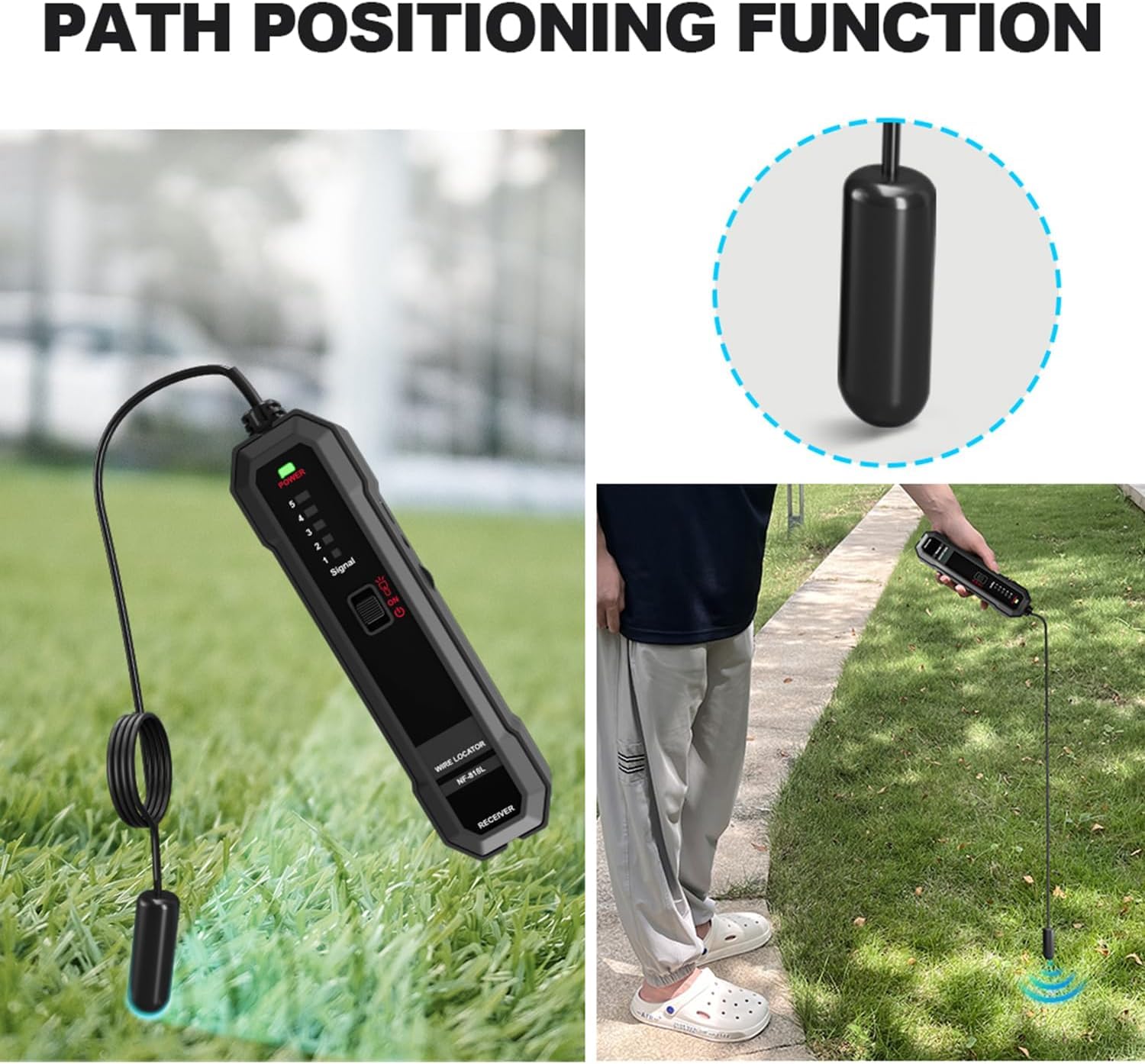
Image Description: This image demonstrates the 'Path Positioning Function' of the NF-818L receiver. A person is shown holding the receiver with its probe extended into a grassy area, actively tracing an underground wire. The probe is designed to detect the signal emitted by the transmitter.

Image Description: The receiver unit of the NF-818L is held in a hand, with its white LED flashlight activated, providing illumination in a dark environment, likely near an electrical panel, to assist in tracing wires.
Official Product Video: NF-818L Underground Cable Locator
Video Description: This video demonstrates the application of the NF-818L Underground Cable Locator. It shows the setup process, including connecting the transmitter to a circuit breaker and grounding it, then using the receiver to trace a buried cable in a garden setting. The video highlights how the device emits a beeping signal when detecting the line and how to use headphones for clearer audio in noisy environments. It also illustrates how to pinpoint an open circuit or short circuit by observing where the acoustic signal stops.
7. Maintenance
To ensure the longevity and optimal performance of your SZJMS NF-818L Underground Wire Locator, follow these maintenance guidelines:
- Cleaning: Wipe the device with a soft, dry cloth after each use. Do not use abrasive cleaners or solvents.
- Storage: Store the device in a cool, dry place, away from direct sunlight and extreme temperatures.
- Battery Care: Recharge the lithium-ion batteries regularly, even if the device is not in frequent use, to maintain battery health. Avoid fully discharging the batteries for extended periods.
- Cable Inspection: Periodically inspect the alligator clips and connecting wires for any signs of wear or damage. Replace if necessary.
8. Troubleshooting
If you encounter issues with your NF-818L, refer to the following common problems and solutions:
| Problem | Possible Cause | Solution |
|---|---|---|
| No signal or weak signal from receiver. | Low battery; incorrect connection; wire too deep; high environmental interference; receiver volume too low. | Ensure batteries are charged. Verify transmitter is correctly connected to the wire. Increase receiver volume to maximum. Use headphones for clearer signal. Consider grounding the black wire. Note that signal may weaken beyond 2-3 feet depth. |
| Device not turning on. | Depleted battery. | Charge the device fully using the provided charging cable. |
| Inaccurate location detection. | High ambient noise; improper technique; environmental factors (e.g., very wet soil). | Use headphones to minimize external noise. Move the receiver slowly and methodically. Ensure the transmitter's power is adjusted appropriately. |
| Device damaged after use. | Used on live circuits or high voltage lines. | This device is only for non-energized cables or low voltage below 24V. Damage from misuse is not covered by warranty. |
9. Specifications
| Feature | Specification |
|---|---|
| Brand | SZJMS |
| Model Number | NF-818L |
| Power Source | Battery Powered (Rechargeable Lithium-ion) |
| Battery Capacity | 3.7V 1100mAh |
| Operating Voltage | Below 24 Volts (DC) |
| Max. Tracking Depth | 2-3 feet (0.6-0.9 meters) |
| Max. Tracking Length | 1600 feet (487 meters) |
| Item Weight | 14.9 ounces (approx. 422 grams) |
| Color | Blue (device color) |
| UPC | 762744782252 |

Image Description: This image provides a detailed view of the dimensions for both the emitter and receiver units of the NF-818L. Measurements are shown in millimeters, highlighting the compact size of each component.
10. Warranty and Support
SZJMS provides worry-free after-sales service for the NF-818L Underground Wire Locator. If you encounter any problems during use, please feel free to contact us. We are committed to replying to your inquiries within 24 hours to provide assistance and solutions.
Please note that the device is designed for use with non-energized cables or low voltage lines below 24V. Damage resulting from use on live circuits or higher voltage lines may not be covered under warranty.