
1. Important Safety Instructions
Always read and understand all safety warnings, instructions, illustrations, and specifications provided with this power tool. Failure to follow all instructions listed below may result in electric shock, fire, and/or serious injury.
General Power Tool Safety Warnings:
- Work Area Safety: Keep work area clean and well-lit. Cluttered or dark areas invite accidents. Do not operate power tools in explosive atmospheres, such as in the presence of flammable liquids, gases, or dust. Power tools create sparks which may ignite the dust or fumes.
- Electrical Safety: Power tool plugs must match the outlet. Never modify the plug in any way. Do not use any adapter plugs with earthed (grounded) power tools. Unmodified plugs and matching outlets will reduce risk of electric shock.
- Personal Safety: Stay alert, watch what you are doing, and use common sense when operating a power tool. Do not use a power tool while you are tired or under the influence of drugs, alcohol, or medication. A moment of inattention while operating power tools may result in serious personal injury. Always wear eye protection. Use safety glasses, goggles, or a face shield.
- Tool Use and Care: Do not force the power tool. Use the correct power tool for your application. The correct power tool will do the job better and safer at the rate for which it was designed. Disconnect the plug from the power source and/or remove the battery pack, if detachable, from the power tool before making any adjustments, changing accessories, or storing power tools.
- Service: Have your power tool serviced by a qualified repair person using only identical replacement parts. This will ensure that the safety of the power tool is maintained.
2. Package Contents
Verify that all items are present and in good condition upon opening the package.
- NANWEI NW-M20XMD Cordless Reciprocating Saw (Tool Only)
- 2 x Wood Saw Blades
- 2 x Metal Saw Blades
- English User Manual
Note: Battery and charger are not included with this 'Tool Only' package.
3. Product Specifications
| Feature | Specification |
|---|---|
| Model Number | NW-M20XMD |
| Motor Type | Brushless Motor |
| No Load Speed | 0-3500 SPM (Strokes Per Minute) |
| Stroke Length | 15mm |
| Voltage | 20 Volts (Compatible with Makita 18V batteries) |
| Item Weight | 2.6 lbs (Tool Only) / 3.3 lbs (Shipping Weight) |
| Product Dimensions | 12"L x 10"W x 10"H |
| Blade Material | Alloy Steel |
| Included Components | Reciprocating Saw Body, 2 Wood Blades, 2 Metal Blades, Manual |
The NANWEI NW-M20XMD features a powerful brushless motor for increased efficiency and durability, along with low-vibration control for comfortable operation.

Image: Detailed view of the NANWEI NW-M20XMD Reciprocating Saw highlighting its features like alloy blade, LED light, trigger, safety lock, and battery remaining display.
4. Setup
4.1 Battery Installation
This tool is compatible with Makita 18V batteries (e.g., BL1860B, BL1850B, BL1850, BL1840, BL1830B, BL1830, BL1820B, BL1815).
- Ensure the tool is switched off and the trigger is locked.
- Align the battery pack with the battery port on the bottom of the saw handle.
- Slide the battery pack into the port until it clicks securely into place.
- To remove, press the release button on the battery pack and slide it out.
4.2 Blade Installation (Tool-Free)
The NANWEI NW-M20XMD features a tool-free blade change system for quick and easy blade replacement.
- Ensure the tool is switched off and the battery is removed for safety.
- Turn the chuck counter-clockwise to open the blade clamp.
- Insert the saw blade fully into the blade clamp until it seats firmly.
- Release the chuck. It will automatically lock the blade in place. Gently pull on the blade to ensure it is securely fastened before operation.

Image: Step-by-step guide demonstrating the tool-free blade installation process: turning the chuck, inserting the blade, and completion.
5. Operating Instructions
5.1 Powering On/Off and Safety Lock
The saw is equipped with a safety lock to prevent accidental startup.
- To activate the saw, push the safety lock button (typically located above the trigger) to the 'unlocked' position.
- Press the trigger to start the saw.
- To stop the saw, release the trigger.
- For storage or when changing blades, always engage the safety lock by pushing it to the 'locked' position.

Image: Illustration showing the location of the safety lock and how to engage/disengage it, along with the stepless speed trigger.
5.2 Variable Speed Control
The saw features a stepless variable-speed trigger (0-3500 SPM) for precise control over various materials.
- Low Speed: Press the trigger lightly for slower strokes, ideal for starting cuts or working with delicate materials.
- High Speed: Press the trigger heavily for faster strokes, suitable for aggressive cutting through tougher materials.
- Stopping: Release your finger from the trigger to stop the saw.

Image: Visual guide on how to control the stepless speed by pressing the trigger lightly for low speed, heavily for high speed, and releasing to stop.
5.3 Built-in LED Light
An integrated LED light illuminates the work area for improved visibility, especially in low-light conditions.
- The LED light activates automatically when the trigger is pressed.
- It helps to clearly see the cutting line and workpiece.

Image: Close-up view of the saw's front, showing the integrated LED light illuminating the blade area, and the ergonomic rubber comfort handle.
5.4 Cutting Techniques and Applications
The NANWEI NW-M20XMD is designed for versatile cutting tasks. Always select the appropriate blade for the material.
- Wood Cutting: Use wood-specific blades for efficient cutting of wood, branches, and lumber. Apply steady pressure and allow the saw to do the work.
- Metal Cutting: Use metal-specific blades for cutting metal pipes, tubing, and sheet metal. Use a slower speed and apply cutting oil if necessary to prolong blade life.
- PVC/Plastic Cutting: Use appropriate blades for PVC pipes and other plastic materials. Variable speed control helps prevent melting of plastic.
- Other Materials: The saw can also be used for bamboo, corrugated paper, and other soft materials with the correct blade.

Image: Diagram illustrating the versatile applications of the reciprocating saw for cutting various materials including metal, bamboo, corrugated paper, plastic, wood, and PVC pipe.
5.5 One-Handed Use
Weighing only 2.6 lbs, this saw is optimized for comfortable one-handed control, providing uncompromised precision for users of all demographics.
- Ensure a firm grip on the handle.
- Maintain balance and control of the tool during operation.
- For heavier tasks or when more stability is required, use both hands.
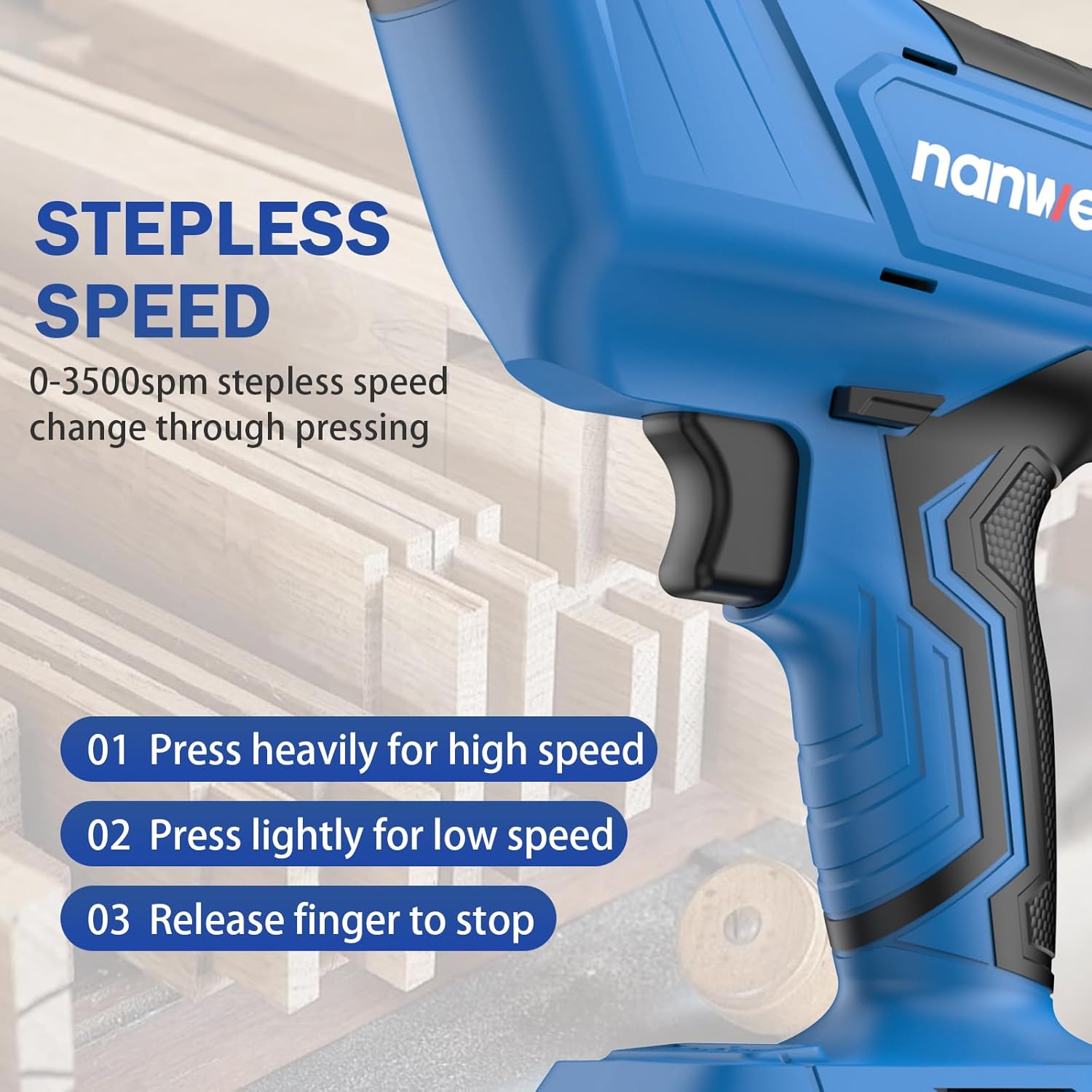
Image: A woman demonstrating the ease of one-handed use of the NANWEI reciprocating saw for pruning branches, highlighting its light and small design.
5.6 Brushless Motor Performance
The advanced brushless motor delivers 80% higher power output and 60% lower energy consumption compared to traditional copper motors. This results in quieter operation, enhanced durability, and unrestricted mobility.

Image: Diagram illustrating the internal components of the upgraded brushless motor, emphasizing its high control, efficiency, stable speed increase, and extended service life.
5.7 High-Speed Cutting Demonstration
Observe the saw's performance in various cutting scenarios.
Video: Official NANWEI demonstration of the reciprocating saw in action, showcasing its high-speed cutting capabilities on various materials like wood, metal, and PVC.
6. Maintenance
Regular maintenance ensures optimal performance and extends the life of your tool.
- Cleaning: After each use, clean the saw body with a soft, damp cloth. Remove any sawdust, debris, or metal shavings from the ventilation openings and blade clamp area. Do not use harsh chemicals or abrasive cleaners.
- Blade Care: Inspect blades before each use for sharpness and damage. Replace dull or damaged blades immediately. Store blades in a dry, safe place.
- Lubrication: The brushless motor is generally maintenance-free. Refer to the manufacturer's guidelines for any specific lubrication requirements for the blade mechanism.
- Storage: Store the tool in a dry, secure location out of reach of children. Remove the battery pack before storing for extended periods.
7. Troubleshooting
If you encounter issues with your NANWEI NW-M20XMD, refer to the following common problems and solutions:
| Problem | Possible Cause | Solution |
|---|---|---|
| Saw does not start | Battery not charged or improperly installed; Safety lock engaged; Faulty trigger. | Ensure battery is fully charged and correctly inserted. Disengage the safety lock. If problem persists, contact support. |
| Poor cutting performance | Dull or incorrect blade for material; Insufficient pressure; Overheating. | Replace blade with a sharp, appropriate type. Apply steady, firm pressure. Allow tool to cool if overheating. |
| Excessive vibration/noise | Loose blade; Damaged blade; Internal issue. | Check blade for secure installation and damage. Replace if necessary. If issue continues, seek professional service. |
| LED light not working | Trigger not pressed; Electrical fault. | Ensure trigger is pressed. If light still fails, contact support. |
8. Warranty and Support
For warranty information and customer support, please refer to the documentation included with your purchase or contact NANWEI customer service directly. Keep your purchase receipt as proof of purchase.
Manufacturer: NANWEI
Part Number: NW-WMD49
Item Model Number: NW-M20XMD