1. Introduction
The LILYGO T-Echo-Lite is a compact and power-efficient development board designed for mesh networking and GPS applications. It features an SX1262 LoRa transceiver, an NRF52840 microcontroller, and a 1.22-inch SPI E-Paper display. This module is a lighter version of the original T-Echo, offering reduced size and lower power consumption, with a deep sleep power consumption as low as 2μA to 10μA. It integrates inertial sensors, a LoRa module, solar charging capabilities (5V), and an external L76K GPS module for multi-system positioning.
This manual provides detailed instructions for setting up, operating, maintaining, and troubleshooting your LILYGO T-Echo-Lite L76K GPS Expansion Module.
2. Product Overview
2.1. Key Features
- Microcontroller: NRF52840
- Memory: 1MB Flash, 256KB RAM
- LoRa Transceiver: SX1262 (Long Range, Low Power)
- Supported LoRa Bands: 433, 868, 915, 923MHz
- Display: 1.22-inch SPI E-Paper Display (176 x 192 resolution)
- GPS Module: L76K Multi-System Positioning GNSS module (GPS, GLONASS, BeiDou, QZSS) - Note: GPS module is optional and may be an expansion.
- Wireless Connectivity: Bluetooth 5, Thread, ANT, Bluetooth Mesh, 802.15.4, Zigbee, 2.4 GHz proprietary
- Power: Solar charging (5V 500mA), 3.7V battery support, low deep sleep power consumption (2μA to 10μA)
- Other Features: Inertial sensors, USB-C port for charging and firmware upload.
2.2. Components
The LILYGO T-Echo-Lite L76K GPS Expansion Module typically includes the following components:
- 1 x T-Echo Lite L76K Development Board
- 1 x GPS Antenna

Image: LILYGO T-Echo-Lite L76K GPS Expansion Module and included GPS antenna.
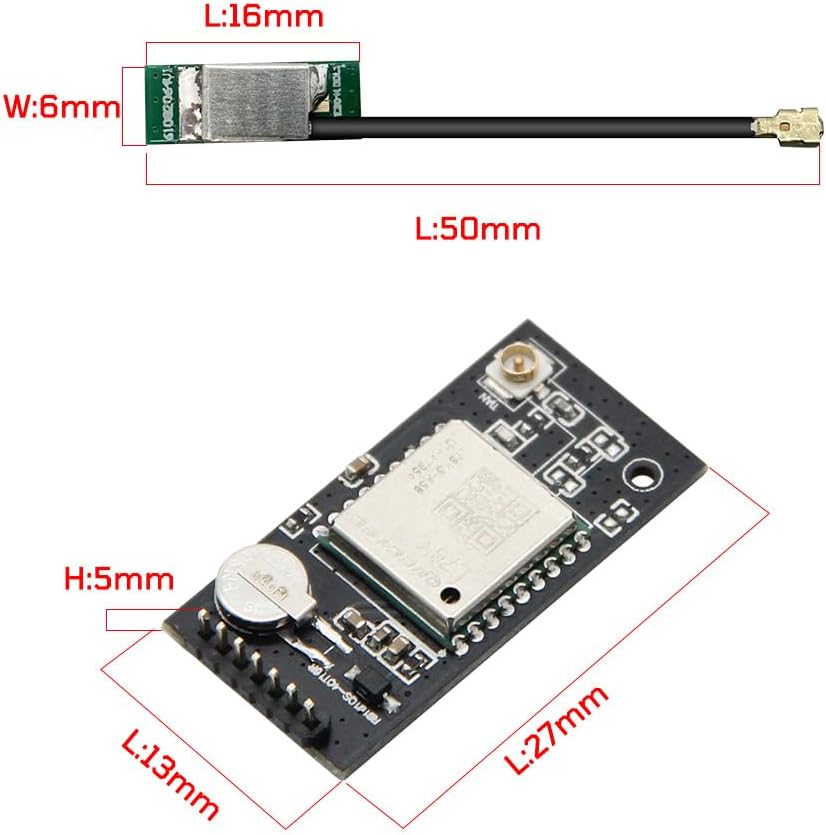
Image: Detailed dimensions of the LILYGO T-Echo-Lite L76K GPS Expansion Module and its antenna.
2.3. Board Layout and Pinout
The T-Echo-Lite Core features a stamp hole design, NRF52840 MCU, battery charge/discharge circuit, solar charging circuit, and LoRa module. The device is housed in a transparent case with an E-ink screen for display.

Image: LILYGO T-Echo-Lite Pinmap and component overview, highlighting NRF52840, E-Paper, LoRa, GPS, and IMU connections.

Image: LILYGO T-Echo-Lite features and specifications, including MCU, Flash, RAM, Programming Platform, Wireless Connectivity, LoRa Transceiver, E-Paper Display, L76K GNSS module, size, and battery charging details.
3. Setup
To get started with your LILYGO T-Echo-Lite, you will typically need to flash the Meshtastic firmware and connect it to the Meshtastic mobile application.
3.1. Flashing Meshtastic Firmware
The LILYGO T-Echo-Lite is compatible with Meshtastic, an open-source mesh network communication platform. Follow these steps to flash the firmware:
- Download Firmware: Visit the official Meshtastic website (meshtastic.org/docs/software/) and navigate to the 'Device firmware' section. Download the appropriate firmware file for the T-Echo-Lite (e.g., 'firmware-t-echo-xxxx.uf2').
- Connect Device: Connect your T-Echo-Lite to your computer using a USB-A to USB-C cable.
- Enter Bootloader Mode: The device should appear as a removable disk (e.g., 'TECHBOOT'). If not, you may need to double-click the reset button to enter bootloader mode.
- Copy Firmware: Copy the downloaded '.uf2' firmware file directly into the 'TECHBOOT' disk. The device will automatically refresh and restart after the firmware is copied.
Video: Instructions on how to install Meshtastic firmware to the LILYGO T-Echo-Lite.
3.2. Mobile App Connection
After flashing the firmware, install the Meshtastic App on your smartphone (available for Android and iOS). Follow these steps to connect your device:
- Install App: Download the Meshtastic App from your device's app store or from meshtastic.org/downloads.
- Connect via Bluetooth: Open the Meshtastic App. The app will search for nearby Meshtastic devices. Select your T-Echo-Lite from the list.
- Configure Device: Once connected, you can select the desired frequency band and enter a username.
Video: Demonstrates connecting the T-Echo-Lite to the Meshtastic mobile application and basic messaging.
4. Operating Instructions
4.1. Basic Device Operation
The T-Echo-Lite features a simple interface with an E-ink screen and a few buttons:
- Screen Backlight: Press the top button to illuminate the E-ink screen.
- Cycle Screens: Use the bottom button to cycle through different information screens, which typically include:
- Messaging Screen: Displays received messages.
- Nodes Map: Shows the location of other Meshtastic nodes in your network.
- Node List: Lists detected nodes and their distances.
4.2. Sending and Receiving Messages
Messages are primarily managed through the Meshtastic mobile application connected to your T-Echo-Lite. The device acts as a transceiver, relaying messages over the LoRa mesh network.
- Sending Messages: Use the Meshtastic app to compose and send messages. You can send to individual nodes or broadcast to channels.
- Receiving Messages: Messages received by your T-Echo-Lite will be displayed on its E-ink screen and also appear in the Meshtastic app on your connected phone.
4.3. GPS Functionality
With the L76K GPS Expansion Module, your T-Echo-Lite can provide location data. This data can be shared across the Meshtastic network, allowing other users to see your position on their node maps.
5. Maintenance
5.1. Charging
The T-Echo-Lite is powered by a 3.7V battery and can be charged via its USB-C port. It also supports solar charging (5V 500mA).
- Connect a standard USB-C cable to the device and a power source (e.g., computer, USB wall adapter).
- For optimal battery life, avoid fully discharging the battery frequently.
5.2. Battery Life
Battery life varies significantly based on usage:
- GPS Enabled & Active: Continuous GPS usage and frequent message transmission/reception will consume more power, potentially leading to a battery life of approximately 24 hours.
- GPS Disabled & Passive: If used primarily as a receiving transmitter without active GPS or frequent interaction, the device can last for several weeks on a single charge due to its low deep sleep power consumption.
5.3. Firmware Updates
Regularly check the Meshtastic website (meshtastic.org/docs/software/) for the latest firmware updates. Updating your device ensures you have the latest features, bug fixes, and compatibility improvements. The update process is similar to the initial flashing process described in the Setup section.
6. Troubleshooting
6.1. Signal Range Issues
The effective range of LoRa communication depends on several factors:
- Line of Sight: LoRa performs best with clear line of sight between devices. Obstructions like buildings, terrain, and dense foliage can significantly reduce range.
- Antenna Placement: Optimal antenna placement (e.g., higher elevation) can improve range.
- Number of Nodes: Meshtastic is a mesh network; the more nodes in an area, the better the coverage and message relaying capabilities. In areas with few nodes or significant obstructions (e.g., basements), communication range may be limited.
- Frequency Band: Ensure your device is configured to the correct frequency band for your region.
6.2. Firmware Update Problems
If you encounter issues during firmware updates:
- Verify File Integrity: Ensure the downloaded firmware file is not corrupted.
- Correct File Type: Make sure you are using the correct '.uf2' file for your T-Echo-Lite.
- Re-enter Bootloader: If the device doesn't appear as 'TECHBOOT', try double-clicking the reset button again.
- USB Cable/Port: Try a different USB cable or port on your computer.
6.3. Connectivity Issues with Mobile App
If your device is not connecting to the Meshtastic mobile app:
- Bluetooth Enabled: Ensure Bluetooth is enabled on your smartphone.
- App Permissions: Check that the Meshtastic app has necessary Bluetooth and location permissions.
- Device Powered On: Confirm your T-Echo-Lite is powered on and not in deep sleep mode.
- Restart Devices: Try restarting both your T-Echo-Lite and your smartphone.
7. Specifications
| Feature | Specification |
|---|---|
| Processor | ARMv7 (NRF52840) |
| RAM | 256KB |
| Flash | 1MB |
| LoRa Transceiver | SX1262 |
| LoRa Frequency Bands | 433, 868, 915, 923MHz |
| Display | 1.22 inch SPI E-Paper (176x192) |
| GPS Module | L76K Multi-System Positioning GNSS (GPS, GLONASS, BeiDou, QZSS) |
| Connectivity Technology | LoRaWAN, GPS, USB, GPIO, Bluetooth 5, Thread, ANT, Bluetooth Mesh, 802.15.4, Zigbee, 2.4 GHz proprietary |
| Operating System | Linux (compatible) |
| Power Consumption (Deep Sleep) | 2μA to 10μA |
| Battery Charging | 5V 500mA (via USB-C or Solar) |
| Dimensions | 41 x 41 x 14.5mm (T-Echo-Lite Core) |
8. Warranty and Support
For any questions or suggestions regarding the LILYGO T-Echo-Lite L76K GPS Expansion Module, please feel free to contact LILYGO customer support. We are committed to providing prompt assistance.
Contact Information: Please refer to the seller's contact details on the platform where you purchased the product.
Firmware & Development Resources: For the latest firmware, documentation, and community support, visit the official GitHub repository: github.com/Xinyuan-LilyGO/T-Echo-Lite