1. Introduction
The avedio links USB2.0 Video Capture Card is designed to convert analog RCA composite and S-Video inputs into high-definition USB output. This device allows you to digitize content from various analog sources such as camcorders, set-top boxes, DV camcorders, DVD players, VHS, VCD, VCR, and DVR systems. The maximum output resolution supported is 1920x1080 at 30Hz. Please note that this device is compatible only with NTSC/PAL formats.
This capture card is compatible with Windows and macOS operating systems and supports popular video capture software like OBS and Potplayer. It is an ideal solution for video production, screen recording, and preserving old analog media in a digital format.
2. What's in the Box
Upon unpacking your avedio links USB2.0 Video Capture Card, please verify that all the following items are included:
- RCA & S-Video to USB Capture Card (1 unit)
- USB A to Type-C converter (1 unit)
- CD (1 unit) - Note: Software can also be downloaded from the manufacturer's website.
- S-Video Cable (1 unit)
- RCA Converter (1 unit)
- User Manual (1 unit)
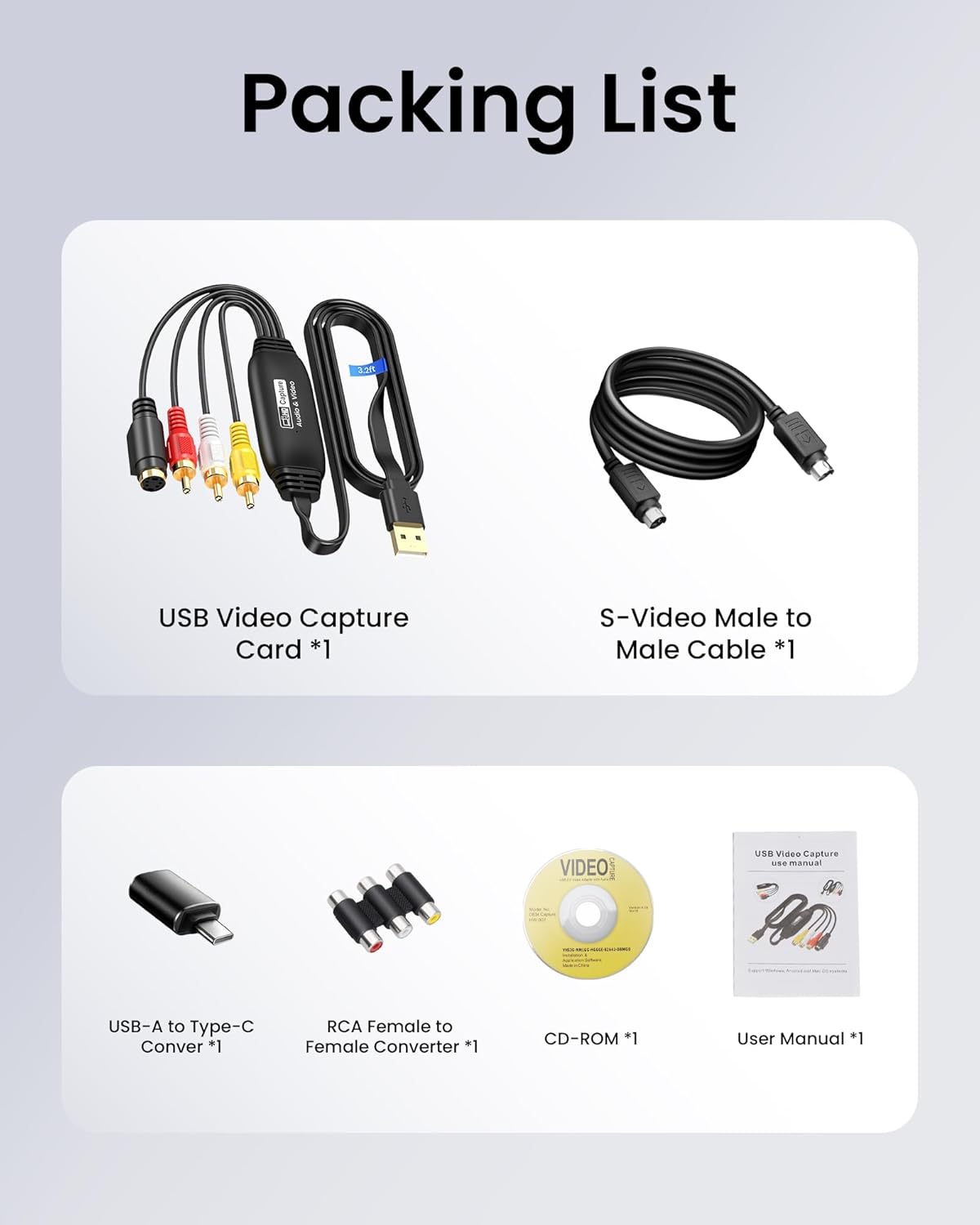
Image: Contents of the product packaging.
3. Setup Instructions
Follow these steps to connect your avedio links USB2.0 Video Capture Card and prepare for video capture:
- Connect Analog Source: Connect the RCA (yellow for video, white for left audio, red for right audio) or S-Video cables from your analog device (e.g., VCR, DVD player, camcorder) to the corresponding input ports on the avedio links capture card.
- Connect to Computer: Plug the USB-A connector of the capture card into an available USB port on your computer. If your computer only has USB-C ports, use the provided USB-A to Type-C converter. The 3.2ft/1m extended USB cable offers flexibility in placement.
- Install Software: Insert the provided CD into your computer's CD drive to install the necessary drivers and software. Alternatively, download the latest software (e.g., OBS Studio) from the manufacturer's official website or the software provider's website.
- Launch Software: Open your chosen video capture software (e.g., OBS Studio, Potplayer).

Image: Direct plug-in design showing RCA and S-Video connections to a source device and USB connection to a laptop.
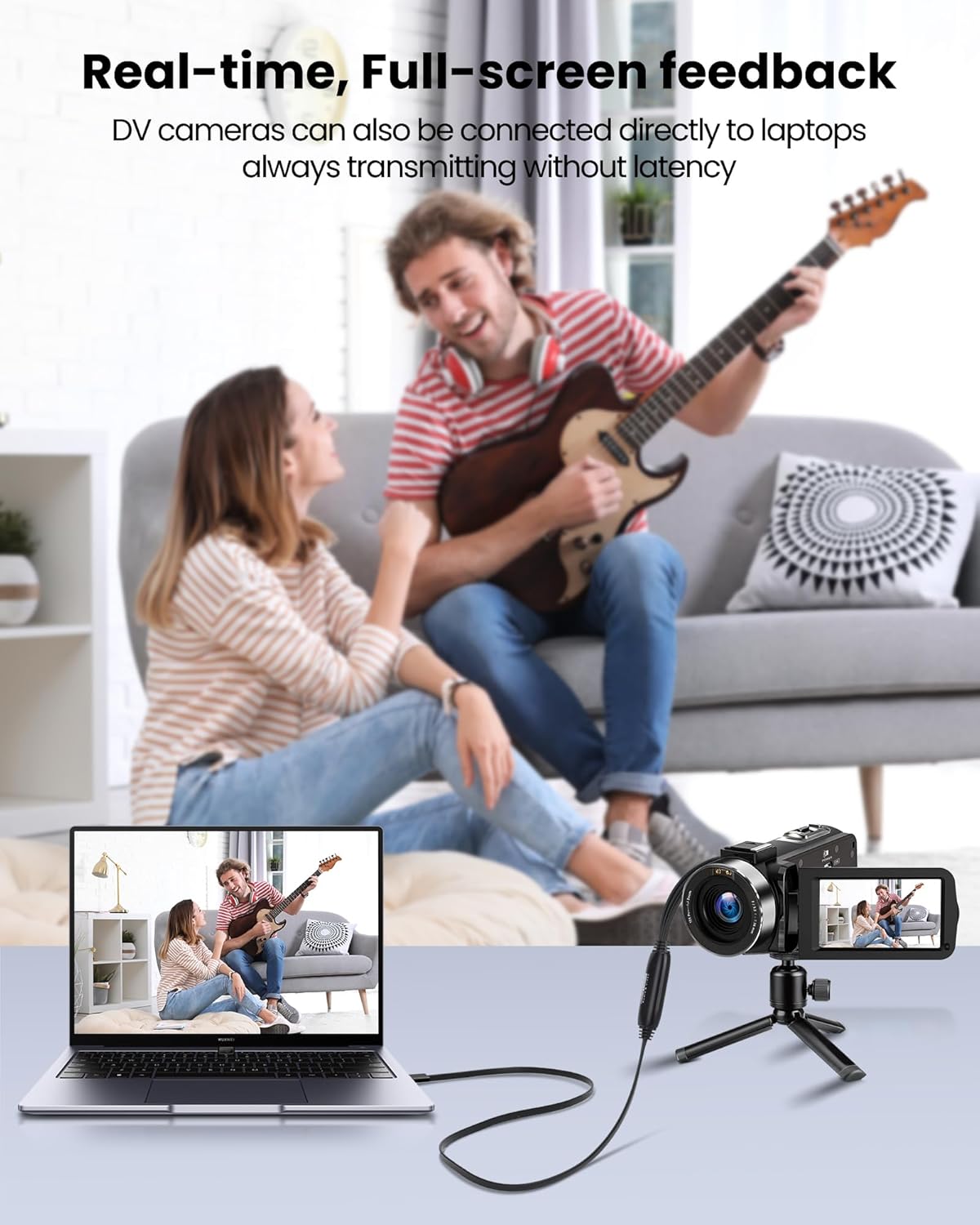
Image: The 3.3ft/1m extended USB cable for flexible connection.
Video: Connection Steps and OBS Setups
This video demonstrates the physical connection steps for the VHS to Digital Converter and initial setup within OBS Studio.
4. Operating Instructions (Using OBS Studio)
This section outlines the basic steps for capturing video using OBS Studio. For detailed instructions, refer to the OBS Studio Operation Guide video.
- Add Source: In OBS Studio, navigate to the 'Sources' panel. Click the '+' button and select 'Video Capture Device'.
- Create/Select Device: Choose 'Create new' and name your source (e.g., 'VHS Capture'). Click 'OK'.
- Select Device: In the properties window, select 'USB Video' from the 'Device' dropdown list.
- Configure Resolution/FPS: Set 'Resolution/FPS Type' to 'Custom'. Choose '1920x1080' for 'Resolution' and '30' for 'FPS'.
- Audio Output Mode: Under 'Audio Output Mode', select 'Output desktop audio (WaveOut)' to hear the audio during capture.
- Start Recording: Once the video feed appears in the preview window, click 'Start Recording' in the 'Controls' panel to begin capturing your analog content.
- Stop Recording: Click 'Stop Recording' when you are finished. Your captured video will be saved to the default recording path configured in OBS settings.
Video: OBS Studio Operation Guide for RCA Capture Card
This video provides a step-by-step guide on how to configure and use OBS Studio with the RCA Capture Card for video recording.

Image: Step 1: Adding sources to the scene in OBS Studio.

Image: Step 2: Configuring the Video Capture Source in OBS Studio.

Image: Step 3: Determining the desired audio output mode in OBS Studio.
5. Compatibility
The avedio links USB2.0 Video Capture Card offers broad compatibility with various devices and operating systems:
- Input Sources: Compatible with devices featuring RCA (composite) or S-Video output, including TV boxes, DV cameras, game consoles, camcorders, VHS players, and DVD players.
- Output Devices: Connects to laptops and personal computers via USB A or Type-C.
- Operating Systems: Supports Windows and macOS.
- Software: Works with popular video capture software such as OBS Studio, Potplayer, Xsplit, VLC, and Skype.

Image: Wide compatibility with various input and output devices.

Image: Compatible with multiple systems and software.
6. Specifications
| Feature | Specification |
|---|---|
| Model Number | AL-RCAUSB-TC |
| Input Interface | RCA (Composite), S-Video |
| Output Interface | USB 2.0 (USB-A, with Type-C converter) |
| Max Output Resolution | 1920x1080 @ 30Hz |
| Compatible Formats | NTSC/PAL |
| Cable Length | 3.2ft / 1m (USB cable) |
| Operating Systems | Windows, macOS |
| Item Weight | 6.7 ounces |
| Package Dimensions | 8.46 x 6.1 x 0.83 inches |
7. Troubleshooting
- No Video Signal:
- Ensure all RCA or S-Video cables are securely connected to both the source device and the capture card.
- Verify that the source device (VCR, DVD player, etc.) is powered on and playing content.
- In your capture software, confirm that 'USB Video' is selected as the correct video capture device.
- Check the input format (NTSC/PAL) of your source and ensure it is supported by the capture card.
- No Audio:
- Ensure the white and red RCA audio cables are correctly connected.
- In your capture software's audio settings, select the appropriate audio input (e.g., 'Digital Audio Interface' or 'USB Audio Device').
- Check your computer's sound settings to ensure the correct playback device is selected and volume is not muted.
- Poor Video Quality:
- The output quality is limited by the original analog source. Analog signals inherently have lower resolution than modern digital formats.
- Ensure the capture software settings (resolution, FPS) match the capabilities of the capture card and your desired output.
- If using S-Video, ensure the S-Video cable is properly connected, as it generally provides better quality than composite RCA.
- Software Not Recognizing Device:
- Try plugging the USB cable into a different USB port on your computer.
- Restart your computer and the capture software.
- Reinstall the drivers for the capture card.
8. Maintenance
To ensure the longevity and optimal performance of your avedio links USB2.0 Video Capture Card, follow these maintenance guidelines:
- Storage: Store the device in a cool, dry place away from direct sunlight and extreme temperatures.
- Cleaning: Use a soft, dry cloth to clean the exterior of the device. Avoid using liquid cleaners or solvents.
- Handling: Handle the cables and connectors with care to prevent damage. Avoid bending cables sharply or pulling them forcefully.
- Software Updates: Periodically check for updates to your video capture software (e.g., OBS Studio) to ensure compatibility and access to the latest features and bug fixes.
9. Warranty and Support
For warranty information and technical support, please refer to the documentation included with your product or visit the official avedio links website.
Official Website: avediolinks.com
Email Support: support@avediolinks.com


