
1. Introduction
This manual provides essential information for the safe and effective use of your Greteefor Heavy-Duty Double Block and Tackle Pulley System, Model HLSS-100. This system is designed to provide a 4:1 mechanical advantage, significantly reducing the force required to lift heavy objects. It is suitable for various applications including garage hoisting, attic lifting, logging, rescue operations, and vehicle recovery. Please read this manual thoroughly before setup and operation to ensure safety and optimal performance.

Image: Overview of the Greteefor Double Block and Tackle Pulley System.
2. Safety Information
WARNING: Failure to follow these safety instructions may result in serious injury or property damage.
- Always inspect all components (pulleys, rope, anchor points) for wear, damage, or defects before each use. Do not use if any component is compromised.
- Ensure the load does not exceed the system's maximum working load limit (WLL) of 7200 lbs (32 kN) for the pulleys and 7700 lbs (35 kN) for the rope. Always use the lower of the two ratings as the effective WLL.
- Securely attach the pulley system to a stable and structurally sound anchor point capable of supporting the intended load.
- Keep hands and body clear of moving parts, especially during lifting and lowering operations.
- Use appropriate personal protective equipment (PPE), such as gloves and safety glasses.
- Distribute the load evenly and ensure it is balanced before lifting.
- Never stand directly under a suspended load.
- Avoid sudden jerking motions when lifting or lowering. Operate smoothly and controllably.
- Protect the rope from sharp edges, abrasion, and chemical exposure.
- Do not modify the pulley system components. Use only as intended.
- Store the system in a clean, dry place away from direct sunlight and harsh chemicals.
3. Product Components
The Greteefor Heavy-Duty Double Block and Tackle Pulley System includes the following main components:
- Double Pulleys (x2): Crafted from forged aluminum, CE-certified, designed for smooth operation and durability. Each pulley has a maximum working load limit of 32 kN (7,200 lbs) and accommodates ropes up to 15mm (3/5 inch) in diameter.
- Polyester Braided Rope (1/2'' x 100ft): A 1/2 inch (12mm) polyester braided rope, rated with a breaking strength of 35 kN (7,700 lbs). This rope is flexible and robust, suitable for heavy lifting.

Image: Detail of the heavy-duty double pulley, highlighting its specifications and robust construction.

Image: Detailed view of the 1/2 inch polyester braided rope, showing its construction and length.
4. Setup Instructions
Setting up the pulley system is designed to be quick and straightforward. Follow these steps for proper assembly:
- Secure the Rope: Firmly attach one end of the rope to the becket (the small loop at the bottom) of one pulley. Ensure the knot is secure and will not slip under tension.
- Guide the Rope: Swing open the side plate of the movable pulley. Pass the rope around its sheave (wheel) and close the side plate.
- Complete the Loop: Guide the rope back towards the fixed pulley, passing it around its sheave.
- Finalize: Continue threading the rope between the two pulleys until the desired mechanical advantage is achieved (for a 4:1 system, the rope will pass through each pulley twice). Ensure the rope runs freely through all sheaves.
- Attach to Anchor: Secure the fixed pulley to a strong, stable overhead anchor point. Secure the movable pulley to the object you intend to lift.

Image: Step-by-step visual guide for assembling the pulley system.
Setup Videos:
Video: "How to install the block and tackle pulley system?" - A visual guide on the installation process.
Video: "Pulley System Setup Guide (Step-by-Step)" - A detailed step-by-step video for setting up the pulley system.
5. Operating Instructions
Once the system is correctly set up and all connections are secure, you can begin lifting.
- Verify Connections: Double-check that both pulleys are securely attached to their respective anchor points and the rope is correctly threaded and knotted.
- Apply Force: Pull the free end of the rope steadily and smoothly. The 4:1 mechanical advantage will allow you to lift heavy loads with significantly less effort.
- Control Movement: Maintain control of the rope at all times. Avoid releasing the rope suddenly, as this can cause the load to drop.
- Secure the Load: Once the load is at the desired height, secure the free end of the rope to a fixed point using a reliable knot (e.g., a cleat hitch or figure-eight follow-through) to prevent accidental lowering.
- Lowering: To lower the load, carefully release the secured rope while maintaining a firm grip, allowing the rope to feed out slowly and controllably.

Image: Examples of the pulley system in various lifting and pulling applications.
Product Overview Video:
Video: "Greteefor Double Block and Tackle Pulley System" - An overview of the product and its features.
6. Maintenance
Regular maintenance ensures the longevity and safe operation of your pulley system.
- Inspection: Before and after each use, thoroughly inspect the pulleys for any signs of cracks, deformation, corrosion, or excessive wear on the sheaves. Check the rope for fraying, cuts, abrasions, discoloration, or stiff spots.
- Cleaning: Clean the pulleys with a damp cloth to remove dirt, dust, and debris. Avoid using harsh chemicals that could damage the aluminum or bearings. The rope can be hand-washed with mild soap and water, then air-dried completely before storage.
- Lubrication: The pulley bearings are generally maintenance-free. If you notice any stiffness or unusual noise, a light application of a dry lubricant (e.g., silicone spray) to the axle might be beneficial, but avoid over-lubricating.
- Storage: Store the pulley system in a cool, dry place, away from direct sunlight, moisture, and corrosive substances. Coil the rope neatly to prevent tangling and kinking.
7. Troubleshooting
If you encounter issues with your pulley system, consider the following:
- Difficulty Lifting:
- Ensure the load does not exceed the system's capacity.
- Check for friction points: Is the rope rubbing against anything other than the pulley sheaves?
- Verify the rope is correctly threaded through both pulleys without twists or tangles.
- Inspect pulleys for damage or debris obstructing smooth rotation.
- Rope Fraying/Damage:
- Immediately cease use if the rope shows significant damage.
- Check for sharp edges on anchor points or the load that might be cutting the rope.
- Ensure the rope is not being pinched or crushed.
- Pulleys Not Rotating Smoothly:
- Clean any dirt or debris from the sheaves and axles.
- Inspect for physical damage or deformation of the pulley components.
If problems persist or you suspect a component is damaged, discontinue use and contact customer support.
8. Specifications
| Feature | Specification |
|---|---|
| Model Number | HLSS-100 |
| Mechanical Advantage | 4:1 |
| Pulley Material | Forged Aluminum |
| Pulley Max Working Load Limit (WLL) | 32 kN (7,200 lbs) |
| Max Rope Diameter for Pulleys | 15mm (3/5 inch) |
| Rope Type | Polyester Braided Rope |
| Rope Dimensions | 1/2 inch (12mm) diameter x 100 feet length |
| Rope Breaking Strength | 35 kN (7,700 lbs) |
| Item Weight | 8.69 pounds |
| Package Dimensions | 13.03 x 7.44 x 7.24 inches |
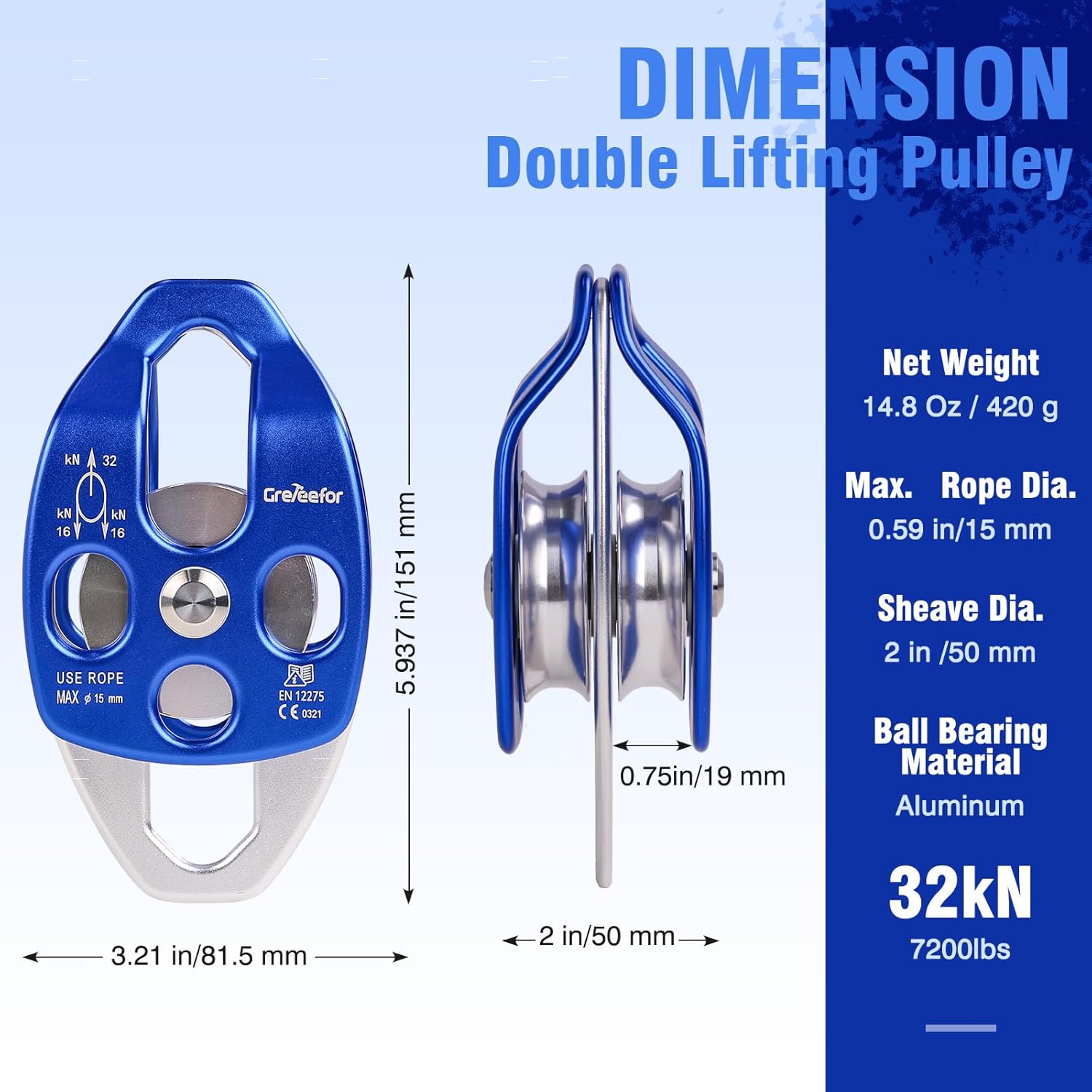
Image: Detailed dimensions and specifications of the double lifting pulley.
9. Warranty and Support
For warranty information or technical support regarding your Greteefor Heavy-Duty Double Block and Tackle Pulley System, please refer to the product packaging or contact Greteefor customer service directly. Keep your purchase receipt as proof of purchase.
You can typically find contact information on the manufacturer's official website or through the retailer where the product was purchased.