
Introduction
Welcome to the ULTRICS Digital Multimeter D2 user manual. This device is designed for precise and reliable electrical measurements, suitable for professionals and DIY enthusiasts. It accurately measures AC/DC voltage, DC current, resistance, continuity, and diodes. This manual provides essential information for safe and effective operation, helping you to maximize the utility of your new multimeter.
Safety Information
WARNING: Always exercise extreme caution when working with electrical circuits. Improper use of this multimeter can result in electric shock, personal injury, or damage to the device.
- Do not exceed the maximum input values for any range.
- Do not use the multimeter if it or the test leads appear damaged. Inspect them before each use.
- Ensure the function switch is in the correct position before making measurements. Changing ranges while connected to a live circuit can cause damage.
- Disconnect power to the circuit before measuring resistance, continuity, or diodes.
- Use caution when working with voltages above 30V AC RMS, 42V peak, or 60V DC. These voltages pose a significant shock hazard.
- Always connect the common (COM) test lead first, then the live lead. Disconnect the live lead first, then the common lead.
- Replace the battery when the low battery indicator appears to ensure accurate readings and proper device function.
This multimeter is rated CAT II 600V, indicating its suitability for measurements on circuits directly connected to the low-voltage installation.
Package Contents
Verify that all items are present in the package:
- 1 x ULTRICS Digital Multimeter D2
- 2 x Test Leads (Red and Black)
- 1 x 9V Battery
- 1 x User Manual (this document)
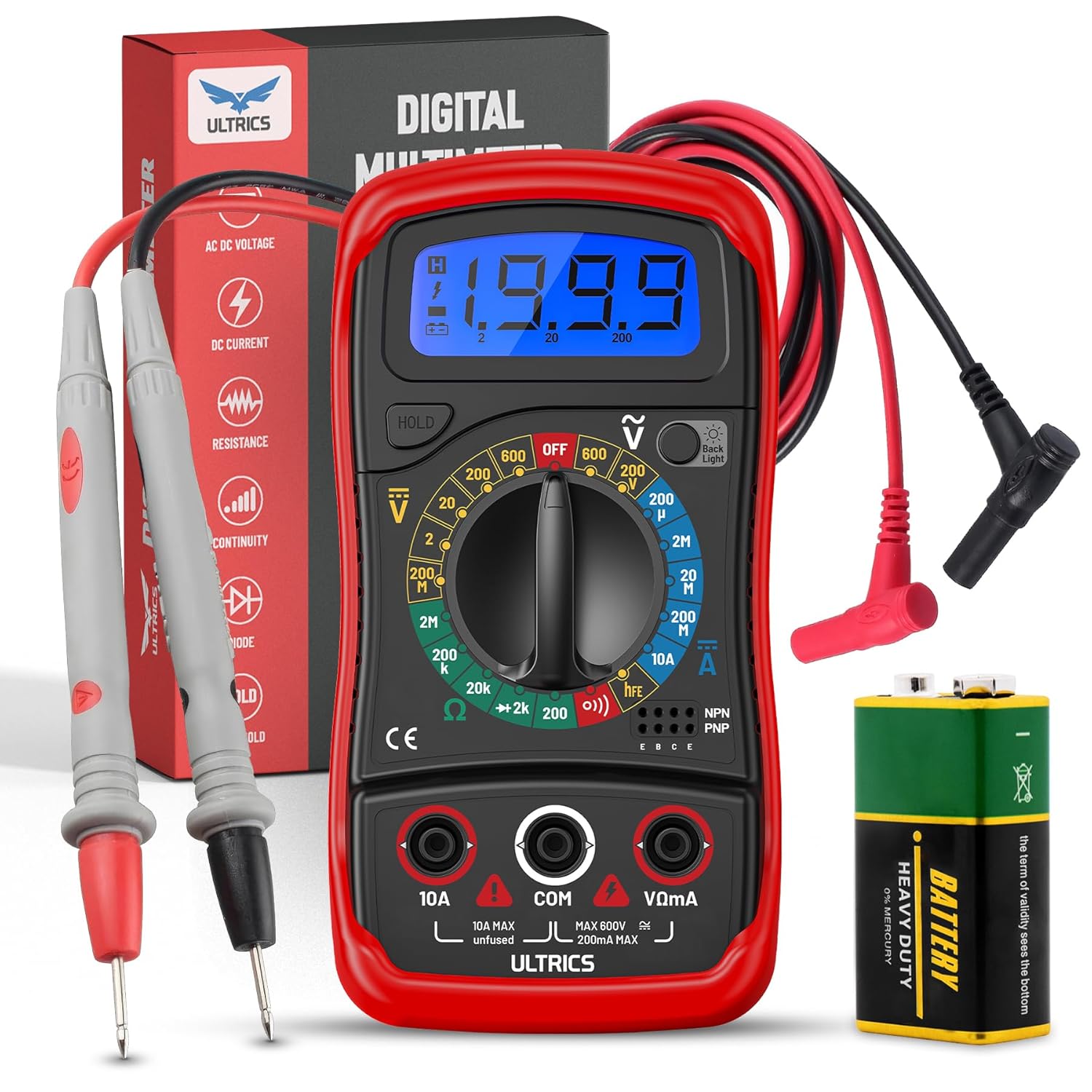
Image: Contents of the ULTRICS Digital Multimeter D2 package, including the multimeter, red and black test leads, and a 9V battery.
Product Overview
Familiarize yourself with the components of your ULTRICS Digital Multimeter D2.

Image: Detailed diagram of the ULTRICS Digital Multimeter D2, highlighting its key components such as the LCD display, data hold button, backlight button, function switch, test lead jacks, and protective rubber shell.
- LCD Display: Shows measurement readings, units, and polarity. Features a bright backlight for low-light conditions.
- Data Hold Button: Freezes the current reading on the display for easier recording.
- Backlight Button: Activates or deactivates the display backlight.
- Function Switch (Rotary Dial): Selects the desired measurement function and range.
- 10A Input Jack: Used for measuring DC current up to 10 Amperes.
- COM (Common) Input Jack: The negative (-) input for all measurements. Always connect the black test lead here.
- VΩmA Input Jack: The positive (+) input for voltage, resistance, and milliampere current measurements. Connect the red test lead here.
- Transistor Test Jacks (hFE): Used for testing NPN and PNP transistors.
- Protective Rubber Shell: Provides durability and protection against minor impacts and splashes.
- Foldable Kickstand: Allows for hands-free operation and easy viewing angle.
Setup
Installing the Battery
The ULTRICS Digital Multimeter D2 requires one 9V battery (included).
- Locate the battery compartment on the back of the multimeter.
- Use a screwdriver to remove the screw securing the battery cover.
- Gently remove the battery cover.
- Connect the 9V battery to the battery clips, ensuring correct polarity (+ to + and - to -).
- Place the battery inside the compartment.
- Replace the battery cover and secure it with the screw.
Connecting Test Leads
Always ensure test leads are securely connected before taking measurements.
- Insert the black test lead's banana plug into the COM (Common) input jack.
- For most measurements (voltage, resistance, continuity, diode, small current), insert the red test lead's banana plug into the VΩmA input jack.
- For high current measurements (up to 10A DC), insert the red test lead's banana plug into the 10A input jack.
Operating Instructions
This section details how to perform various measurements using your multimeter.
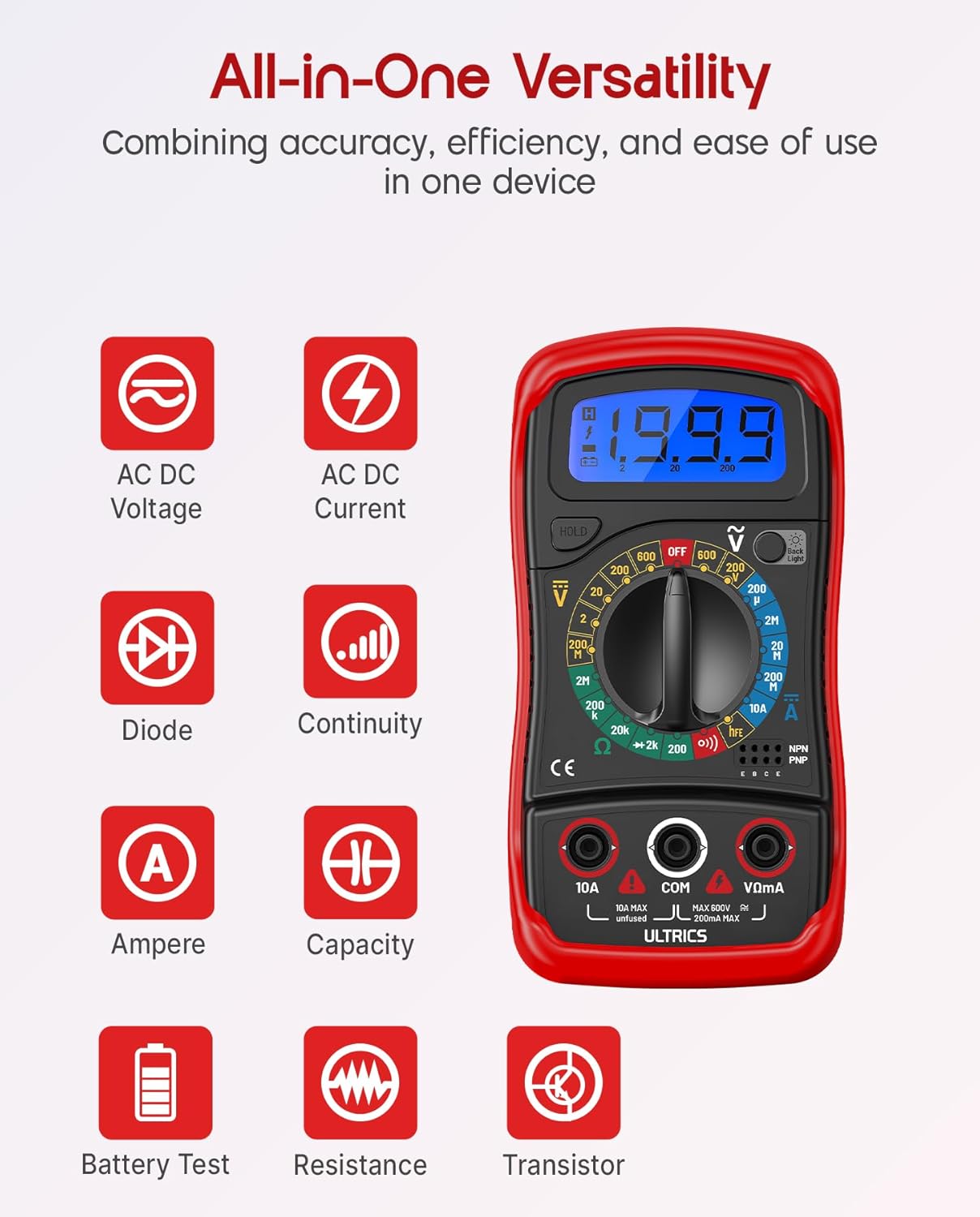
Image: Visual representation of the multimeter's versatile functions, including AC/DC Voltage, AC/DC Current, Diode, Continuity, Ampere, Capacity, Battery Test, Resistance, and Transistor measurements.
Measuring DC Voltage (VDC)
- Connect the black test lead to the COM jack and the red test lead to the VΩmA jack.
- Turn the function switch to the desired VDC range (e.g., 200mV, 2V, 20V, 200V, 600V). If unsure, start with the highest range and decrease as needed.
- Connect the test leads in parallel across the component or circuit to be measured.
- Read the voltage value on the LCD display.
Measuring AC Voltage (VAC)
- Connect the black test lead to the COM jack and the red test lead to the VΩmA jack.
- Turn the function switch to the desired VAC range (e.g., 200V, 600V).
- Connect the test leads in parallel across the AC voltage source.
- Read the voltage value on the LCD display.
Measuring DC Current (ADC)
CAUTION: Never connect the multimeter in parallel when measuring current. Always connect it in series with the circuit. Improper connection can damage the multimeter or the circuit.
- Turn off power to the circuit.
- For currents up to 200mA, connect the black test lead to the COM jack and the red test lead to the VΩmA jack.
- For currents up to 10A, connect the black test lead to the COM jack and the red test lead to the 10A jack.
- Turn the function switch to the desired ADC range (e.g., 200µA, 2mA, 20mA, 200mA, 10A).
- Break the circuit and connect the multimeter in series with the circuit.
- Turn on power to the circuit.
- Read the current value on the LCD display.
- Turn off power to the circuit before disconnecting the multimeter.
Measuring Resistance (Ω)
CAUTION: Ensure the circuit is completely de-energized before measuring resistance. Measuring resistance on a live circuit can damage the multimeter.
- Connect the black test lead to the COM jack and the red test lead to the VΩmA jack.
- Turn the function switch to the desired Ω range (e.g., 200Ω, 2kΩ, 20kΩ, 200kΩ, 2MΩ, 20MΩ).
- Connect the test leads across the component whose resistance you want to measure.
- Read the resistance value on the LCD display.
Continuity Test
The continuity test checks for a complete circuit path. An audible buzzer will sound if continuity is detected.
- Connect the black test lead to the COM jack and the red test lead to the VΩmA jack.
- Turn the function switch to the Continuity (buzzer) position.
- Connect the test leads across the circuit or component.
- If the resistance is below approximately 50Ω, the buzzer will sound, indicating continuity.
Diode Test
The diode test measures the forward voltage drop of a diode.
- Connect the black test lead to the COM jack and the red test lead to the VΩmA jack.
- Turn the function switch to the Diode position.
- Connect the red test lead to the anode (+) and the black test lead to the cathode (-) of the diode.
- Read the forward voltage drop on the LCD display. Reverse the leads; the display should show "OL" (Overload) for a good diode.
Transistor hFE Test
This function tests the DC current gain (hFE) of NPN and PNP transistors.
- Turn the function switch to the hFE position.
- Identify the Emitter (E), Base (B), and Collector (C) leads of the transistor.
- Insert the transistor leads into the corresponding holes in the hFE socket on the multimeter, ensuring correct NPN or PNP type.
- Read the hFE value on the LCD display.
Data Hold Function
Press the HOLD button to freeze the current reading on the display. Press it again to release the hold and resume live readings.
Backlight Function
Press the Backlight button to turn the LCD backlight on or off, improving visibility in dim environments.

Image: A close-up view of the multimeter's LCD display, demonstrating its bright backlight feature for enhanced readability in various lighting conditions.
Maintenance
Cleaning
To clean the multimeter, wipe the case with a damp cloth and a mild detergent. Do not use abrasives or solvents, as these may damage the casing or display.
Battery Replacement
When the low battery indicator appears on the display, replace the 9V battery as described in the "Installing the Battery" section to ensure continued accurate readings.
Fuse Replacement
If the current measurement function stops working, the fuse may need replacement. This multimeter is equipped with internal fuses for protection.
- Ensure the multimeter is OFF and all test leads are disconnected.
- Remove the battery cover and battery.
- Carefully open the main casing (this may require removing additional screws, typically located under the rubber shell).
- Locate the fuse(s) on the circuit board. This model typically uses a 200mA/250V fuse for the mA range and a 10A/250V fuse for the 10A range.
- Replace the blown fuse with a fuse of the same type and rating. Never use a fuse with a different rating.
- Reassemble the multimeter, ensuring all screws are tightened and the casing is properly sealed.
Storage
If the multimeter is not used for a long period, remove the battery to prevent leakage and store the device in a cool, dry place, away from direct sunlight and extreme temperatures.
Troubleshooting
| Problem | Possible Cause | Solution |
|---|---|---|
| No display or dim display | Dead or low battery | Replace the 9V battery. |
| "OL" (Overload) displayed | Input value exceeds selected range; open circuit (for resistance/continuity) | Select a higher range; check for breaks in the circuit or component. |
| Incorrect readings | Incorrect function/range selected; poor test lead connection; low battery | Verify function switch position and range; ensure leads are firmly connected; replace battery. |
| Current measurement not working | Blown fuse | Replace the appropriate fuse (refer to Maintenance section). |
| No continuity buzzer | Open circuit; resistance too high | Ensure circuit is closed; check resistance value (buzzer typically activates below 50Ω). |
Specifications
| Feature | Detail |
|---|---|
| Model | Digital Multimeter D2 |
| Display | 3 ½ digit LCD, 1999 counts, with backlight |
| DC Voltage | 200mV / 2V / 20V / 200V / 600V |
| AC Voltage | 200V / 600V |
| DC Current | 200µA / 2mA / 20mA / 200mA / 10A |
| Resistance | 200Ω / 2kΩ / 20kΩ / 200kΩ / 2MΩ / 20MΩ |
| Diode Test | Yes |
| Continuity Buzzer | Yes |
| Transistor hFE Test | Yes |
| Data Hold | Yes |
| Power Source | 9V Battery |
| Safety Rating | IEC CAT II 600V, CE, RoHS compliant |
| Dimensions (L x W x H) | 14.6 x 10 x 5 cm (5.75 x 3.94 x 1.97 inches) |
| Weight | 240 grams (0.53 lbs) |
Warranty and Support
ULTRICS provides a 12-month warranty for this product, covering manufacturing defects from the date of purchase. Please retain your proof of purchase for warranty claims.
For technical support, warranty claims, or any questions regarding your ULTRICS Digital Multimeter D2, please contact ULTRICS customer service through the retailer's platform or the official ULTRICS website. Please have your purchase details and model number ready when contacting support.
Manufacturer: ULTRICS
Model Number: Digital Multimeter D2
ASIN: B0DYP62MW7


