1. Introduction
This manual provides comprehensive instructions for the installation, operation, and maintenance of your HEATIT 2ft Self-Regulating Pipe Heating Cable. This product is designed to prevent water pipes from freezing in cold temperatures, ensuring continuous water flow and protecting your plumbing system. Please read this manual thoroughly before installation and use to ensure safe and efficient operation.
2. Safety Information
WARNING: Failure to follow these safety instructions could result in fire, electric shock, serious injury, or property damage.
- The HEATIT pipe heating cable is ETL certified, ensuring compliance with rigorous industry safety standards. The plug is UL certified. Always choose fully certified heating cables for complete safety.
- Ensure the power supply is 120V AC.
- Do not cut, splice, or alter the heating cable.
- Do not install the cable inside pipes. It is designed for external pipe application only.
- Do not use on flexible hoses unless specifically designed for such application.
- Ensure the cable is not kinked or sharply bent during installation.
- Always plug the cable into a Ground Fault Circuit Interrupter (GFCI) protected outlet.
- Keep the plug and thermostat dry and protected from moisture.
- For better freeze protection, insulation material is recommended and sold separately.

Image: ETL Certification Document. This image displays the ETL approval certificate, which verifies that the HEATIT pipe heating cable meets stringent quality and safety standards, backed by a $2 million insurance policy.
3. Product Overview
The HEATIT Self-Regulating Pipe Heating Cable is an automatic, energy-saving solution for pipe freeze protection. It features a built-in thermostat and is suitable for both metal and plastic home pipes.
Key Components:
- Self-Regulating Heating Cable: Automatically adjusts heat output based on ambient temperature.
- Built-in Thermostat: Activates at 37℉ (3℃) and deactivates at 50℉ (10℃).
- Power Cord with Light Indicator: 2 ft power cord with an indicator light to show when the cable is active.
- Waterproof End Seal: Ensures durability and safety.

Image: HEATIT Pipe Heating Cable. The image displays the HEATIT self-regulating pipe heating cable, coiled, with its integrated plug and thermostat. Below it, a pipe section illustrates the application of the heating cable secured with tape.

Image: Cable Details. This graphic provides a close-up view of the heating cable's key components, including the power plug with an indicator light, the thermostatic controller, the self-regulating cable structure, and the waterproof end seal, all certified for safety.
4. Specifications
| Feature | Detail |
|---|---|
| Model | 3W/FT 2 ft |
| Power Output | 3 Watts per foot |
| Voltage | 120V |
| Cable Length | 2 ft |
| Power Cord Length | 2 ft |
| Activation Temperature | 37℉ (3℃) |
| Deactivation Temperature | 50℉ (10℃) |
| Minimum Operating Temperature | -40℉ (-40℃) |
| Maximum Cable Temperature | 65℃ (149℉) |
| Certifications | ETL Listed (cable), UL Certified (plug) |
| Compatibility | Metal and Plastic Pipes |
| Item Weight | 12 ounces |
| Manufacturer | Zhukeshi |
5. Setup & Installation
Proper installation is crucial for the effective and safe operation of the heating cable. Ensure the pipe surface is clean and dry before installation.
General Guidelines:
- The heating cable can be installed on both metal and plastic pipes.
- The built-in thermostat should be placed on the coldest end of the pipe and tightly against the pipe surface to accurately sense the temperature.
- Secure the cable to the pipe using electrical tape, zip ties, or glass cloth tape (recommended for better heat transfer and durability).
- Do not use vinyl electrical tape in temperatures below 0℉ (-18℃).
- For optimal performance and energy efficiency, insulate the pipe and heating cable after installation.
Installation Methods:
The cable can be applied using straight tracing, spiral tracing, or overlapping methods, depending on the pipe diameter and desired heat distribution.
- Straight Tracing: Run the cable along the length of the pipe.
- Spiral Tracing: Wrap the cable spirally around the pipe. This method is often used for smaller diameter pipes or when more heat is required.
- Overlap: For valves, spigots, or other irregular shapes, the cable can be overlapped to ensure adequate heat coverage. The self-regulating nature prevents overheating.

Image: Installation Methods. The image illustrates different installation techniques for the heating cable on pipes, including straight, spiral, and overlapping applications, secured with glass cloth tape. It also highlights the product's safety feature of not overheating or burning.
Post-Installation:
- Once the cable is securely attached and the thermostat is in place, plug the power cord into a 120V GFCI-protected outlet.
- The indicator light on the plug will illuminate when the cable is receiving power.
6. Operating Instructions
The HEATIT pipe heating cable operates automatically due to its self-regulating technology and integrated thermostat.
Automatic Operation:
- The built-in thermostat monitors the ambient temperature around the pipe.
- When the temperature drops to approximately 37℉ (3℃), the thermostat activates the heating cable.
- When the temperature rises to approximately 50℉ (10℃), the thermostat deactivates the heating cable.
- The self-regulating cable adjusts its heat output along its length, providing more heat in colder sections and less in warmer sections, preventing overheating.
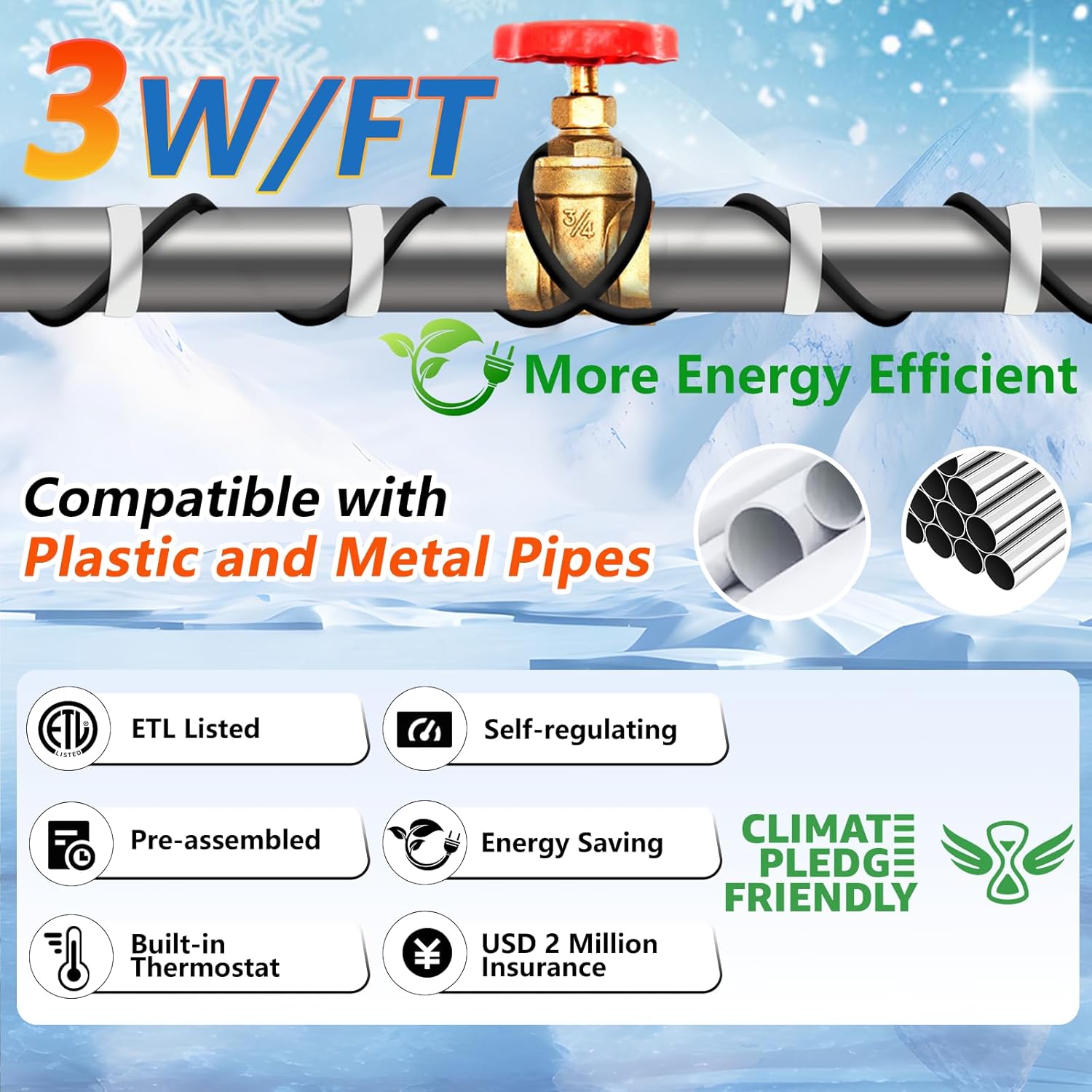
Image: Automatic Thermostat Operation. This graphic demonstrates the integrated thermostat's function, automatically turning the heating cable on at 37℉ (3℃) and off at 50℉ (10℃) to maintain water flow and conserve energy.

Image: Self-Regulating Technology. A detailed diagram explaining how the self-regulating heating cable adjusts its power output (hot, warm, cold) in response to ambient temperatures, ensuring optimal energy usage and preventing overheating.
Testing Method:
To verify the cable's functionality:
- Plug the cable into a working outlet.
- Place the thermostat of the heating cable on ice or in a very cold environment (below 37℉ / 3℃).
- In approximately 5-10 minutes, the cable should feel slightly warm to the touch, indicating it is functioning correctly.
7. Maintenance
The HEATIT pipe heating cable requires minimal maintenance. Regular inspection is recommended to ensure continued performance.
- Annual Inspection: Before the onset of cold weather each year, inspect the cable and its connections for any signs of damage, wear, or loose attachments.
- Check Insulation: Ensure any pipe insulation covering the cable is intact and not damaged.
- Thermostat Placement: Verify that the thermostat remains tightly against the pipe.
- Cleanliness: Keep the plug and thermostat free from dirt, debris, and moisture.
- Storage: If removing the cable for off-season storage, coil it loosely and store it in a dry place.
8. Troubleshooting
If your HEATIT pipe heating cable is not functioning as expected, consider the following common issues and solutions:
| Problem | Possible Cause | Solution |
|---|---|---|
| Cable not heating | Ambient temperature is above 50℉ (10℃) | The thermostat will only activate the cable when temperatures drop below 37℉ (3℃). Test in cold conditions or using the ice method. |
| Cable not heating | No power to the outlet | Check the power outlet with another device. Ensure the GFCI has not tripped. |
| Cable not heating | Damaged cable or plug | Inspect the cable and plug for visible damage. If damaged, discontinue use and replace. |
| Pipes still freezing | Insufficient insulation | Add more insulation around the pipe and heating cable. Ensure the thermostat is on the coldest part of the pipe. |
| Pipes still freezing | Improper installation | Review installation instructions to ensure the cable is properly secured and making good contact with the pipe. |
If problems persist after troubleshooting, contact customer support.
9. Warranty & Support
The HEATIT pipe heating cable is backed by up to USD 2 million in product liability insurance, providing added peace of mind and security in your purchase.
For further assistance, technical support, or warranty inquiries, please refer to the contact information provided with your product packaging or visit the official HEATIT store on Amazon:
10. Wide Range of Uses
The HEATIT Self-Regulating Pipe Heating Cable is versatile and can be used in various applications to prevent freezing:
- Home water pipes (metal and plastic)
- Garden hoses
- Outdoor faucets and spigots
- RV water lines
- Farm water systems
- Protection for palm trees and other sensitive plants from frost

Image: Versatile Applications. A collage of images demonstrating the versatile applications of the HEATIT pipe heating cable for freeze protection, such as on garden hoses, outdoor faucets, various pipes, RV water systems, and farm equipment.


