Introduction
This manual provides detailed instructions for the safe and effective use of your Godox FT433C TTL Wireless Flash Trigger. Please read this manual thoroughly before use to ensure proper operation and to prevent damage to the product or injury to yourself or others. Keep this manual for future reference.
What's in the Box
Verify that all items are present in your package:
- 1 x Wireless Flash Trigger (FT433C)
- 1 x Receiver (FR433)
- 1 x User Manual
- 1 x Pair of Gloves
- 1 x Lens Brush
- 1 x Cleaning Cloth
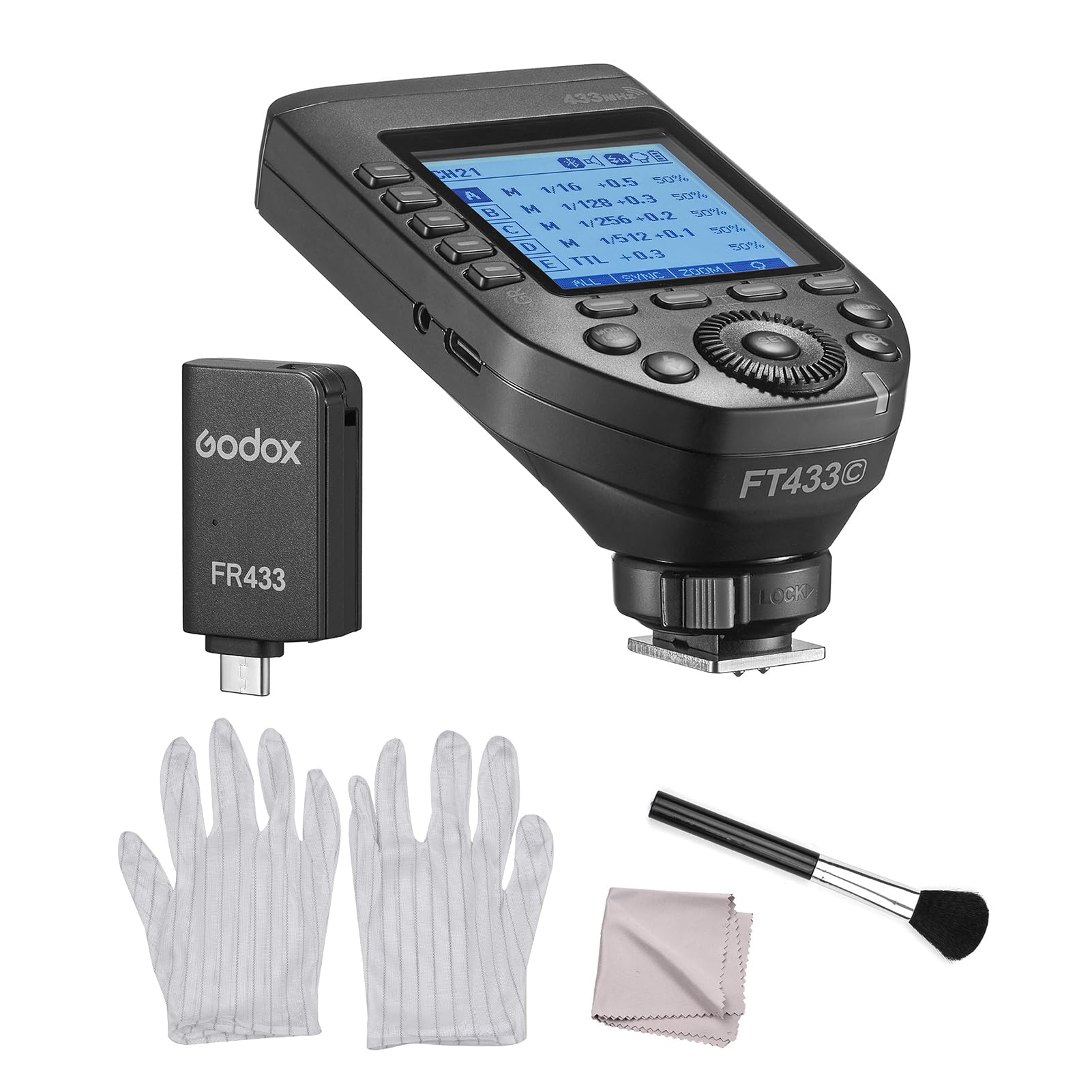
Image: The Godox FT433C Wireless Flash Trigger and its accompanying FR433 Receiver.
Setup
1. Battery Installation
The FT433C Wireless Flash Trigger requires two AA batteries (not included).
- Locate the battery compartment cover on the back of the trigger.
- Slide the cover downwards to open.
- Insert two AA batteries, ensuring correct polarity (+/-).
- Close the battery compartment cover securely.
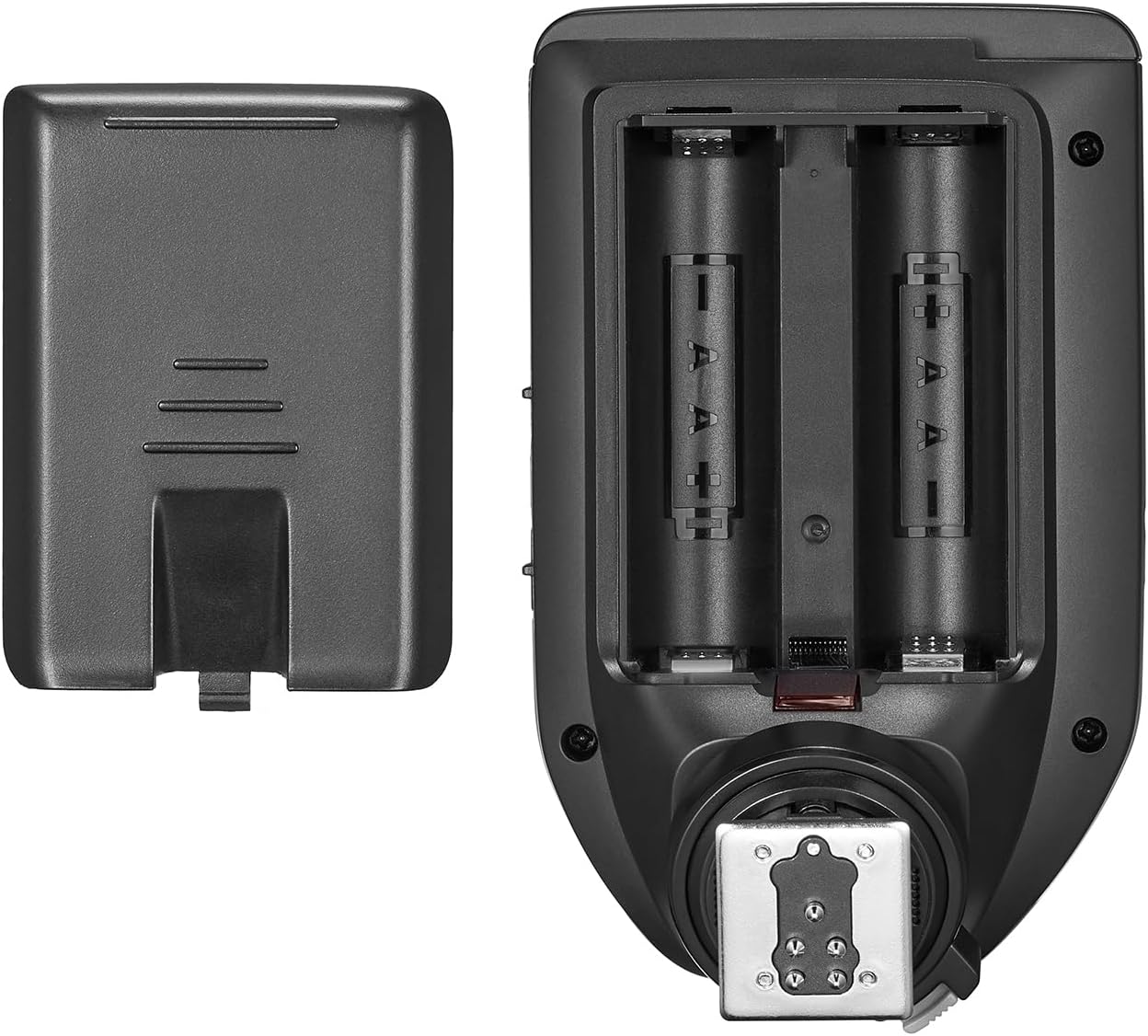
Image: View of the open battery compartment on the Godox FT433C, showing slots for two AA batteries.
2. Attaching the Trigger to Your Camera
Slide the FT433C trigger onto your camera's hot shoe mount until it clicks into place. Secure it by tightening the locking mechanism if available.
3. Connecting the Receiver to a Flash Unit
The FR433 Receiver connects to compatible flash units. Insert the receiver into the flash unit's sync port or hot shoe, depending on the flash model.
Operating Instructions
1. Power On/Off
Press and hold the power button on the FT433C trigger to turn it on or off. The LCD screen will illuminate upon power-on.
2. Basic Controls and Display
The FT433C features a large LCD panel for clear display of settings, along with various buttons for navigation and adjustment:
- Group Buttons (GR): Select flash groups (A, B, C, D, E).
- Function Buttons: Access specific settings displayed on the LCD.
- Dial/Set Button: Navigate menus and confirm selections.
- SYNC Button: Adjust sync modes.
- ZOOM Button: Adjust flash zoom settings.
- MODE Button: Switch between TTL, Manual, and Multi-flash modes.
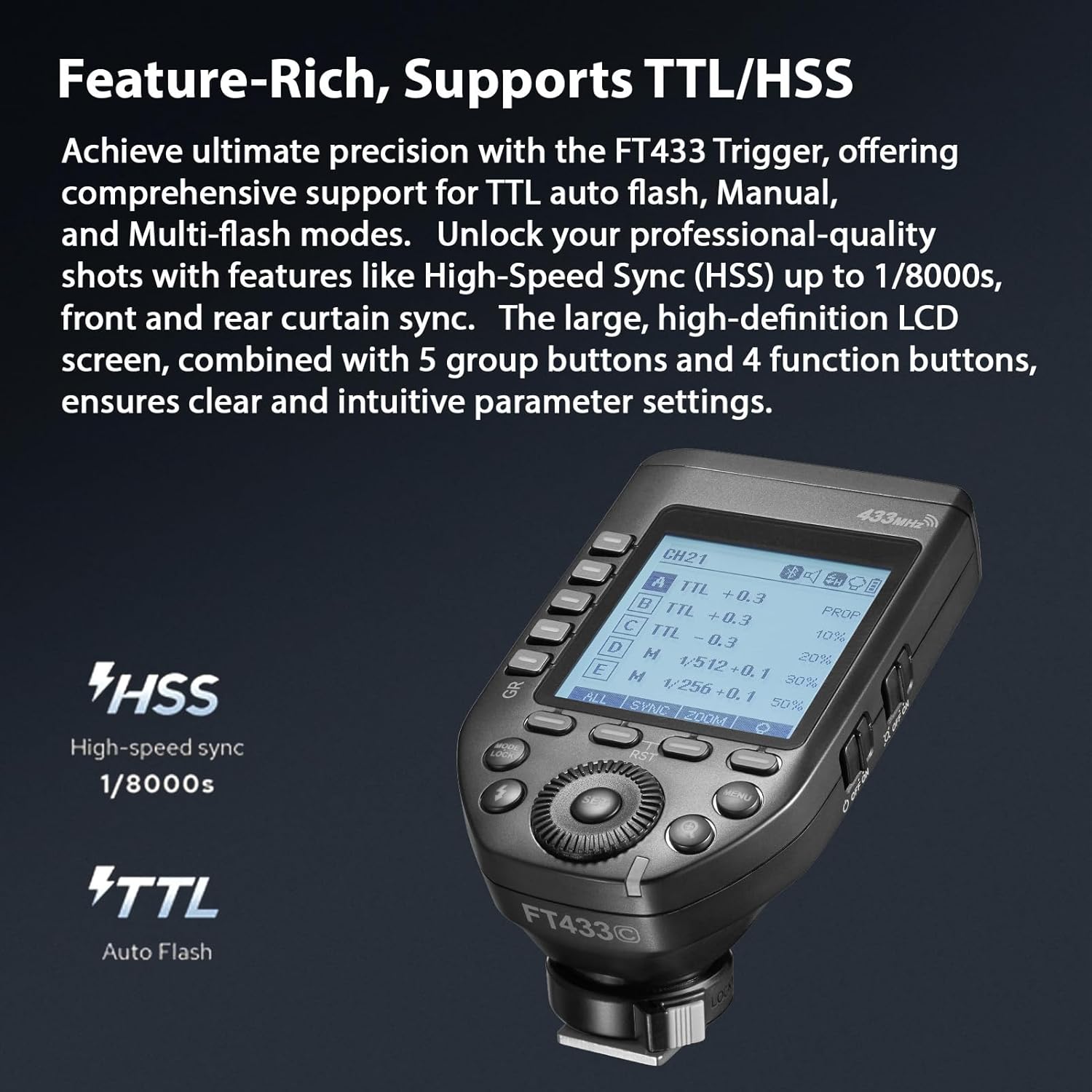
Image: The Godox FT433C's LCD screen displaying settings for High-Speed Sync (HSS) and TTL Auto Flash modes.
3. Flash Modes (TTL, Manual, Multi-flash)
Press the MODE button to cycle through the available flash modes:
- TTL Auto Flash: Automatically adjusts flash output for correct exposure.
- Manual Flash: Allows manual control over flash power output.
- Multi-flash: Fires a series of rapid flashes for stroboscopic effects.
4. High-Speed Sync (HSS)
The FT433C supports High-Speed Sync up to 1/8000s, allowing you to use flash with fast shutter speeds. This feature is automatically enabled or can be selected via the SYNC button, depending on camera and flash compatibility.
5. Flash Exposure Compensation (FEC)
Adjust flash exposure compensation from ±3 EV in 1/3 EV increments to fine-tune flash brightness.
6. Zoom Setting
The trigger supports Auto/24-200mm zoom settings, which can be adjusted via the ZOOM button.
7. Wireless Control (433MHz, Groups, Channels, ID)
The FT433C operates on a 433MHz frequency for stable wireless communication. It supports 5 or 16 groups and 32 channels. Use the 1-99 wireless ID settings to prevent interference from other systems.

Image: The Godox FT433C trigger on a camera wirelessly communicating with an FR433 receiver attached to a Godox AD200Pro II flash unit.
8. APP Flexible Control
Control the FT433C trigger wirelessly using the Godox Flash app on your smartphone (iOS or Android). This allows remote adjustment of flash mode, power levels, modeling lamp, and beeper settings.
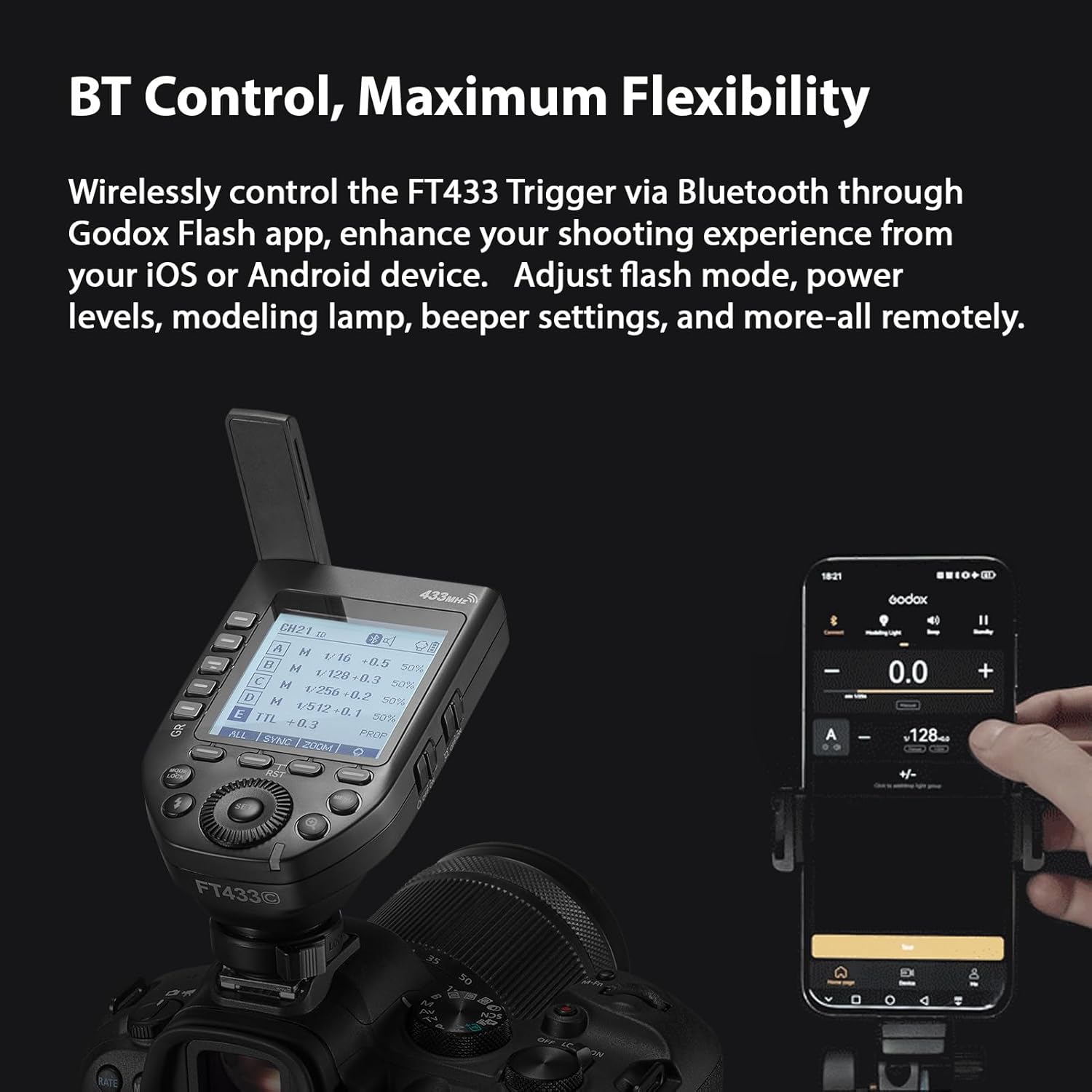
Image: A smartphone displaying the Godox Flash app interface, used to wirelessly control the FT433C trigger mounted on a camera.
9. TCM Switch (TTL to Manual Conversion)
The TCM function allows a one-click conversion from TTL mode parameters to Manual settings. This streamlines workflow by automatically transferring TTL output values to manual power levels, eliminating repetitive manual adjustments.

Image: The Godox FT433C's LCD screen showing the TCM (TTL to Manual) function in action, converting TTL settings to manual power levels.
10. Single-Contact, Rapid-Fire
The single-contact mode of the FT433C ensures faster continuous shooting by minimizing data exchange between the trigger and camera. This mode is ideal for rapid-fire photography scenarios.

Image: The Godox FT433C trigger mounted on a camera, illustrating its single-contact design for rapid-fire photography.
Maintenance
- Keep the device dry. Do not handle with wet hands or immerse in water.
- Use a soft, dry cloth to clean the unit. Avoid harsh chemicals or abrasive cleaners.
- Remove batteries if the device will not be used for an extended period.
- Store in a cool, dry place away from direct sunlight and extreme temperatures.
- Firmware Upgrade: The device supports firmware upgrades through its USB-C port. Visit the official Godox website for the latest firmware and instructions.
Troubleshooting
1. Signal Stability
The FT433C utilizes the 433MHz frequency band to ensure signal stability. If you experience signal issues, ensure:
- The trigger and receiver are within the effective transmission range (approx. 0-100M).
- There are no major obstructions between the trigger and receiver.
- Wireless ID settings are correctly configured to avoid interference.

Image: Two photographers using Godox flash triggers and lighting equipment in a studio, demonstrating the use of wireless flash control for stable signal transmission.
2. Flash Not Firing
- Check if the trigger and receiver are powered on and have sufficient battery.
- Ensure the trigger is securely mounted on the camera's hot shoe.
- Verify that the receiver is properly connected to the flash unit.
- Confirm that the channel and group settings on both the trigger and receiver match.
- Check camera compatibility. The FT433C is compatible with Canon R8, R6, R5, R3, R, M6, 850D, 800D/T7i, 760D/T6s, 750D/T6i, 650D, 600D, 7D Mark II, 7D, 6D Mark II, 6D, 5D Mark IV/III/II, 1D Mark III, 1DX, 550D, 500D, 450D, 90D, 80D, 70D, 60D, 50D, 1100D, 77D, SL3/250D, T7/1500D, 2000D, T100/3000D, 4000D. Note: Not compatible with Canon RP R50.
Specifications
| Item Name | Wireless Flash Trigger |
| Model | Godox FT433C |
| Compatible Camera Models | Canon R8, R6, R5, R3, R, M6, 850D, 800D/T7i, 760D/T6s, 750D/T6i, 650D, 600D, 7D Mark II, 7D, 6D Mark II, 6D, 5D Mark IV/III/II, 1D Mark III, 1DX, 550D, 500D, 450D, 90D, 80D, 70D, 60D, 50D, 1100D, 77D, SL3/250D, T7/1500D, 2000D, T100/3000D, 4000D (Not compatible with Canon RP R50) |
| Sync Triggering | Supports cameras with PC sync socket |
| Power Supply | 2 x AA batteries (not included) |
| Flash Exposure Compensation | ± 3EV, adjustable in 1/3 EV increment |
| Focus Assist | Yes (if available on camera) |
| Zoom Setting | Auto/ 24-200mm |
| Firmware Upgrade | Via USB-C port |
| Memory Function | Settings stored 2 seconds after last operation, recovered after restart |
| Display | Large LCD panel, backlighting ON or OFF |
| Transmission Range | Approx. 0-100M |
| Built-in Wireless | 433MHz |
| Modulation Mode | GFSK |
| Channel | 32 |
| Wireless ID | OFF/ 1-99 |
| Group | 5 groups or 16 groups |
| Net Weight | 97g |
| Package Dimensions | 5.51 x 4.72 x 2.36 inches |
| Item Weight | 9.9 ounces |
Warranty and Support
For warranty information and technical support, please refer to the warranty card included with your product or visit the official Godox website. Keep your purchase receipt as proof of purchase for warranty claims.