1. Introduction
Thank you for choosing the VIVOHOME HVAC Vacuum Pump and Refrigerant Recovery Machine Kit. This comprehensive kit is designed for professional and DIY use in automotive air conditioning, HVAC, and refrigeration systems. It includes a 3.5 CFM single-stage rotary vane vacuum pump, an R134a AC manifold gauge set, and an R1234yf R32 3/4 HP portable refrigerant recovery machine. This manual provides essential information for safe operation, setup, maintenance, and troubleshooting.
2. Safety Information
Please read and understand all safety warnings and instructions before operating this equipment. Failure to follow these instructions may result in electric shock, fire, serious injury, or property damage.
- Always wear appropriate personal protective equipment (PPE), including safety glasses and gloves, when handling refrigerants.
- Ensure the work area is well-ventilated to prevent the accumulation of refrigerant vapors.
- Do not operate the equipment near open flames or sources of ignition. Refrigerants can be flammable under certain conditions.
- Disconnect power before performing any maintenance or service on the units.
- Never discharge refrigerants into the atmosphere. Always use a certified recovery machine to reclaim refrigerants.
- Ensure all connections are secure and leak-free before operating.
- Do not expose the equipment to rain or wet conditions.
- Keep children and unauthorized personnel away from the equipment during operation.
3. Package Contents
Verify that all items listed below are included in your package. If any items are missing or damaged, please contact VIVOHOME customer service.

Image: Complete VIVOHOME HVAC Vacuum Pump and Refrigerant Recovery Machine Kit, including vacuum pump, manifold gauge set, hoses, and recovery machine.
- VIVOHOME 3.5 CFM Single Stage Rotary Vane Vacuum Pump (Model: VP125)
- R134a AC Manifold Gauge Set
- Three Color-Coded Hoses (Red, Yellow, Blue)
- 0.35 qt Vacuum Pump Oil
- Carry Case for Vacuum Pump and Gauge Set
- Two R410a Fitting Adapters (1/4" male to 5/16" female)
- One 1/4" male to 1/2" female Fitting Adapter
- One R134a Self-Sealing Can Tap
- Two Quick Coupler Adapters
- VIVOHOME R1234yf R32 3/4 HP Portable Refrigerant Recovery Machine (Model: RR250)
- Filter Drier for Recovery Machine
- User Manual
4. Product Overview
4.1 VIVOHOME 3.5 CFM Single Stage Rotary Vane Vacuum Pump (VP125)
The VP125 vacuum pump is designed for efficient evacuation of HVAC and refrigeration systems. It features a robust motor and specialized ports for broad compatibility.
- Powerful Performance: Equipped with a 1/4 HP high-torque, four-pole pure copper motor, ensuring minimal wear and maximum efficiency. Achieves a 3.5 CFM flow rate and can evacuate systems down to 5 Pa (37.5 Microns) rapidly.
- Efficient Operation & Protection: Includes 1/2" ACME and 1/4" SAE ports, along with adapters for R134a, R12, R22, R502, and R410a systems. Features a 304 stainless steel coarse filter to block dust and a cotton exhaust filter to remove oil mist and reduce noise.

Image: Internal view of the VIVOHOME vacuum pump motor, highlighting the four-pole pure copper design and 1440 RPM speed.

Image: Close-up of the vacuum pump's air inlet ports, showing 1/2" ACME and 1/4" SAE connections, suitable for various refrigerant systems, and an anti-backflow design.

Image: Illustration of the vacuum pump's oil inlet and air outlet, detailing the built-in cotton filter for oil mist elimination and noise reduction.
4.2 VIVOHOME R1234yf R32 3/4 HP Portable Refrigerant Recovery Machine (RR250)
The RR250 recovery machine is designed for quick and efficient recovery of various refrigerants, featuring an oil-less compressor for versatility.
- Fast Recovery: Features a 3/4 HP, 1750 rpm speed motor and an oil-less air-cooled piston type compressor, enabling rapid recycling of liquid and vapor refrigerants. A larger condenser and fan enhance cooling performance. Includes a filter drier to remove moisture and impurities.
- Easy Operation: Equipped with 3 valves (Inlet/Outlet/Functional Shifting) and dual-pressure gauges for monitoring and managing the recovery process. A pressure warning lamp panel helps prevent accidents.

Image: The VIVOHOME RR250 Refrigerant Recovery Machine, showing its control panel, gauges, and ports.
5. Setup
5.1 Vacuum Pump Setup
- Unpack: Carefully remove the vacuum pump and accessories from the packaging.
- Add Oil: Remove the oil fill cap and pour the provided vacuum pump oil into the reservoir until it reaches the indicated level on the sight glass. Do not overfill.
- Connect Power: Ensure the power switch is in the OFF position, then connect the power cord to a grounded 110V AC outlet.
- Prepare Ports: Select the appropriate fitting adapter (e.g., 1/4" male to 5/16" female for R410a) for your system and securely attach it to the vacuum pump's inlet port.
5.2 Manifold Gauge Set Setup
- Connect Hoses: Attach the color-coded hoses to the manifold gauge set:
- Blue Hose: Low-pressure side (connects to the blue port on the manifold).
- Red Hose: High-pressure side (connects to the red port on the manifold).
- Yellow Hose: Service/Vacuum/Refrigerant port (connects to the yellow port on the manifold).
- Attach Adapters: If necessary, attach quick coupler adapters to the blue and red hoses for connecting to the vehicle's AC service ports.
5.3 Refrigerant Recovery Machine Setup
- Unpack: Remove the recovery machine from its packaging.
- Connect Filter Drier: Install the provided filter drier in-line on the inlet side of the recovery machine, as shown in the diagram. This helps protect the machine from moisture and contaminants.
- Connect Power: Ensure the power switch is OFF, then connect the power cord to a grounded 110V AC outlet.
- Prepare Hoses: Have appropriate hoses ready for connecting to the system being recovered and the recovery tank.

Image: Illustration demonstrating the easy connection of a filter drier and 1/4 inch hose to the recovery machine's inlet port.
6. Operating Instructions
6.1 System Evacuation (Using Vacuum Pump and Manifold Gauge Set)
- Connect Manifold: Connect the blue hose to the low-pressure service port of the AC system and the red hose to the high-pressure service port.
- Connect Vacuum Pump: Connect the yellow service hose from the manifold gauge set to the inlet port of the vacuum pump.
- Open Valves: Ensure both the high-side and low-side valves on the manifold gauge set are fully open.
- Start Vacuum Pump: Turn on the vacuum pump. Allow it to run for a sufficient period (typically 15-30 minutes or until the desired vacuum level, e.g., 5 Pa, is reached on the low-pressure gauge).
- Monitor Vacuum: Observe the manifold gauges to ensure the system is pulling down to the required vacuum level.
- Close Valves: Once the desired vacuum is achieved, close both the high-side and low-side valves on the manifold gauge set.
- Turn Off Pump: Turn off the vacuum pump.
- Vacuum Hold Test: Monitor the gauges for 5-10 minutes. If the vacuum holds steady, the system is leak-free. If the pressure rises, there is a leak that needs to be addressed.
- Disconnect: Slowly disconnect the yellow hose from the vacuum pump, then disconnect the manifold hoses from the AC system.
6.2 Refrigerant Recovery (Using Recovery Machine)
Always use a certified recovery tank for refrigerant recovery. Ensure the tank is not overfilled.
- Connect Hoses:
- Connect a hose from the system's low-pressure service port to the recovery machine's INLET port (often through the manifold gauge set).
- Connect a hose from the recovery machine's OUTLET port to the liquid port of the recovery tank.
- Open Valves: Open the liquid valve on the recovery tank. Open the low-side valve on the manifold gauge set (if used).
- Set Recovery Machine: Turn the functional shifting valve on the recovery machine to the 'RECOVERY' position.
- Start Recovery: Turn on the recovery machine. The machine will begin to pull refrigerant from the system. Monitor the dual-pressure gauges.
- Monitor Progress: The machine will recover both liquid and vapor refrigerant. The pressure warning lamp panel will indicate operational status and potential issues.
- Automatic Shut-Off: The VIVOHOME RR250 features an automatic shut-off function when the recovery process is complete or if a high-pressure condition is detected. The machine will automatically shut off when the system pressure reaches a vacuum level (e.g., 558 PSI / 38.5 BAR for high pressure, or a specific vacuum level for recovery completion).

Image: Setup diagram showing the VIVOHOME recovery machine connected to a system and a recovery tank, with a pump and scale for accurate refrigerant handling.
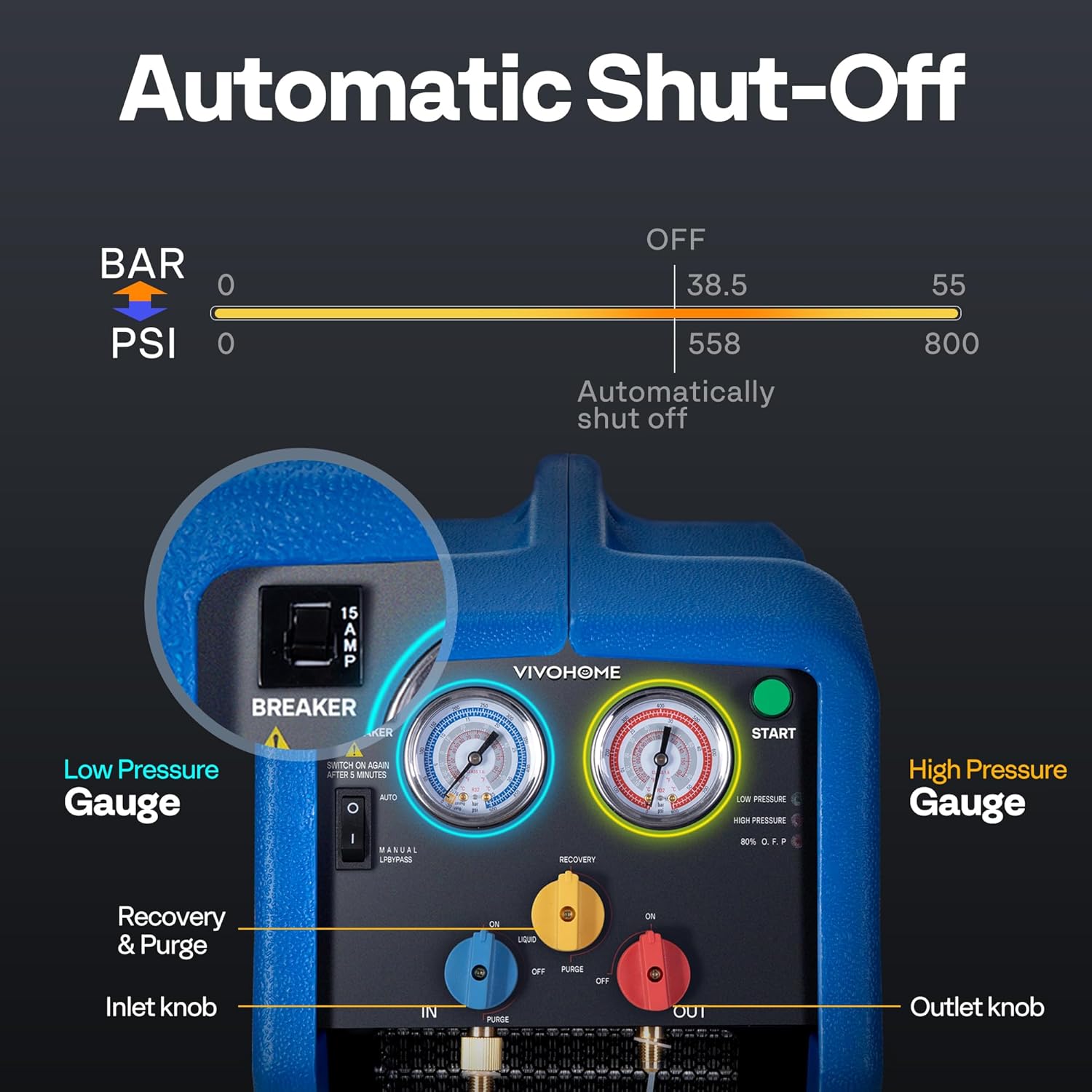
Image: Close-up of the recovery machine's control panel, highlighting the low and high pressure gauges, inlet/outlet knobs, and the automatic shut-off thresholds in BAR and PSI.
- Purge (if necessary): After recovery, turn the functional shifting valve to 'PURGE' to clear any remaining refrigerant from the machine's internal lines into the recovery tank.
- Close Valves & Disconnect: Close all valves on the recovery tank and the manifold gauge set. Turn off the recovery machine and disconnect all hoses.
7. Maintenance
7.1 Vacuum Pump Maintenance
- Oil Change: Regularly check the oil level and clarity in the vacuum pump's sight glass. Change the vacuum pump oil after every 10 hours of use or if it appears cloudy or discolored. Use only high-quality vacuum pump oil.
- Filter Cleaning: Periodically inspect and clean the 304 stainless steel coarse filter and replace the cotton exhaust filter as needed to maintain efficiency and reduce oil mist.
- Storage: When not in use, store the vacuum pump in a clean, dry environment. Ensure the oil fill cap and exhaust port are securely closed to prevent contamination.
7.2 Refrigerant Recovery Machine Maintenance
- Filter Drier Replacement: The filter drier should be replaced regularly, especially after recovering a contaminated system or if the recovery rate decreases significantly.
- General Cleaning: Keep the exterior of the machine clean and free of debris. Ensure the condenser and fan areas are clear for proper cooling.
- Storage: Store the recovery machine in a clean, dry place.
8. Troubleshooting
8.1 Vacuum Pump Issues
| Problem | Possible Cause | Solution |
|---|---|---|
| Pump not starting | No power; Faulty switch | Check power connection; Test outlet; Contact service |
| Poor vacuum performance | Low oil level; Contaminated oil; Leaks in connections; Clogged filter | Add/change oil; Check all connections for leaks; Clean/replace filters |
| Excessive noise/vibration | Low oil level; Loose components | Check oil level; Tighten fasteners |
8.2 Refrigerant Recovery Machine Issues
| Problem | Possible Cause | Solution |
|---|---|---|
| Machine not starting | No power; Breaker tripped; Faulty switch | Check power; Reset breaker; Contact service |
| Slow recovery rate | Clogged filter drier; System valves not fully open; Recovery tank full; High ambient temperature | Replace filter drier; Open all valves; Use empty recovery tank; Ensure good ventilation |
| High pressure shut-off | Recovery tank overfilled; Outlet valve closed; Restricted airflow to condenser | Use empty tank; Open outlet valve; Clear obstructions from condenser/fan |
| Pressure warning lamp active | Indicates high pressure or other operational alert | Refer to machine's specific warning codes (if applicable) or check for high pressure causes above |
9. Specifications
9.1 VIVOHOME 3.5 CFM Single Stage Rotary Vane Vacuum Pump (VP125)
- Flow Rate: 3.5 CFM
- Motor: 1/4 HP, Four-pole pure copper
- Ultimate Vacuum: 5 Pa (37.5 Microns)
- Voltage: 110V AC
- Inlet Ports: 1/2" ACME, 1/4" SAE
- Compatible Refrigerants: R134a, R12, R22, R502, R410a (with adapters)
9.2 VIVOHOME R1234yf R32 3/4 HP Portable Refrigerant Recovery Machine (RR250)
- Motor: 3/4 HP, 1750 rpm
- Compressor Type: Oil-less, air-cooled piston
- Voltage: 110V AC
- Compatible Refrigerants: R1234yf, R32, and other common refrigerants
- Features: 3 valves (Inlet/Outlet/Functional Shifting), Dual-pressure gauges, Pressure warning lamp panel, Automatic shut-off
10. Warranty and Support
For warranty information, technical support, or to order replacement parts, please refer to the warranty card included with your product or visit the official VIVOHOME website. You may also contact VIVOHOME customer service directly for assistance.
VIVOHOME Customer Service: Please refer to your purchase documentation or the VIVOHOME website for current contact information.