
1. Introduction
This manual provides comprehensive instructions for the proper setup, operation, and maintenance of the RIMADMIADIND RDA5807M FM Stereo Radio Module, model RRD-102V2.0. This module is designed for integration into various electronic projects requiring FM radio reception capabilities. Please read this manual thoroughly before using the module to ensure optimal performance and longevity.
2. Product Overview
The RDA5807M FM Stereo Radio Module (RRD-102V2.0) is a compact, low-power, and high-performance FM stereo radio receiver. It integrates a complete FM tuner from antenna input to audio output, making it suitable for embedded applications. The module typically communicates via an I2C interface, allowing for easy control by microcontrollers.
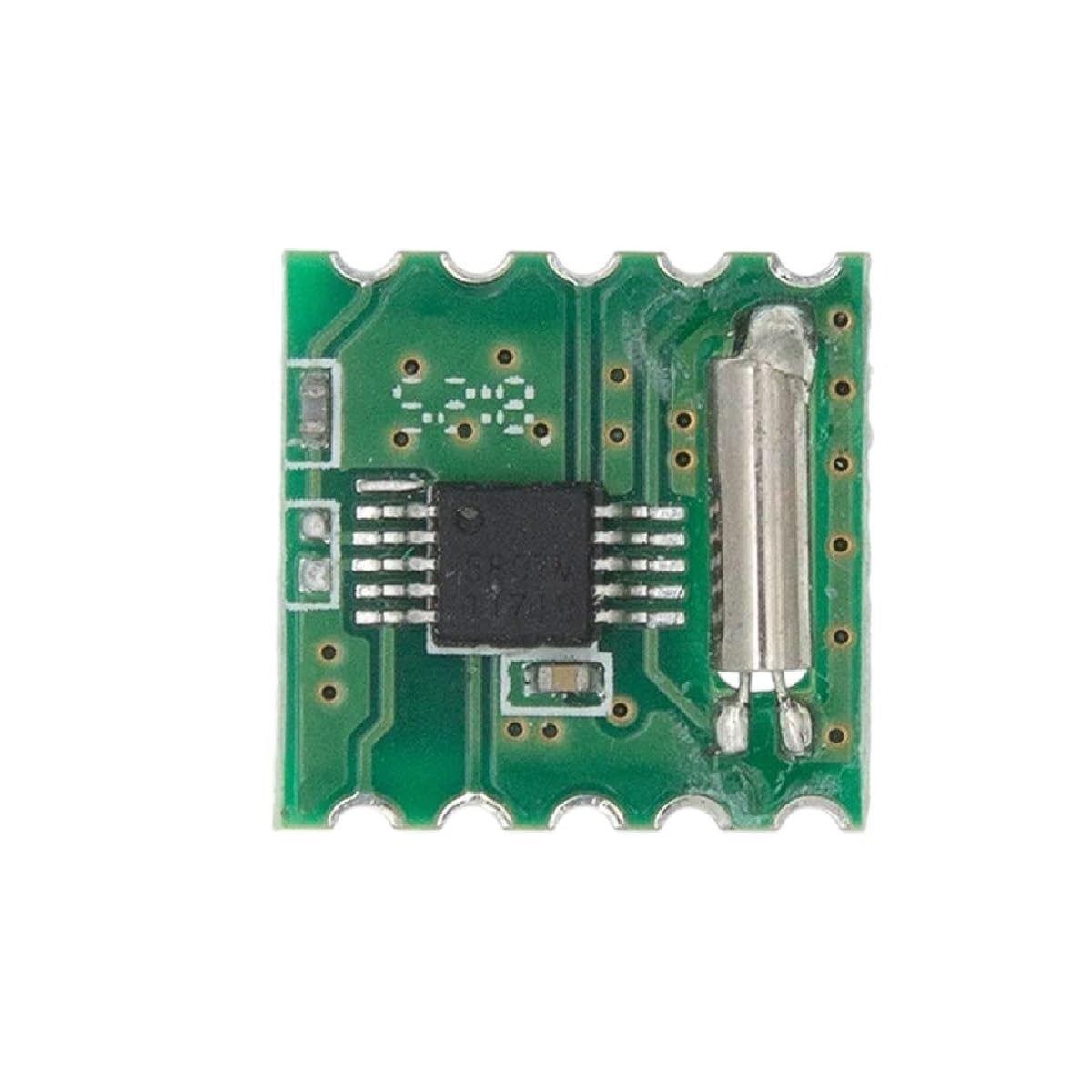
Figure 1: RDA5807M FM Stereo Radio Module (RRD-102V2.0). This image displays the compact green printed circuit board of the RDA5807M FM Stereo Radio Module. The module features the main RDA5807M integrated circuit (IC) in a surface-mount package, along with passive components and a metallic antenna or crystal oscillator component. The board has castellated edges for easy soldering into a larger circuit.
3. Features
- Utilizes high-quality electronic components for reliable and consistent performance.
- Designed for straightforward installation and user-friendly operation within electronic projects.
- Suitable for various applications, including industrial, automotive, and household electronics projects.
- Integrated FM stereo receiver with digital low-IF tuner.
- Supports worldwide FM bands (e.g., 50-115 MHz).
- I2C serial control interface for easy integration with microcontrollers.
- Low power consumption.
4. Specifications
| Parameter | Value |
|---|---|
| Model | RRD-102V2.0 |
| Chipset | RDA5807M |
| Manufacturer | RIMADMIADIND |
| ASIN | B0DW492FN9 |
| Operating Voltage | Typically 2.7V - 3.6V (Refer to RDA5807M datasheet for exact range) |
| Communication Interface | I2C (Two-Wire Interface) |
| Frequency Range | FM 50-115 MHz (typical, configurable) |
| Audio Output | Stereo Analog Output |
5. Pinout Information
The RRD-102V2.0 module typically features several pins for power, communication, and audio output. While the exact pin arrangement may vary slightly between module revisions, common pins include:
- VCC: Power supply input (e.g., 3.3V).
- GND: Ground connection.
- SDA: I2C Data Line.
- SCL: I2C Clock Line.
- LOUT: Left Audio Output.
- ROUT: Right Audio Output.
- ANT: Antenna connection point.
Note: Always refer to the specific datasheet or silkscreen markings on your module for precise pin identification and recommended operating conditions.
6. Setup and Connection
Follow these steps to integrate the RDA5807M module into your project:
- Power Supply: Connect the VCC pin to a stable 3.3V power source and GND to your circuit's ground. Ensure the power supply can provide sufficient current.
- I2C Communication: Connect the SDA and SCL pins to the corresponding I2C pins of your microcontroller. Pull-up resistors (typically 4.7kΩ) are usually required on both SDA and SCL lines to VCC.
- Antenna: Connect a suitable FM antenna to the ANT pin. A simple wire of approximately 75cm (quarter-wavelength for 100MHz) can serve as an effective antenna.
- Audio Output: Connect LOUT and ROUT to an audio amplifier or directly to headphones (with appropriate impedance matching if necessary).
- Software Integration: Develop or use existing library code for your microcontroller to communicate with the RDA5807M via I2C. This code will handle tuning, volume control, and other module functions.
7. Operating Instructions
Once the module is correctly wired and powered, operation is primarily controlled via the I2C interface from your microcontroller:
- Initialization: Send the appropriate I2C commands to initialize the RDA5807M chip, setting up basic parameters like band, de-emphasis, and stereo/mono mode.
- Tuning: To tune to a specific FM frequency, send the corresponding I2C commands to the module. The RDA5807M supports direct frequency tuning or channel scanning.
- Volume Control: Adjust the audio output volume by sending I2C commands to the module's internal digital volume control.
- Stereo/Mono Mode: The module can be configured for stereo or mono reception via I2C commands, which can be useful for improving reception in weak signal areas.
- Seek Function: Utilize the module's seek function to automatically find the next available strong station.
Refer to the RDA5807M datasheet and relevant programming guides for detailed I2C command structures and register maps.
8. Troubleshooting
If you encounter issues with your RDA5807M module, consider the following:
- No Sound:
- Verify power connections (VCC, GND).
- Check audio output connections to amplifier/headphones.
- Ensure the module is correctly initialized and tuned to an active station.
- Confirm volume is not set to zero.
- Poor Reception/Static:
- Check antenna connection and ensure it is of adequate length and properly positioned.
- Move the module away from sources of electromagnetic interference (e.g., motors, power supplies).
- Try tuning to a different frequency or enabling mono mode for weaker signals.
- I2C Communication Failure:
- Verify SDA/SCL connections and ensure pull-up resistors are correctly installed.
- Check your microcontroller's I2C code for correct addressing and command sequences.
- Confirm the module is receiving proper power.
9. Maintenance
The RDA5807M module is a robust electronic component requiring minimal maintenance. To ensure its longevity and optimal performance:
- Keep the module in a dry environment, away from moisture and extreme temperatures.
- Avoid exposing the module to static electricity. Handle with care, especially when integrating into a circuit.
- Ensure proper ventilation if enclosed in a case to prevent overheating, although this module typically generates very little heat.
- Periodically inspect solder joints and connections for any signs of corrosion or damage.
10. Warranty and Support
RIMADMIADIND is committed to providing high-quality electronic components and exceptional customer support. If you encounter any issues or have questions regarding the RDA5807M FM Stereo Radio Module (RRD-102V2.0), please contact our support team. We stand by the quality of our products and aim for customer satisfaction.
For specific warranty details or technical assistance, please refer to the vendor's official website or contact their customer service directly.