
1. Introduction
This manual provides detailed instructions for the installation, operation, maintenance, and troubleshooting of your TP-Link Archer NX600 5G Wireless Router. The Archer NX600 is designed to deliver high-speed 5G connectivity with Wi-Fi 6 AX3600Mbps dual-band performance. It features a 2.5G WAN/LAN port and two Gigabit LAN ports, offering a plug-and-play setup for advanced network sharing. It is compatible with EasyMesh and HomeShield for flexible and secure home networking.
2. Package Contents
Verify that all items are present in your package. If any item is missing or damaged, please contact your retailer.
- TP-Link Archer NX600 5G Wireless Router
- Power Adapter
- Ethernet Cable
- Quick Installation Guide
3. Hardware Overview
Familiarize yourself with the physical components of your router.
3.1 Front Panel

Image Description: The front panel of the Archer NX600 router is white with a vertical black strip containing LED indicators. These indicators show the status of signal strength, internet connection, Wi-Fi, and power.
3.2 Rear Panel
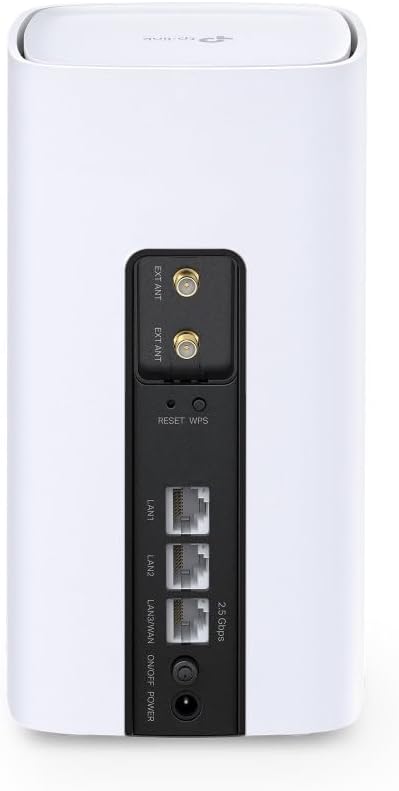
Image Description: The rear panel of the Archer NX600 router features various ports and buttons. From top to bottom, it includes two external antenna connectors (EXT ANT), a Reset/WPS button, two Gigabit LAN ports (LAN1, LAN2), a 2.5G WAN/LAN port, an On/Off switch, and a power input port.
3.3 LED Indicators
- Signal Strength: Indicates the strength of the 5G/LTE cellular signal.
- Internet: Shows the status of the internet connection.
- Wi-Fi: Indicates Wi-Fi network activity.
- Power: Shows the power status of the device.
3.4 Ports and Buttons
- SIM Card Slot: Insert your 5G/4G SIM card here.
- 2.5G WAN/LAN Port: Connect to a modem for wired internet or to a device for high-speed LAN connection.
- Gigabit LAN Ports (x2): Connect wired devices such as computers or gaming consoles.
- Reset/WPS Button: Press and hold to reset the router to factory settings. Press briefly to activate WPS.
- Power Port: Connect the provided power adapter.
- On/Off Switch: Power the router on or off.
4. Setup
Follow these steps for initial setup of your Archer NX600 router.
4.1 Insert SIM Card
- Ensure the router is powered off.
- Locate the SIM card slot, typically on the bottom or side of the device.
- Insert your 5G/4G SIM card into the slot until it clicks into place. Ensure the correct orientation as indicated on the router.
4.2 Power On
- Connect the provided power adapter to the router's power port and then to a power outlet.
- Press the On/Off switch to power on the router.
- Wait for the LED indicators on the front panel to stabilize. The Signal Strength and Internet LEDs should indicate a stable connection.
4.3 Connect to the Internet
The router is designed for plug-and-play operation with a SIM card. Once the SIM card is inserted and the router is powered on, it should automatically connect to the 5G/4G network.
You can connect your devices to the router via Wi-Fi or Ethernet cable:
- Wi-Fi Connection: Find the Wi-Fi network name (SSID) and password printed on the label at the bottom of the router. Select this network on your device and enter the password.
- Ethernet Connection: Connect an Ethernet cable from one of the router's LAN ports to your computer or other wired device.
4.4 Access Web Management Interface
For advanced settings and configuration, access the router's web management interface:
- Connect your device to the router (Wi-Fi or Ethernet).
- Open a web browser and enter the default access address (e.g., http://tplinkwifi.net or the IP address printed on the router label) in the address bar.
- Log in using the administrator password you set during the first login, or the default password (if not changed).
5. Operating Instructions
This section covers common operational aspects of your Archer NX600 router.
5.1 Wi-Fi Network Management
Through the web management interface, you can:
- Change Wi-Fi network names (SSIDs) and passwords.
- Enable or disable guest networks.
- Configure Wi-Fi security settings.
5.2 EasyMesh Compatibility
The Archer NX600 supports EasyMesh, allowing it to work with other EasyMesh-compatible devices to form a unified mesh Wi-Fi network. This provides seamless coverage with a single Wi-Fi name throughout your home.
- Refer to the EasyMesh setup guide within the router's web interface or on the TP-Link support website for detailed instructions on expanding your mesh network.
5.3 HomeShield Features
TP-Link HomeShield provides comprehensive network protection and parental controls. Access these features via the TP-Link Tether app or the web management interface.
- Network Protection: Real-time IoT protection, malicious site blocker, intrusion prevention, and home network scanner.
- Parental Controls: Profile management, content filtering, time limits, and insights.
- Quality of Service (QoS): Prioritize devices or activities for optimal performance.
5.4 Using the 2.5G WAN/LAN Port
The versatile 2.5G port can be configured as either a WAN port or a LAN port:
- WAN Mode: Connect an external modem (cable, fiber, or DSL) to this port to use the Archer NX600 as a traditional wireless router, in addition to its 5G capabilities.
- LAN Mode: Use this port to connect a high-speed wired device, such as a network-attached storage (NAS) or a powerful desktop PC, for faster local network transfers.
6. Maintenance
Regular maintenance helps ensure optimal performance and longevity of your router.
- Placement: Place the router in a central location, away from obstructions and sources of interference (e.g., microwaves, cordless phones).
- Ventilation: Ensure adequate airflow around the router to prevent overheating. Do not cover ventilation openings.
- Firmware Updates: Periodically check for and install firmware updates through the router's web management interface. Updates often include performance improvements, security patches, and new features.
- Cleaning: Gently clean the router's exterior with a soft, dry cloth. Avoid using liquid cleaners or abrasive materials.
- Reboot: If you experience minor performance issues, try rebooting the router by unplugging it from the power outlet for 10 seconds and then plugging it back in.
7. Troubleshooting
This section addresses common issues you might encounter.
7.1 No Internet Connection
- Check SIM Card: Ensure the SIM card is correctly inserted and active with a data plan.
- LED Indicators: Verify that the Signal Strength and Internet LEDs are solid green. If not, try repositioning the router or checking your SIM card.
- APN Settings: In the web management interface, check the APN (Access Point Name) settings. These are usually configured automatically, but may need manual adjustment for some carriers.
- Reboot: Power cycle the router.
7.2 Slow Internet Speed
- Signal Strength: Check the Signal Strength LED. If it's low, try moving the router to a location with better 5G/4G reception.
- Network Congestion: High network traffic from multiple devices can reduce speed. Consider using QoS settings to prioritize important devices or applications.
- Wi-Fi Interference: Other wireless devices can interfere with your Wi-Fi signal. Try changing Wi-Fi channels in the router settings.
- Carrier Throttling: Your mobile carrier might be throttling your speed after a certain data usage. Check your data plan.
7.3 Cannot Connect to Wi-Fi Printer
Some older Wi-Fi printers may have compatibility issues with newer Wi-Fi standards or dual-band networks. If you are experiencing difficulty connecting a Wi-Fi printer:
- Separate Wi-Fi Bands: In the router's web management interface, try separating the 2.4 GHz and 5 GHz Wi-Fi networks by giving them different SSIDs (network names). Then, attempt to connect your printer specifically to the 2.4 GHz network, as many older printers only support this band.
- Printer Firmware: Ensure your printer's firmware is up to date.
- WPS: Try using the WPS button on the router and your printer (if supported) for an easier connection.
- Ethernet Connection: If possible, connect the printer to one of the router's LAN ports using an Ethernet cable.
7.4 Router Overheating
If the router feels excessively hot or experiences frequent disconnections, it might be overheating.
- Ventilation: Ensure the router is placed in a well-ventilated area and its vents are not blocked.
- Ambient Temperature: Avoid placing the router in direct sunlight or in an enclosed space where heat can build up.
8. Specifications
| Feature | Detail |
|---|---|
| Brand | TP-Link |
| Model Name | Archer NX600 5G/4G Wi-Fi 6 |
| Item Model Number | Archer NX600 |
| Connectivity Technology | Wi-Fi |
| Wireless Communication Standard | 802.11ax |
| Frequency Band Class | Dual Band |
| Special Feature | Dual Band |
| Wireless Type | 802.11ax |
| Operating System | TP-Link OS |
| Color | White |
| Item Weight | 600 grams |
| Package Dimensions | 22.8 x 22.7 x 11.9 cm |
| Recommended Uses For Product | Home |
| Compatible Devices | Smartphone, Tablet, PC, Gaming Console, Smart TV, Surveillance Camera, Smart Thermostat, Printer |
| Included Components | TP-Link Archer NX600 |
9. Warranty and Support
For warranty information and technical support, please refer to the official TP-Link website or the warranty card included with your product. You can typically find:
- Product registration.
- Technical support contact information (phone, email, chat).
- Firmware downloads and FAQs.
- Warranty terms and conditions.
Visit TP-Link Support for the latest information.


