Introduction
This manual provides essential information for the installation, operation, maintenance, and troubleshooting of your Sapphire Nitro+ AMD Radeon RX 9070 XT Gaming OC Graphics Card. Please read this manual thoroughly before installing and using your new graphics card to ensure optimal performance and longevity.

Image: The Sapphire Nitro+ AMD Radeon RX 9070 XT Graphics Card shown alongside its retail packaging.
Package Contents
Verify that all items are present in your product package:
- Sapphire Nitro+ AMD Radeon RX 9070 XT Graphics Card
- User Manual (this document)
- Graphics Card Support Bracket
- Power Cable Adapter (if applicable)
- ARGB Sync Cable
Video: An unboxing video demonstrating the contents of the Sapphire Nitro+ AMD Radeon RX 9070 XT Graphics Card package, including the card and accessories.
Setup and Installation
Follow these steps to properly install your graphics card:
- Preparation: Power off your computer and disconnect all cables. Open your computer case.
- Remove Old Graphics Card (if applicable): If you are replacing an existing graphics card, carefully remove it by unscrewing its retention bracket and releasing the PCIe slot latch.
- Insert New Graphics Card: Align the Sapphire Nitro+ RX 9070 XT with an available PCI Express x16 slot on your motherboard. Press down firmly until the card is securely seated and the PCIe slot latch engages. This card typically occupies three expansion slots.
- Secure the Card: Use screws to secure the graphics card's retention bracket to your computer case.
- Connect Power Cables: Connect the necessary PCIe power cables from your power supply to the graphics card. Ensure all connections are firm. This model features a hidden power cable design for a cleaner aesthetic.
- Install Support Bracket: Due to the size and weight of the card, it is recommended to install the included anti-sag support bracket to prevent GPU sag over time.
- Close Case and Reconnect: Close your computer case, reconnect all cables, and power on your system.
- Driver Installation: Once your operating system loads, install the latest AMD Radeon drivers from the official AMD or Sapphire website.

Image: The rear I/O panel of the graphics card, featuring multiple DisplayPort and HDMI outputs for connecting to monitors.

Image: A diagram showcasing the STEALTH Hidden Power Cable design, which routes power connectors for a cleaner build appearance.
Operating Your Graphics Card
After successful installation and driver setup, your Sapphire Nitro+ RX 9070 XT is ready for use. Connect your display(s) to the available ports (2 x HDMI, 2 x DisplayPort). For optimal performance, ensure your display cables are securely connected and your monitor is set to the correct input source.
Regularly check for driver updates through the AMD Radeon Software application to benefit from performance improvements and bug fixes. You can also utilize Sapphire's Trixx software for advanced monitoring, fan control, and RGB lighting customization.

Image: The graphics card displaying its integrated ARGB lighting, which can be customized for various visual effects.
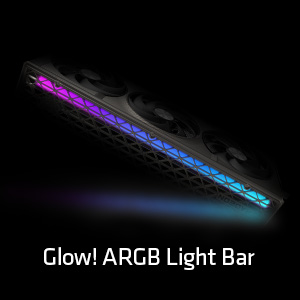
Image: A detailed view of the Glow! ARGB Light Bar, highlighting its customizable illumination capabilities.
Maintenance
To maintain optimal performance and extend the lifespan of your graphics card, periodic cleaning is recommended.
- Dust Removal: Use compressed air to gently clear dust from the fans and heatsink fins. Ensure the fans do not spin rapidly during cleaning to prevent damage.
- Fan Inspection: Periodically check the fans for any obstructions or unusual noises. The Quick Connect Fan feature allows for easy removal and cleaning of individual fans.
- General Cleaning: Wipe the exterior of the card with a soft, dry, anti-static cloth. Avoid using liquid cleaners directly on the card.

Image: A diagram demonstrating the Quick Connect Fan system, which allows for easy removal and replacement of the cooling fans.
Troubleshooting
If you encounter issues with your graphics card, consider the following common solutions:
- No Display Output:
- Ensure the monitor cable is securely connected to both the graphics card and the monitor.
- Verify that the graphics card is fully seated in the PCIe slot and the power cables are properly connected.
- Check if your monitor is set to the correct input source.
- System Instability or Crashes:
- Update your graphics drivers to the latest version.
- Ensure your power supply unit (PSU) meets the minimum wattage requirements for the graphics card and your system.
- Monitor GPU temperatures using software like AMD Radeon Software or Sapphire Trixx. Overheating can cause instability.
- Poor Performance:
- Confirm that your display is connected to the graphics card, not the motherboard's integrated graphics.
- Check in-game settings to ensure they are appropriate for your system's capabilities.
- Ensure background applications are not consuming excessive system resources.
- Fan Noise:
- Clean the fans and heatsink to remove dust buildup.
- Adjust fan curves using AMD Radeon Software or Sapphire Trixx to find a balance between cooling and noise.
If issues persist, consult the Sapphire support website or contact their customer service.
Specifications
| Feature | Detail |
|---|---|
| Model Number | 11348-01-20G |
| Graphics Coprocessor | AMD Radeon RX 9070 XT |
| Memory Size | 16 GB GDDR6 |
| Memory Interface | 256-bit |
| Memory Speed | 20 GHz |
| GPU Clock Speed | 3060 MHz |
| Max Screen Resolution | 3840x2160 |
| Output Ports | 2 x HDMI, 2 x DisplayPort |
| Item Weight | 5.72 pounds |
| Product Dimensions (LxWxH) | 13.02 x 5.06 x 0.04 inches |
Warranty and Support
Your Sapphire Nitro+ AMD Radeon RX 9070 XT Graphics Card is covered by a manufacturer's warranty. Please refer to the warranty card included in your product packaging or visit the official Sapphire website for detailed warranty terms and conditions.
For technical assistance, driver downloads, FAQs, and further support, please visit the Sapphire Technology website. You may also find helpful resources and community support through the official AMD Radeon channels.


