
1. Introduction
The TobenONE USB-C Docking Station (Model: XYY-PD100CL) is a versatile 16-in-1 solution designed to expand the connectivity of your USB-C enabled laptop. It provides comprehensive port expansion, multi-monitor support, high-speed data transfer, and power delivery, enhancing productivity for both professionals and students.

Image: The TobenONE USB-C Docking Station, showcasing its compact design alongside a laptop and the included 100W GaN III charger.
2. Key Features
- Universal Compatibility: Seamlessly works with Windows 10+ and Chromebook devices featuring USB-C DisplayPort Alt Mode, Thunderbolt 4/3, and USB4. Compatible with HP, Dell, and Lenovo laptops. (Note: Not recommended for Mac users.)
- 16-in-1 Connectivity: Offers extensive port options including dual HDMI, one DisplayPort, multiple USB-C and USB-A ports, 2.5Gbps Ethernet, 100W Power Delivery, and SD/TF card slots.
- Blazing-Fast Data Transfer: Equipped with 10Gbps USB-C and USB-A ports, enabling data transfers up to 20 times faster than traditional USB 2.0.
- 2.5Gbps Ethernet: Provides stable and high-speed internet connectivity, ideal for video calls, streaming, and large file downloads.
- 100W PD Charging: Features a robust 100W GaN power supply to keep your laptop charged during intensive work sessions, eliminating the need for a separate charger.
- Stunning Visuals: Supports up to 4K@60Hz resolution for dual or triple monitor setups. A single display can achieve 8K@30Hz or 4K@120Hz for razor-sharp clarity.
- Sleek Cooling Stand Design: Ergonomically designed to elevate your laptop, promoting better airflow and heat dissipation.
3. Package Contents
Please verify that all items are present in your package:
- TobenONE USB-C Docking Station (Model: XYY-PD100CL)
- 100W Power Adapter
- 60CM (1.96 Feet) USB-C Cable

Image: The package includes the UDS041W Laptop Dock Stand, a 100W Power Adapter, and a 60CM USB-C Cable.
4. Setup Guide
Follow these steps to set up your TobenONE USB-C Docking Station:
- Connect Power: Plug the 100W power adapter into the DC-IN port on the docking station, then connect the adapter to a wall outlet.
- Connect to Laptop: Use the provided 60CM USB-C cable to connect the "HOST" USB-C port on the docking station to your laptop's USB-C port. Ensure your laptop supports USB-C DisplayPort Alt Mode, Thunderbolt 4/3, or USB4.
- Connect Displays:
- For single display: Connect your monitor to either HDMI 1, HDMI 2, or DisplayPort.
- For dual or triple displays: Connect your monitors to the available HDMI 1, HDMI 2, and DisplayPort outputs.

Image: A laptop connected to two external 4K monitors, demonstrating a dual display setup for enhanced productivity.
- Connect Peripherals: Plug your USB devices (keyboard, mouse, external drives, etc.) into the available USB 3.0, USB 3.2 (10Gbps), or USB-C (10Gbps) ports.

Image: A detailed view of the docking station's rear and side ports, including Ethernet, HDMI, DisplayPort, various USB types, SD/MicroSD slots, audio, and power button.

Image: An external hard drive connected to one of the 10Gbps USB ports, highlighting the high-speed data transfer capabilities.
- Connect Ethernet: For a stable wired internet connection, plug an Ethernet cable into the 2.5Gbps Ethernet port on the docking station.
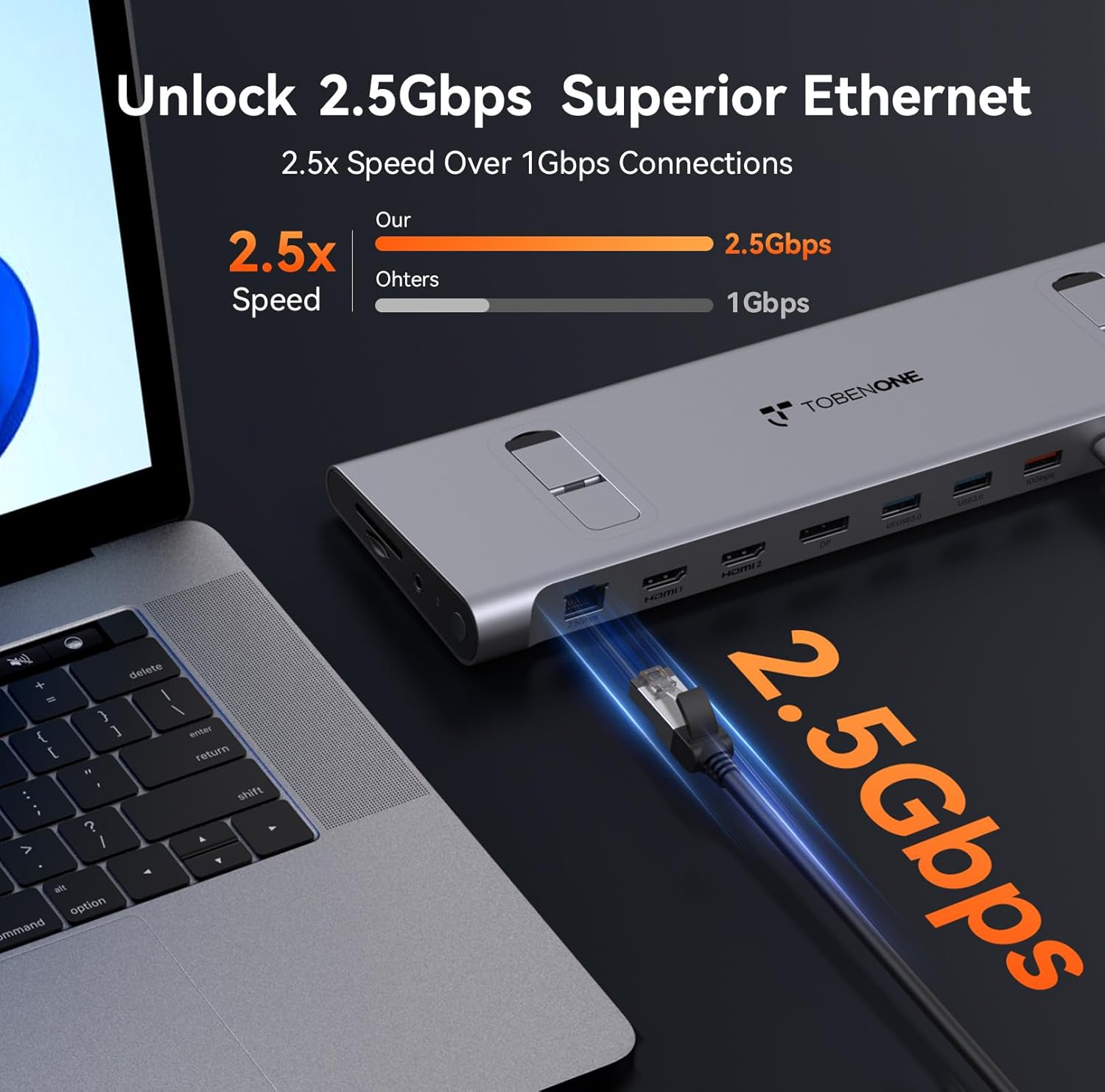
Image: An Ethernet cable connected to the 2.5Gbps Ethernet port on the docking station, ensuring a fast and reliable network connection.
- Insert SD/TF Cards: If needed, insert your SD or MicroSD cards into the dedicated slots on the side of the docking station.
- Audio Connection: Connect headphones or speakers to the 3.5mm audio port for audio output.
- Power On: Press the power button on the side of the docking station to turn it on.
5. Operating Instructions
Display Configuration (Windows/Chromebook)
The docking station supports various display configurations. Your laptop's capabilities (e.g., Thunderbolt 4/DP 1.4 with DSC vs. DP 1.2) will determine the maximum resolution and refresh rates.
| Interface Standard | Thunderbolt 4/DP 1.4 (support DSC) | DP 1.2 | ||||
|---|---|---|---|---|---|---|
| HDMI1 | HDMI2 | DP | HDMI1 | HDMI2 | DP | |
| Single Display | 8K@30Hz | 8K@30Hz | 8K@30Hz | 4K@30Hz | 4K@30Hz | 4K@30Hz |
| 4K@60Hz | 4K@60Hz | 4K@60Hz | 1080P@60Hz | 1080P@60Hz | 1080P@60Hz | |
| Dual Display | 4K@60Hz | 1080P@60Hz | ||||
| 4K@60Hz | 4K@60Hz | 1080P@60Hz | 1080P@60Hz | |||
| Triple Display | 4K@60Hz | 1080P@60Hz | ||||
Table: This table outlines the supported display resolutions and refresh rates for single, dual, and triple monitor setups, depending on your laptop's DisplayPort interface standard.
Laptop Placement and Cooling
The docking station is designed to function as a sleek cooling stand. Place your laptop directly on top of the docking station, aligning it with the integrated supports. This ergonomic design helps improve airflow and prevent overheating during extended use.

Image: A laptop positioned on the docking station, illustrating how the design facilitates airflow for efficient cooling.
6. Maintenance
- Keep the docking station clean by wiping it with a soft, dry cloth. Avoid using abrasive cleaners or solvents.
- Ensure proper ventilation around the device to prevent overheating.
- Store the docking station in a cool, dry place when not in use.
- Handle cables and connectors carefully to prevent damage.
7. Troubleshooting
Common Issues and Solutions:
- No Display Output:
- Ensure the docking station is powered on and properly connected to your laptop's USB-C port.
- Verify that your laptop's USB-C port supports DisplayPort Alt Mode, Thunderbolt 3/4, or USB4.
- Check all display cables (HDMI, DisplayPort) for secure connections.
- Try updating your laptop's graphics drivers.
- Confirm your laptop supports Display Stream Compression (DSC) for higher resolutions (e.g., 8K@30Hz or 4K@120Hz single display).
- No Power Delivery to Laptop:
- Ensure the 100W power adapter is securely connected to the docking station and a working power outlet.
- Verify the USB-C cable connecting the dock to your laptop is capable of power delivery.
- USB Devices Not Recognized:
- Reconnect the USB device to a different port on the docking station.
- Ensure the docking station is powered on.
- Try connecting the device directly to your laptop to confirm it functions independently.
- Ethernet Connection Issues:
- Check the Ethernet cable connection to both the docking station and your router/modem.
- Verify your network settings on your laptop.
8. Specifications
| Attribute | Detail |
|---|---|
| Model Number | XYY-PD100CL |
| Product Dimensions | 11.81"L x 3.14"W x 0.86"H |
| Item Weight | 2.27 pounds |
| Total USB Ports | 6 (including 10Gbps USB-A and USB-C) |
| Total HDMI Ports | 2 |
| DisplayPort | 1 |
| Ethernet Port | 2.5Gbps |
| Power Delivery | 100W (Input), 87W (Output) |
| Card Reader | SD/TF Slots |
| Audio Port | 3.5mm Audio |
| Compatible Devices | Supports full-featured USB-C, USB4, and Thunderbolt 3 / Thunderbolt 4 systems running Windows 10 / 11 & ChromeOS 100 or newer (e.g., HP ProBook/EliteBook/Spectre x360, Dell XPS/Latitude, Lenovo ThinkPad/IdeaPad/Yoga, Microsoft Surface Pro/Go/Book/Laptop, LG Gram). |
9. Warranty and Support
TobenONE is committed to providing professional office connectivity solutions. For any questions, technical support, or warranty inquiries regarding your docking station, please refer to the official TobenONE website or contact their customer service directly. Keep your purchase receipt for warranty claims.
Visit the official TobenONE Store: TobenONE Amazon Store


