
1. Introduction
This manual provides detailed instructions for the Coliao DC 6-30V Programmable Timer Relay Module. This versatile module is designed for various applications including smart home automation, industrial control, automatic irrigation systems, and ventilation control. It features an LED display for easy parameter setting and monitoring, and supports a wide operating voltage range with Micro USB 5V power supply option.

Image 1.1: Overview of two Coliao DC 6-30V Timer Relay Modules. Each module features a 3-digit LED display, control buttons, and screw terminals for connections.
2. Specifications
- Operating Voltage: DC 6-30V (supports Micro USB 5V power supply)
- Operating Current: 50mA
- Static Current: 20mA
- Trigger Source: High trigger 3V-24V
- NO (Normally Open) Maximum Load: < AC 250V/10A, < DC 30V/10A
- Working Temperature: -20~60℃
- Service Life: More than 100,000 times
- Timing Range: 0.1 seconds (min.) ~ 999 minutes (max.), continuously adjustable
- Dimensions: Approximately 6.4 x 3.8 x 1.7 cm (2.52 x 1.50 x 0.67 inches)
- Features: Optocoupler isolation, enhanced anti-interference ability, industrial-grade circuit board, permanent parameter storage after power off, reverse polarity protection diode, emergency stop function.
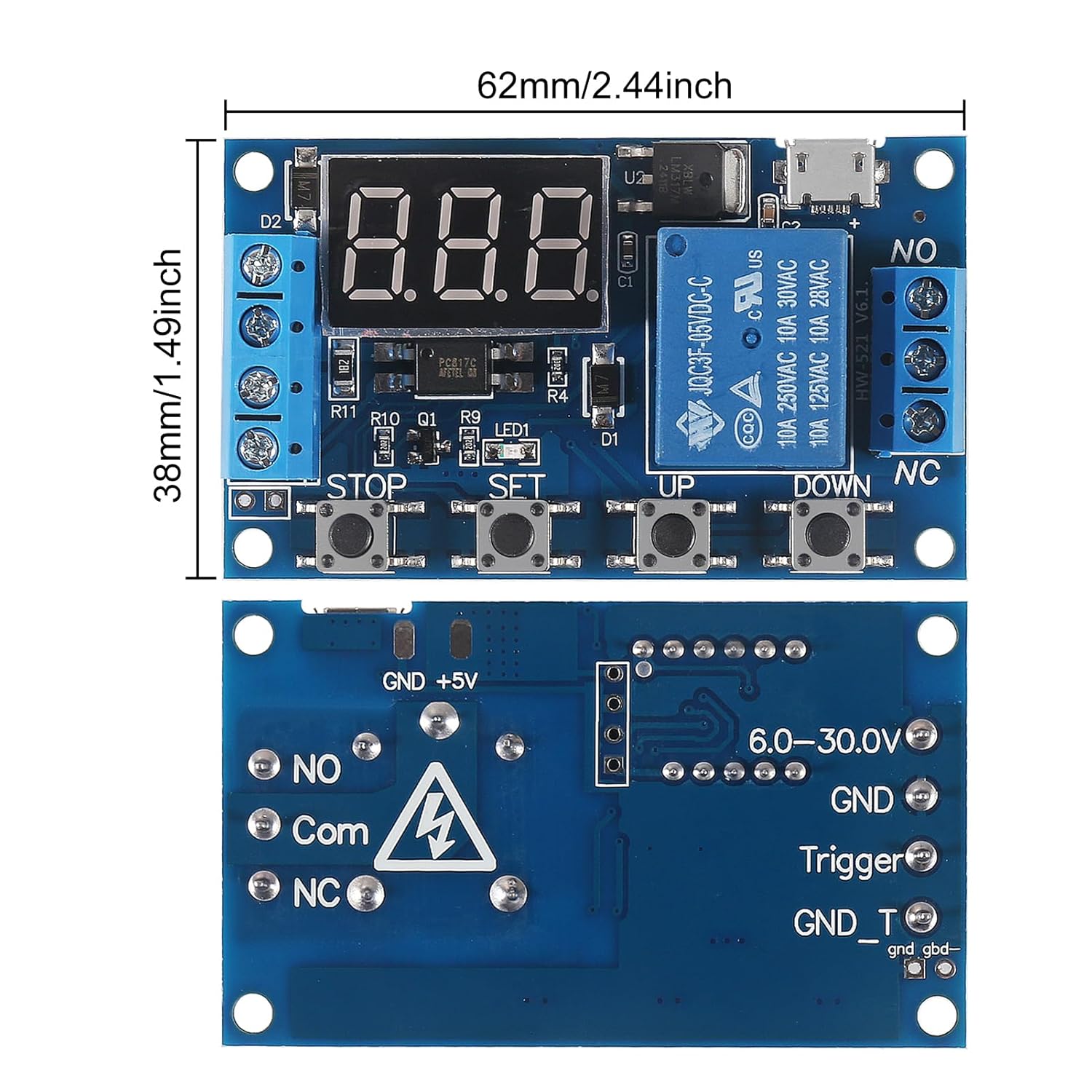
Image 2.1: Top and bottom views of the timer relay module, showing dimensions (62mm x 38mm) and key components like the LED display, control buttons (STOP, SET, UP, DOWN), Micro USB port, and terminal blocks.
3. Setup and Wiring
Proper wiring is crucial for the safe and correct operation of the timer relay module. Ensure all connections are secure before applying power.
3.1 Power Supply
- The module can be powered by a DC 6-30V source connected to the "Input (+)" and "GND (-)" terminals.
- Alternatively, a Micro USB 5V power supply can be used via the Micro USB port.
3.2 Trigger Signal
- The trigger signal (3V-24V) should be connected to the "Trigger Signal" terminal.
- The ground for the trigger signal can be connected to "GND_T(-)".

Image 3.1: Detailed connection diagram showing input power (DC 6-30V), trigger signal (3V-24V), Micro USB 5V power supply, and output relay connections (NO, COM, NC) for controlling a load. The four control buttons (STOP, SET, UP, DOWN) are also indicated.
3.3 Load Connection
The relay output terminals are: NO (Normally Open), COM (Common), and NC (Normally Closed). Connect your load (e.g., a light bulb) according to your application's requirements.
- For a load that turns ON when the relay is active, connect it between NO and COM.
- For a load that turns OFF when the relay is active, connect it between NC and COM.
3.4 Common Ground Configuration
The two pins labeled "GND" and "GND_Trigger" can be short-circuited to establish a common ground for both the trigger signal and the main circuit, simplifying wiring in certain setups.

Image 3.2: Diagram illustrating how to short-circuit the "GND" and "GND_Trigger" pins to create a common ground for the trigger signal and the main power supply.
3.5 Wiring Diagrams
Below are common wiring configurations for different applications:

Image 3.3: Two wiring diagrams. The top diagram shows "Weak Current Controlling Strong Current," where the module's power and trigger are separate from the AC load. The bottom diagram shows "Sharing One Power Supply," where the module and the DC load share the same power source.
4. Operation Modes
The module offers several programmable operation modes. Parameters OP (conduction time), CL (off time), and LOP (circuit times) can be set individually and are saved permanently after power off.
4.1 Mode P1: Single Trigger Delay
- Upon receiving a trigger signal, the relay turns ON for the set OP time, then turns OFF.
- P1.1: Re-triggering the signal during the OP period is ignored.
- P1.2: Re-triggering the signal during the OP period resets the timer (re-clocks).
- P1.3: Re-triggering the signal during the OP period disconnects the relay and stops timing.
- P1.4 (Random Mode): The relay conducts for the OP time only once when power is applied, without requiring an external trigger.
4.2 Mode P2: Delay Before Conduction
After receiving a trigger signal, the relay remains OFF for the set CL time, then turns ON for the set OP time. After the OP time, the relay turns OFF.
4.3 Mode P3.1: Cyclic Operation with Trigger Reset
Upon receiving a trigger signal, the relay turns ON for OP time, then turns OFF for CL time. This cycle repeats for LOP times. If a re-trigger signal is received within the timing cycle, the relay disconnects and stops timing.
4.4 Mode P3.2: Automatic Cyclic Operation
No trigger signal is required at power-on. The relay turns ON for OP time, then turns OFF for CL time. This cycle repeats for LOP times automatically.
4.5 Mode P4: Signal Retention
The timing resets upon receiving a trigger signal, and the relay contacts remain connected. When no signal is present, the relay turns OFF after the set OP time. If a signal is re-triggered during the OP timing period, the timing is reset.
5. Parameter Setting and Display
The module uses a 3-digit LED display to show current settings and timing. Use the "SET", "UP", and "DOWN" buttons to navigate and adjust parameters.
5.1 Setting Parameters (OP, CL, LOP)
- Press the SET button to enter parameter setting mode. The display will show the current mode (e.g., P1.1).
- Use the UP and DOWN buttons to select the desired operation mode (P1.1 to P4).
- Press SET again to move to the next parameter (OP, CL, LOP, depending on the mode).
- Use UP and DOWN to adjust the value of the parameter. A short press changes by 0.1, a long press changes rapidly.
- Press SET to confirm the value and move to the next parameter or exit setting mode.
- All parameters are saved automatically and permanently after setting.
5.2 Relay Using Mode (ON/OFF)
This setting determines if the relay is allowed to conduct during its ON time or if it remains always closed.
- ON: Relay is allowed to conduct within the set OP time.
- OFF: Relay is banned from conducting and remains in a closed status (always off).
5.3 Sleep Mode
The module features two display modes to conserve power or maintain visibility.
- C-P (Sleeping Mode): If no operation occurs for 5 minutes, the digital display automatically turns off. The program continues to run in the background.
- O-d (Normal Mode): The digital display remains on continuously.
To switch between C-P and O-d modes, long press the STOP button for 2 seconds and then release. The current state will flash briefly before returning to the main interface.
6. Maintenance
To ensure the longevity and reliable operation of your Coliao Timer Relay Module, follow these general maintenance guidelines:
- Keep Clean: Regularly clean the module with a soft, dry cloth to prevent dust accumulation, which can affect performance.
- Avoid Moisture: Protect the module from water, humidity, and corrosive environments. Operate it within the specified working temperature range (-20~60℃).
- Secure Connections: Periodically check all wiring connections to ensure they are tight and free from corrosion. Loose connections can lead to intermittent operation or damage.
- Power Off Before Servicing: Always disconnect power to the module and any connected loads before performing any maintenance or wiring changes.
7. Troubleshooting
If you encounter issues with your Coliao Timer Relay Module, refer to the following troubleshooting steps:
- Module Not Powering On:
- Check the power supply voltage (DC 6-30V or Micro USB 5V) to ensure it is within the specified range.
- Verify that the power connections to the module are correct and secure (positive to Input (+), negative to GND (-)).
- Relay Not Activating/Deactivating:
- Ensure the trigger signal is applied correctly (3V-24V to Trigger terminal).
- Check the selected operation mode (P1.x, P2, P3.x, P4) and its parameters (OP, CL, LOP) to ensure they match your intended behavior.
- Verify the load connections to the NO, COM, and NC terminals are correct.
- Confirm the "Relay Using Mode" is set to "ON" if you expect the relay to conduct.
- Parameters Not Saving:
- Ensure you are pressing the SET button to confirm each parameter change and exit the setting mode. Parameters are saved permanently after setting.
- Display Not Visible in C-P Mode:
- This is normal behavior for C-P (Sleeping Mode). The display turns off after 5 minutes of inactivity. The program continues to run.
- To reactivate the display, press any button or switch to O-d (Normal Mode) by long-pressing the STOP button for 2 seconds.
- Module Overheating:
- Ensure the load connected to the relay does not exceed the maximum specified load (< AC 250V/10A, < DC 30V/10A).
- Verify proper ventilation around the module.
If the problem persists after following these steps, please contact customer support.
8. Warranty and Support
This product is manufactured by Coliao. For specific warranty information, please refer to the purchase documentation or contact your retailer. For technical support or inquiries, please reach out to Coliao customer service.